Bi₇O₂₄SmTi₆
rare earth oxide · rare earth ceramicBi7O24Sm1Ti6 is a rare earth oxide suitable as rare earth ceramic. Color: neutral. Fired at 1200°C from 3 precursors (Bi2O3, TiO2, Sm2O3). Workshop batch: 100g at €6.93. Compressive strength ~100 MPa; estimated 0.90 kg CO₂/kg (+309% vs clay brick). Notable: uv luminescent, visible absorber. Confidence: medium.
- forms at
- 1200 °C · high-fire
- replaces
- clay brick
- CO₂
- 309% higher than clay brick (0.90 vs 0.22 kg CO₂/kg; 4.1× higher)
- energy
- 100% higher than clay brick (6.00 vs 3.00 MJ/kg; 2.0× higher)
- compressive
- 100 MPa
- density
- 0.75 g/cm³
- crystal
- triclinic
- band gap
- 2.31 eV
- cost
- €69.30/kg · €6.93 / 100 g batch
- confidence
- medium (synthesis route)
- potential
- 0.37 · env 0.00 · novel 1.00 · struct 0.20 · lineage 0.50 · supply 0.10
- flags
- uv luminescent: Converts invisible ultraviolet into visible light. Signage panels, low-energy wayfinding tiles, emergency markings that draw their illumination from daylight rather than mains power. visible absorber: A real-colour solar-gain control layer. Where the body takes visible light into itself rather than reflecting it, the material becomes a selective heat collector — useful on thermal-mass walls, absorber panels, and warm-toned cladding.
Architectural potential
A bismuth-titanium samarium oxide in the signal-bearing ceramic register, carrying both UV-luminescent conversion and visible-absorber solar-gain chemistry on a bismuth-titanate host — a dual functional body in the same family as ferroelectric titanates. At 100 MPa and embodied CO₂ four times that of fired clay brick, this is strictly a functional-overlay register. Natural placements are south-facing absorber tiles paired with a thermal-mass backing wall where the body takes visible light into itself, emission patches in exhibition architecture where the tile also reads under ambient daylight UV, and signage or accent plaques at named thresholds in public interiors. The 300 g workshop ceiling and 0.14 supply-chain score hold specification at plaque and patch scale. Against the other rare-earth siblings the bismuth-titanate host opens the door to future ferroelectric coupling research — untested in architectural production at slab scale, so any structural or actuating claim has to be verified first. The density figure tells the main caveat: at 0.753 g/cm³ over a 120×120×92 mm slab the body is clearly under-densified — a porous sinter rather than a fully closed ceramic — which pulls the compression number to upper-bound status and flags the verification requirement.
Material character
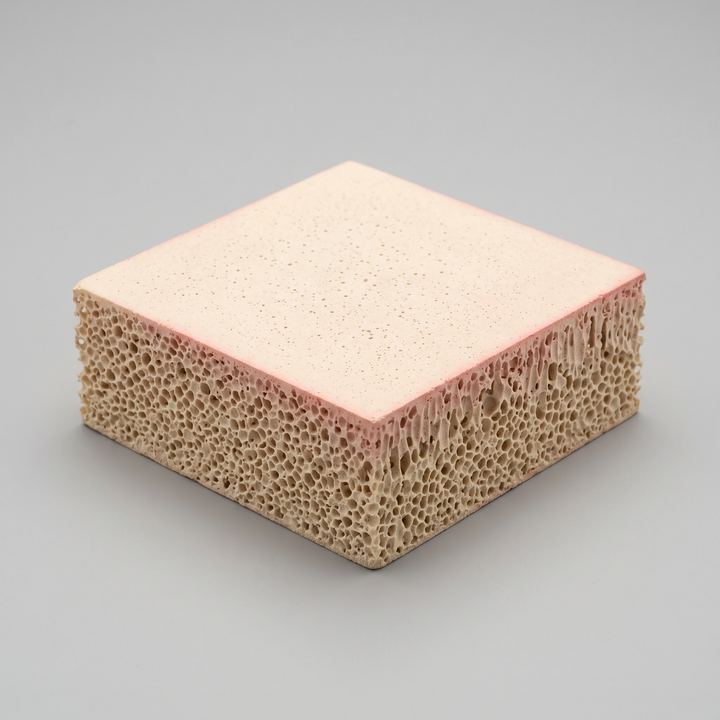
The 120×120×92 mm slab reads a neutral warm cream under daylight — bismuth brings a slight yellow tint to the white titanate host, with samarium barely registering at the edges. Under 365 nm excitation a pale peach glow lifts over the face, weaker than the praseodymium or erbium siblings because the samarium loading is only one unit in the formula. Surface sintered matte with visible inter-particle porosity from the under-densified fire; edges cold-cut with a coarse kerf. At 0.753 g/cm³ the slab lifts easily for its size — a hardwood-register weight rather than a dense-ceramic register, lighter in hand than the Er³⁺ and Sm³⁺ slabs of comparable footprint.
Recipe
100 g batch · peak 1200 °C| element | precursor | formula | mass | safety |
|---|---|---|---|---|
| Bi | bismuth(III) oxide (yellow) | Bi2O3 | 71.39 g | moderate |
| Sm | samarium oxide | Sm2O3 | 7.63 g | moderate |
| Ti | titanium dioxide (rutile) | TiO2 | 20.98 g | safe |
- 1Ramp
- 2Hold
- 3Ramp
- 4Ramp
- 5Hold
- 6Ramp
- 7Ramp
UV-luminescent — emits visible light under 365 nm UV
Visible absorber — saturated color from bandgap in the visible range