Cu₆S₆Se₂TiV
sulfide metal composite · sulfide low tempCu6S6Se2Ti1V1 is a sulfide metal composite suitable as sulfide low temp. Color: green-red-copper. Fired at 130°C from 5 precursors (CuO, S, Se). Workshop batch: 300g at €13.82. Compressive strength ~350 MPa; estimated 0.09 kg CO₂/kg (-89% vs Portland cement). Notable: forms without a kiln. Confidence: medium.
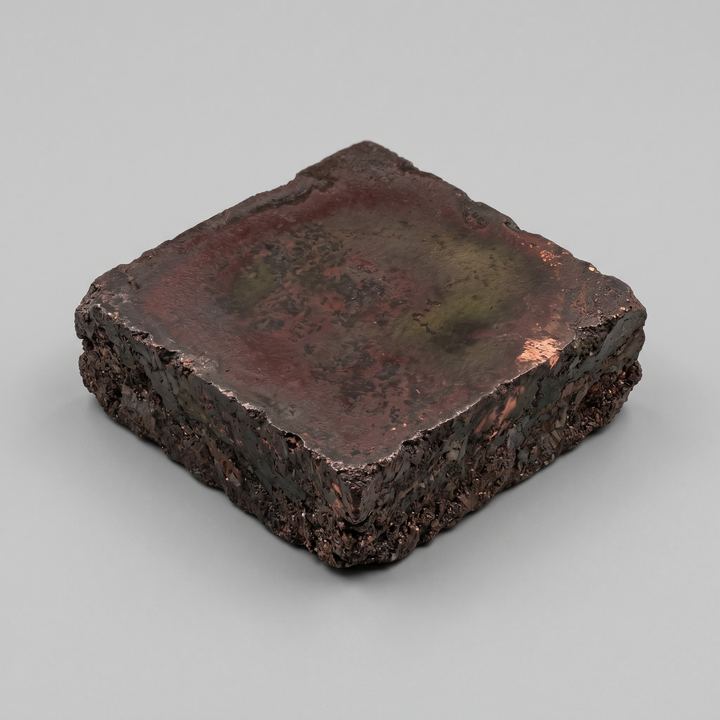
- forms at
- 130 °C · hotplate · no kiln
- replaces
- portland cement
- CO₂
- 89.1% lower than Portland cement (0.09 vs 0.83 kg CO₂/kg)
- energy
- 89.1% lower than Portland cement (0.60 vs 5.50 MJ/kg)
- compressive
- 350 MPa
- density
- 0.41 g/cm³
- crystal
- orthorhombic
- band gap
- 0.00 eV
- cost
- €46.07/kg · €13.82 / 300 g batch
- confidence
- medium (synthesis route)
- potential
- 0.80 · env 1.00 · novel 1.00 · struct 0.70 · lineage 0.50 · supply 0.46
- flags
- zero kiln: Forming happens without firing — the material cures through chemistry at ambient or hotplate temperature. At building scale this removes the kiln from the supply chain: on-site casting, regional workshops, cold-country fabrication all become available.
Architectural potential
A copper-selenide-tungstate variant of the zero-kiln sulfide family, cast at 130 °C and reaching 350 MPa of compression with the same eighty-nine-per-cent reduction in embodied CO₂ against Portland cement that defines the group. Where this entry departs from its siblings is geometry: the slab form in the atlas is 120×120×168 mm — thick-block register rather than thin-tile — so the natural placements tilt toward cast thresholds, stepped plinths, cast-in-situ door sills in retrofit carpentry, and low landscape-wall courses in garden rooms where the kiln simply cannot be brought to site. The cement analogy remains the clearest argument to a client: the same slow compressive weight, the same plywood formwork, without the fired supply chain. Titanium-vanadium as minor modifiers push the matrix toward a harder, slightly more brittle body than the copper-manganese reference, which suits static compression better than impact-loaded floor tile. The caveat is twofold: the stated density of 0.41 g/cm³ is anomalously low for this chemistry and flags the slab as a porous or partially-foamed cast — a verification requirement before structural use — and saw-cutting a selenide body releases irritant fume, so a fume hood and full PPE sit alongside the hotplate in the fabrication room.
Material character
At the recorded 0.414 g/cm³ the slab reads as a foamed or heavily-voided cast, firming single-handed despite its 120×120×168 mm block presence — a softwood register rather than a stone one, closer in hand to a block of cork-ply than to a cured mortar of the same volume. The copper-selenide body drives the face toward a warm green-red bronze, flecked where selenium crystallises out in small darker patches across the cast skin. Surface mold-matte with the characteristic cast meniscus at the upper rim; edges as-cast, slightly soft, reading porous where the void structure meets the form wall. A pale α-sulfur bloom sits across the face with darker selenium speckling through it. Distinct in the hand from the dense Cu3Mn1Na2S4 flagship — same chemistry family, opposite weight register.
Recipe
300 g batch · peak 130 °C| element | precursor | formula | mass | safety |
|---|---|---|---|---|
| Cu | copper(II) oxide (black) | CuO | 59.21 g | safe |
| Se | selenium (elemental) | Se | 19.59 g | moderate |
| Ti | titanium dioxide (rutile) | TiO2 | 9.91 g | safe |
| V | vanadium pentoxide | V2O5 | 11.28 g | moderate |
- Pre-heatHotplate to 150 °C
- MeltSulfur liquefies at 115 °C; full liquid at 130 °C
- CastPour at 140–145 °C
- SetRoom temperature 30 min (firm) → 24 h (full strength)
Zero-kiln process — 130 °C hotplate cast only