Fe₆Li₂Mg₂O₁₆Sn₂
iron oxide ceramic · structural ceramicFe6Li2Mg2O16Sn2 is a iron oxide ceramic suitable as structural-ceramic. Color: amber-brown. Fired at 1100°C from 4 precursors (SnO2, MgCO3, Fe2O3). Workshop batch: 1000g at €28.04. Compressive strength ~100 MPa; estimated 0.79 kg CO₂/kg (+258% vs clay brick). Notable: visible absorber. Confidence: medium.
- forms at
- 1100 °C · high-fire
- replaces
- clay brick
- CO₂
- 258% higher than clay brick (0.79 vs 0.22 kg CO₂/kg; 3.6× higher)
- energy
- 75% higher than clay brick (5.25 vs 3.00 MJ/kg; 1.8× higher)
- compressive
- 100 MPa
- density
- 4.77 g/cm³
- crystal
- hexagonal
- band gap
- 2.06 eV
- cost
- €28.04/kg · €28.04 / 1000 g batch
- confidence
- medium (synthesis route)
- potential
- 0.23 · env 0.00 · novel 0.46 · struct 0.30 · lineage 0.50 · supply 0.00
- flags
- visible absorber: A real-colour solar-gain control layer. Where the body takes visible light into itself rather than reflecting it, the material becomes a selective heat collector — useful on thermal-mass walls, absorber panels, and warm-toned cladding.
Architectural potential
An iron-oxide ceramic with lithium, magnesium and tin substitutions, fired at 1100 °C into a dense 4.77 g/cm³ amber-brown body at 100 MPa of compression. The visible-absorber chemistry means the body takes daylight into itself rather than reflecting it — the surface becomes a selective heat collector. Architecturally this places the tile in the thermal-mass-adjacent register: south-facing absorber cladding on trombe-wall assemblies where the warm tone reads as architectural choice rather than technical necessity, hypocaust-style floor tile in naturally-ventilated studios, and thermal-storage plinth blocks for passive-solar pavilion walls. The lithium and tin substitutions tune the thermal conductivity a step above the parent iron-oxide ceramic, so the tile takes up heat faster and re-releases it over a slightly compressed evening cycle. Supplements insulation rather than replacing it. Substitutes for conventional dark-toned absorber coatings where a body-coloured ceramic is preferred to a painted or sprayed surface. The caveat is CO₂: embodied carbon runs two hundred and fifty-eight per cent above fired clay brick, the supply-chain score is zero, and the 1000 g batch with 5 kg ceiling allows slightly more generous specification than the rare-earth family but still well short of envelope-run scale. The warm amber tone has to earn its carbon back through specified daily thermal work.
Material character
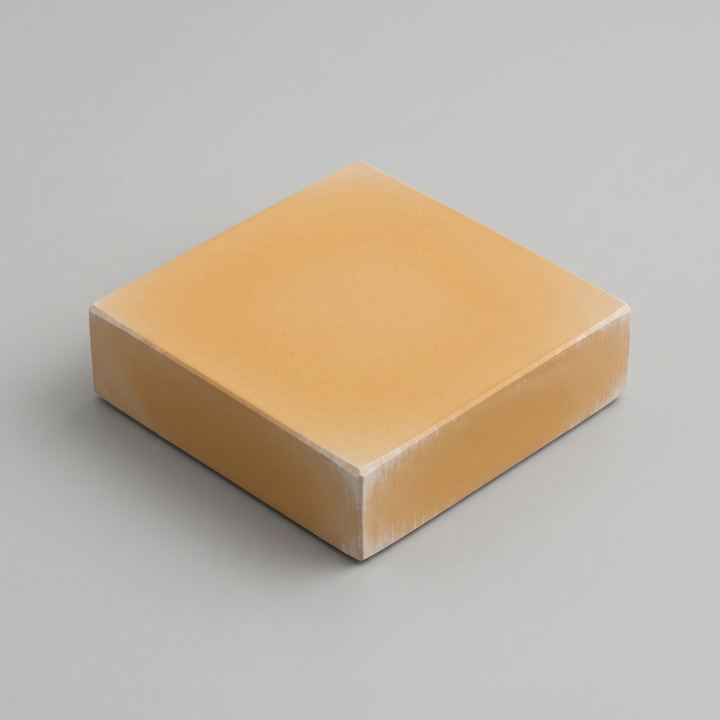
The face carries a saturated amber-brown reading, the iron oxide dominant and the tin content lending a faint reflective warmth rather than lightening the body. At 4.77 g/cm³ in an 85×85×29 mm block the slab is firmly two-handed, close in weight to a fired structural brick of the same footprint but denser-ringing when tapped. Surface vitrified semi-matte from the 1100 °C fire, the iron content producing a uniform skin colour without the grain-legibility of under-fired terracotta. Edges cold-cut, the kerf showing the characteristic iron-oxide rust-brown in the fresh cut where the saw exposes the un-oxidised interior. A distinct warm-absorber cousin to the cool-grey thermal-mass heavy-oxide siblings, closer in visual register to a weathered adobe block than to a fired architectural brick of the same footprint.
Recipe
1000 g batch · peak 1100 °C| element | precursor | formula | mass | safety |
|---|---|---|---|---|
| Fe | iron(III) oxide (red) | Fe2O3 | 46.83 g | safe |
| Li | lithium carbonate | Li2CO3 | 7.22 g | safe |
| Mg | magnesium carbonate | MgCO3 | 16.48 g | safe |
| Sn | tin(IV) oxide | SnO2 | 29.46 g | safe |
- 1Ramp
- 2Hold
- 3Ramp
- 4Hold
- 6Ramp
- 7Hold
Visible absorber — saturated color from bandgap in the visible range