B₂FeO₆W
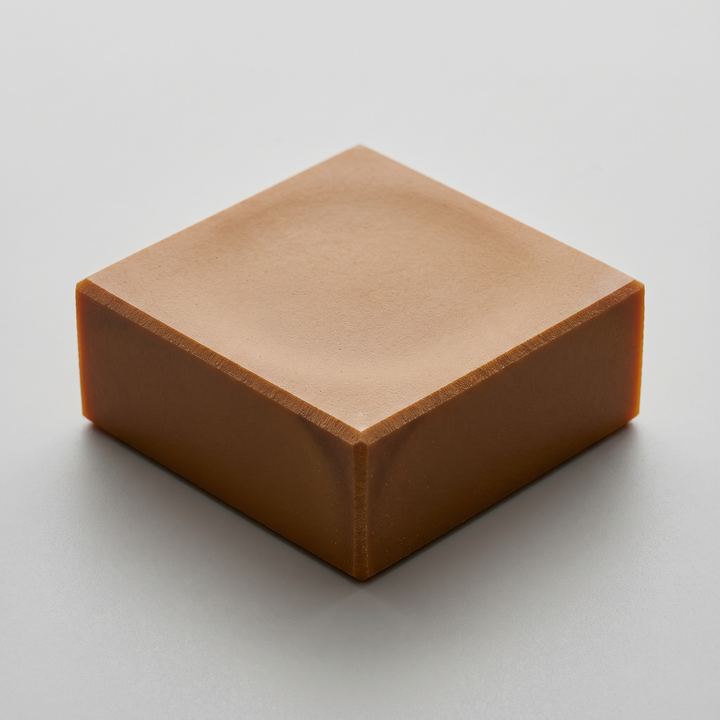
heavy oxide ceramic · thermal mass ceramicB2Fe1O6W1 is a heavy oxide ceramic suitable as thermal mass ceramic. Color: amber-brown. Fired at 1250°C from 3 precursors (WO3, Fe2O3, B2O3). Workshop batch: 200g at €53.06. Compressive strength ~100 MPa; estimated 0.94 kg CO₂/kg (+326% vs clay brick). Notable: electrochromic tungstate. Confidence: medium.
- forms at
- 1250 °C · high-fire
- replaces
- clay brick
- CO₂
- 326% higher than clay brick (0.94 vs 0.22 kg CO₂/kg; 4.3× higher)
- energy
- 108% higher than clay brick (6.25 vs 3.00 MJ/kg; 2.1× higher)
- compressive
- 100 MPa
- density
- 5.79 g/cm³
- crystal
- trigonal
- band gap
- 3.02 eV
- cost
- €265.30/kg · €53.06 / 200 g batch
- confidence
- medium (synthesis route)
- potential
- 0.35 · env 0.00 · novel 1.00 · struct 0.20 · lineage 0.50 · supply 0.00
- flags
- electrochromic tungstate: A voltage-switchable optical chemistry. In thin-film form a small DC signal shifts transmission from clear to tinted blue, opening the door to dimmable glazing and responsive partitions that do not need mechanical shading.
Architectural potential
A boron-iron-tungsten heavy-oxide ceramic fired at 1250 °C, carrying 100 MPa of compression and the same voltage-switchable tungstate behaviour as its lanthanum-manganese sibling. The CO₂ runs at more than four times that of a fired clay brick, so the function has to pay for the fire. What the chemistry opens is a monolithic, wiring-ready dimmable surface — a small DC signal shifts the body's optical transmission measurably, closing down solar gain without mechanical louvres. Natural placements are responsive accent tiles in south-facing office partitions, switchable signage panels in exhibition architecture where the curator dims the tile from the gallery console, electrochromic border tiles around skylight perimeters, and amber-bodied sill inserts in double-skin façades where the thermal argument and the dimming argument are wanted together. The amber-brown body sits warmer than the purple-brown La-Mn sibling, which positions it for programmes where the resting colour is part of the design rather than an engineering side-effect. At 200 g per batch and a 500 g workshop ceiling, specification is firmly at the signature-element and small-panel scale. The caveat is cost (€53.06 per batch) and cycle-life verification — architectural-duty switching endurance is untested in architectural production.
Material character
The slab reads a warm amber-brown with a higher 3.02 eV absorption edge than the visibly-coloured siblings of the atlas, so the colour sits lighter and cleaner in the glaze-like surface than the tungsten fraction would suggest. At 5.79 g/cm³ in a 70×70×35 mm format the piece carries weight but not the dead-weight of the La-Mn version — a firm two-handed lift rather than a bench-only register. Surface vitrified matte from the peak fire; edges cold-cut, the kerf powder pale against the warm body. Against the La-Mn-W-Y sibling of the same firing the tone is immediately warmer and the density noticeably lower.
Recipe
200 g batch · peak 1250 °C| element | precursor | formula | mass | safety |
|---|---|---|---|---|
| B | boron oxide (or borax Na2B4O7) | B2O3 | 18.26 g | safe |
| Fe | iron(III) oxide (red) | Fe2O3 | 20.94 g | safe |
| W | tungsten trioxide (yellow) | WO3 | 60.8 g | moderate |
- 1Ramp
- 2Hold
- 3Ramp
- 4Ramp
- 5Hold
- 6Ramp
- 7Ramp
Electrochromic — color switches under applied voltage (thin-film chemistry)