Bi₄O₄S₆Sr₄
heavy oxide ceramic · thermal mass ceramicBi4O4S6Sr4 is a heavy oxide ceramic suitable as thermal mass ceramic. Color: neutral. Fired at 1250°C from 2 precursors (Bi2O3, SrCO3). Workshop batch: 200g at €7.77. Compressive strength ~100 MPa; estimated 0.94 kg CO₂/kg (+326% vs clay brick). Notable: visible absorber. Confidence: medium.
- forms at
- 1250 °C · high-fire
- replaces
- clay brick
- CO₂
- 326% higher than clay brick (0.94 vs 0.22 kg CO₂/kg; 4.3× higher)
- energy
- 108% higher than clay brick (6.25 vs 3.00 MJ/kg; 2.1× higher)
- compressive
- 100 MPa
- density
- 5.69 g/cm³
- crystal
- monoclinic
- band gap
- 1.52 eV
- cost
- €38.85/kg · €7.77 / 200 g batch
- confidence
- medium (synthesis route)
- potential
- 0.22 · env 0.00 · novel 0.46 · struct 0.20 · lineage 0.50 · supply 0.00
- flags
- visible absorber: A real-colour solar-gain control layer. Where the body takes visible light into itself rather than reflecting it, the material becomes a selective heat collector — useful on thermal-mass walls, absorber panels, and warm-toned cladding.
Architectural potential
A bismuth-strontium sulfo-oxide ceramic in the thermal-mass register, carrying visible-absorber behaviour that shifts the body into a real-colour solar-gain collector. At 100 MPa and 5.686 g/cm³ the material has the density to work as a genuine thermal battery in surface-scale application — trombe-wall infill tiles on south-facing elevations, hypocaust-style floor patches in conservatory and greenhouse architecture, radiant-heat storage inlays in night-flush cooling cores. The visible-absorber layer means the body takes visible light into itself rather than reflecting it, making the material a selective heat collector rather than a neutral mass: warm-toned absorber panels on solar walls, darker-reading cladding strips at window sill level where direct morning gain is wanted. Against clay brick the CO₂ runs four times higher, so specification has to be earned by the absorber function — volume use is unjustifiable. Natural placements are the small-area thermal patch scale: a 70×70 mm tile field across a south-facing infill panel, not a whole wall of the material. Cost is €7.77 per 200 g batch, by atlas standards modest, but supply-chain score is 0.0 from bismuth-strontium precursor logistics, and safety score sits at 0.65 because sulphur content in the fired body releases odour under heavy saw-cutting — workshop ventilation must be genuinely rigorous.
Material character
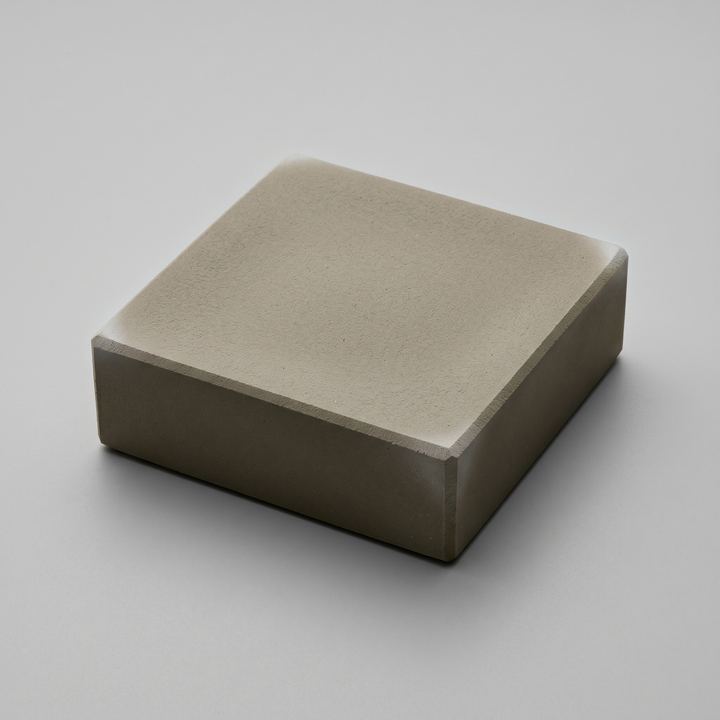
A neutral body with the warm bismuth-grey undertone that bismuth-heavy ceramic sinters develop after the 1250 °C firing — not quite the grey of ordinary stoneware, with a subdued silvery cast under raking light. At 5.686 g/cm³ and 70×70×36 mm the slab is denser in hand than the aluminate thermal-mass sibling, a firm single-hand lift that rings low and short on the edge-tap. Surface reads sintered matte, tighter-grained than the low-density tungstate cousin in the same family, with a fine even sheen. Edges come cold-cut with a clean, slightly silvery kerf bloom. Against the Ca-Fe-Sn amber sibling the body reads cooler, heavier and more metallic.
Recipe
200 g batch · peak 1250 °C| element | precursor | formula | mass | safety |
|---|---|---|---|---|
| Bi | bismuth(III) oxide (yellow) | Bi2O3 | 61.21 g | moderate |
| Sr | strontium carbonate | SrCO3 | 38.79 g | safe |
- 1Ramp
- 2Hold
- 3Ramp
- 4Ramp
- 5Hold
- 6Ramp
- 7Ramp
Visible absorber — saturated color from bandgap in the visible range