B₃GdO₁₅Pr₂Si₃
borosilicate glass · structural translucent advancedB3Gd1O15Pr2Si3 is a borosilicate glass suitable as structural translucent advanced. Color: neutral. Fired at 1300°C from 4 precursors (Pr6O11, Gd2O3, SiO2). Workshop batch: 200g at €57.70. Compressive strength ~500 MPa; estimated 1.01 kg CO₂/kg (+18% vs float glass). Notable: uv luminescent. Confidence: medium.
- forms at
- 1300 °C · extreme-fire
- replaces
- float glass
- CO₂
- 18% higher than float glass (1.01 vs 0.86 kg CO₂/kg; 1.2× higher)
- energy
- 55.0% lower than float glass (6.75 vs 15.00 MJ/kg)
- compressive
- 500 MPa
- density
- 4.83 g/cm³
- crystal
- triclinic
- band gap
- 2.66 eV
- cost
- €288.50/kg · €57.70 / 200 g batch
- confidence
- medium (synthesis route)
- potential
- 0.58 · env 0.69 · novel 0.57 · struct 1.00 · lineage 0.50 · supply 0.05
- flags
- uv luminescent: Converts invisible ultraviolet into visible light. Signage panels, low-energy wayfinding tiles, emergency markings that draw their illumination from daylight rather than mains power.
Architectural potential
This is a translucent mass element with a dual life: as a load-bearing light-admitting solid at daylight, and as an ultraviolet-excited emitter when evening light shifts into the near-UV. Five hundred megapascals of compression and the highest density in the borosilicate group (4.83 g/cm³) lift it out of the sheet-glass register entirely and into the inhabitable translucent solid zone. Natural placements are monolithic light-admitting columns in public interiors — gallery piers, bath-house screens, crematoria thresholds — where the pier both carries load and glows under dedicated UV excitation during ritual moments. Illuminated stair treads with 365 nm excitation from below read chartreuse under daylight and shift to amber along the long edges; museum plinths carry and signal at the same time. Against float glass the embodied CO₂ is eighteen per cent higher but the energy overhead is fifty-five per cent lower, so the trade is thermal rather than carbonaceous. The caveat is rarity: gadolinium-praseodymium availability is small, the supply-chain score sits below 0.15, and €57 per 200 g batch puts specification firmly in the signature-element register, not in bulk glazing.
Material character
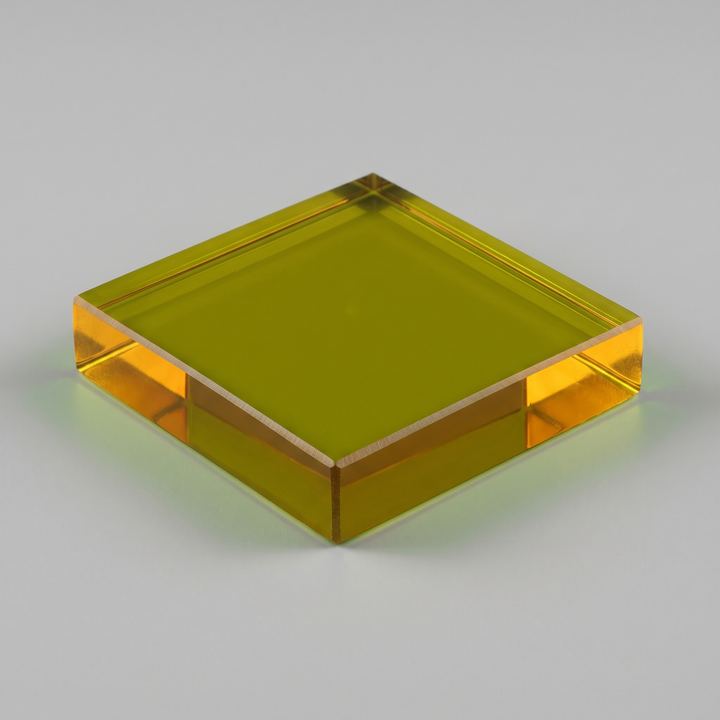
The slab's intrinsic absorption edge sits at 2.66 eV, so the body carries real colour rather than tinted clarity — a saturated chartreuse read through the 29 mm top face, an amber read when sighted along the 85 mm long edge as the slab thickens. Cold-cut edges carry the usual lapidary bloom; the top face sits under a low convex crown with three thin anneal striae close to one long edge. At 4.83 g/cm³ and 85×85×29 mm the slab sits stably on the bench and resists the one-handed lift — a distinct weight step up from the lanthanum-variant borosilicates.
Recipe
200 g batch · peak 1300 °C| element | precursor | formula | mass | safety |
|---|---|---|---|---|
| B | boron oxide (or borax Na2B4O7) | B2O3 | 12.95 g | safe |
| Gd | gadolinium oxide | Gd2O3 | 22.48 g | moderate |
| Pr | praseodymium oxide | Pr6O11 | 42.22 g | moderate |
| Si | quartz flour / silica | SiO2 | 22.35 g | safe |
- 1Ramp
- 2Hold
- 3Ramp
- 4Hold
- 5Ramp
- 6Hold
UV-luminescent — emits visible light under 365 nm UV