Bi₆Ce₁₀CuSi
metal pm only · sintered metalBi6Ce10Cu1Si1 is a metal pm only suitable as sintered-metal. Color: green-red-copper. Fired at 1100°C from 4 precursors (Ce, Bi, Cu). Workshop batch: 200g at €8.02. Compressive strength ~350 MPa; estimated 0.84 kg CO₂/kg (-53% vs structural steel). Notable: no special functions flagged. Confidence: medium.
- forms at
- 1100 °C · high-fire
- replaces
- structural steel
- CO₂
- 53.1% lower than structural steel (0.84 vs 1.80 kg CO₂/kg)
- energy
- 74.4% lower than structural steel (5.62 vs 26.00 MJ/kg)
- compressive
- 350 MPa
- density
- 8.72 g/cm³
- crystal
- trigonal
- band gap
- 0.00 eV
- cost
- €40.10/kg · €8.02 / 200 g batch
- confidence
- medium (synthesis route)
- potential
- 0.45 · env 0.74 · novel 0.00 · struct 0.84 · lineage 0.20 · supply 0.50
Architectural potential
A cerium-bismuth-dominated sintered metal that also reaches 350 MPa of compression with a fifty-three-per-cent cut in embodied CO₂ against structural steel, but sits in a higher-cost register than its sibling antimony formulations. Fired at 1100 °C in 200 g batches, its reach is single-part hardware rather than repeated runs: custom connector nodes in timber pavilion construction, one-off fçade brackets for heritage retrofit, furniture and fixture details in exhibition architecture, specialised fittings for art installation in museums and galleries. The green-red-copper face is a specification argument in itself — where a welded steel node would be painted or hidden, this body is meant to be seen. The cerium content also opens a niche application in oxidation-tolerant hardware: brackets in swimming-pool halls, fittings in humid plant rooms, connectors in coastal fçade systems. Against cast steel the argument is complex geometry without a foundry, half the embodied carbon, and a finished part that accepts machining. The caveat is cost: at €8.02 per 200 g batch, roughly eleven times the price of the antimony sibling, specification is squarely in the signature-element register — the connector you show rather than the one you hide.
Material character
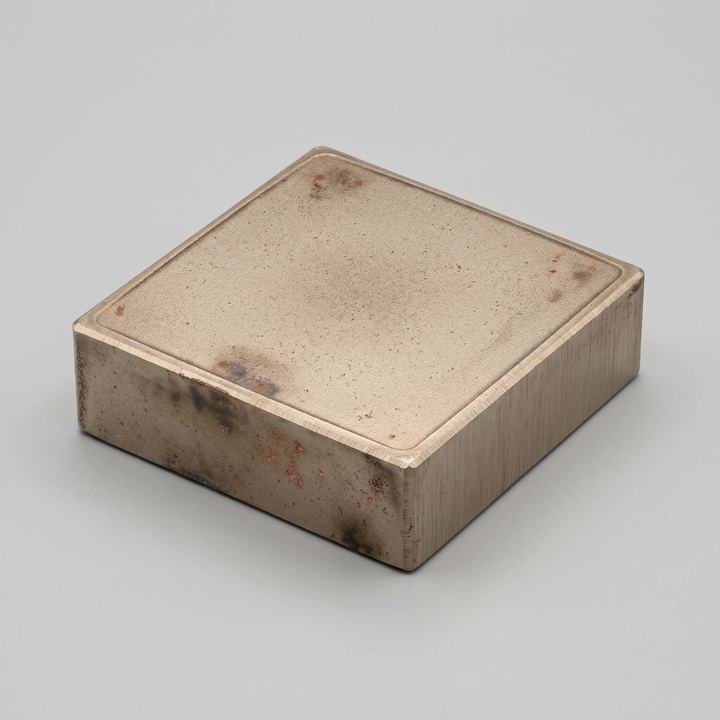
The slab reads a deeper green-red-copper than its lighter powder-pressed siblings, the cerium content pushing the matrix toward a warmer bronze cast with faint bismuth iridescence catching along the 70×70 mm face. At 8.72 g/cm³ in a 70×70×23 mm piece, the body is the densest in the powder-pressed palette here — a distinct weight step up from the 7.30 g/cm³ antimony variant, with a sharper pull on the hand. Skin matte from the furnace with the characteristic granular press-texture; edges cold-cut, leaving a fine metallic kerf. A light oxide shimmer settles across the top face under diffuse light, unlike the flatter antimony-copper face, and the corner rings brighter under the knuckle.
Recipe
200 g batch · peak 1100 °C| element | precursor | formula | mass | safety |
|---|---|---|---|---|
| Bi | bismuth metal | Bi | 45.65 g | safe |
| Ce | cerium metal | Ce | 51.01 g | moderate |
| Cu | copper shot/powder | Cu | 2.31 g | safe |
| Si | silicon granules | Si | 1.02 g | safe |
- 1Ramp
- 2Hold
- 3Ramp
- 4Hold
- 5Ramp
- 6Ramp
- 7END