B₆Ce₄FeMnSi
metal pm only · sintered metalB6Ce4Fe1Mn1Si1 is a metal pm only suitable as sintered-metal. Color: neutral. Fired at 1100°C from 5 precursors (Ce, B, Fe). Workshop batch: 200g at €9.62. Compressive strength ~50 MPa; estimated 0.84 kg CO₂/kg (-53% vs structural steel). Notable: shape memory FeMnSi. Confidence: medium.
- forms at
- 1100 °C · high-fire
- replaces
- structural steel
- CO₂
- 53.1% lower than structural steel (0.84 vs 1.80 kg CO₂/kg)
- energy
- 74.4% lower than structural steel (5.62 vs 26.00 MJ/kg)
- compressive
- 50 MPa
- density
- 7.33 g/cm³
- crystal
- trigonal
- band gap
- —
- cost
- €48.10/kg · €9.62 / 200 g batch
- confidence
- medium (synthesis route)
- potential
- 0.55 · env 0.74 · novel 0.80 · struct 0.12 · lineage 0.20 · supply 0.50
- flags
- shape memory FeMnSi: Deforms on cue and snaps back to a remembered shape when warmed. Deployable canopies, self-tensioning fasteners, seismic-damping brackets, and geometry-changing envelopes all become mechanically possible.
Architectural potential
A powder-pressed metal with a shape-memory twist: the iron-manganese-silicon component deforms on cue and snaps back when warmed, so this body belongs in brackets and fittings that need to do mechanical work rather than simply hold still. Its natural scale is the connector — seismic-damping brackets stitched into timber-frame joints, self-tensioning fasteners for tensile membranes, deployable canopy hinges, facade clips that close gaps as the day heats. The ceramic-boride inclusions harden the matrix, so the part tolerates machining and finish-work cleanly on its way from furnace to site. Against structural steel the embodied CO₂ drops by more than half and the firing energy by nearly three-quarters, which matters most for hardware specified at repeat: thousands of brackets in a long timber-framed hall quickly amortise the sintering route over the cast route. Compressive capacity runs around fifty megapascals, so this is explicitly not a column element — it is the node between columns, the joint between slabs, the clip that carries shear not crush. The caveat is reach: workshop batches cap at five hundred grams, which restricts production to detail hardware in short runs rather than mass-cast structural fittings, and confidence on the shape-memory response at architectural scale remains medium.
Material character
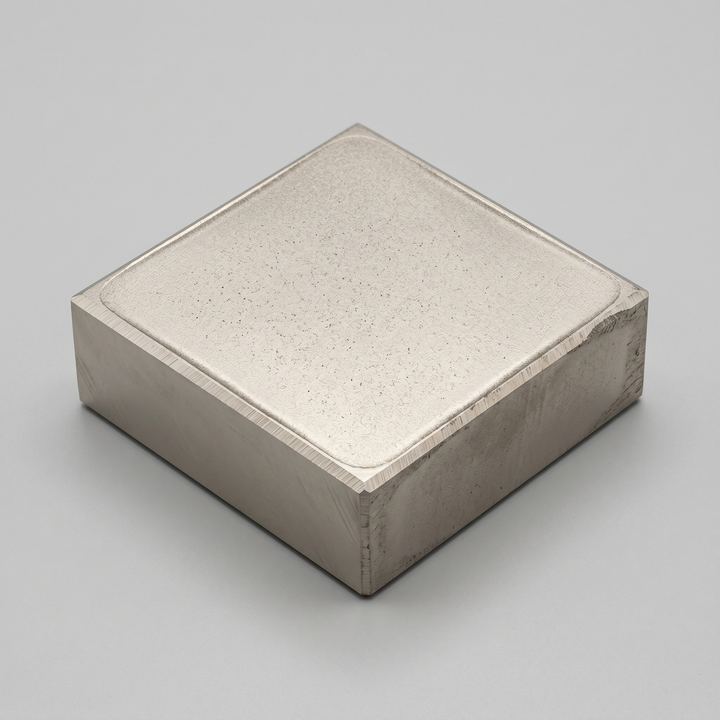
At 7.33 g/cm³ in a 70×70×28 mm slab the piece carries a dense, firm one-handed weight — heavier than an aluminium sibling of the same size but a step below solid steel. The body reads neutral grey with a faint iron-warm cast where manganese and cerium bloom under raking light. Surface sits as a sintered matte grain without cast texture, no tool marks, a uniform micro-porosity that catches light softly and takes a clean bead-blast finish. Edges come from the die, crisply rectangular, with a faint flash line where the powder closed. Against a purely iron-manganese shape-memory alloy the cerium-boron additions harden the surface and mute the characteristic steel lustre.
Recipe
200 g batch · peak 1100 °C| element | precursor | formula | mass | safety |
|---|---|---|---|---|
| B | boron powder | B | 8.49 g | safe |
| Ce | cerium metal | Ce | 73.34 g | moderate |
| Fe | iron powder -325 mesh | Fe | 7.31 g | moderate |
| Mn | manganese flakes | Mn | 7.19 g | moderate |
| Si | silicon granules | Si | 3.68 g | safe |
- 1Ramp
- 2Hold
- 3Ramp
- 4Hold
- 5Ramp
- 6Ramp
- 7END
Shape-memory — deformed body recovers on heating (Fe-Mn-Si)