Co₁₇FeS₁₆
sulfide metal composite · sulfide low tempCo17Fe1S16 is a sulfide metal composite suitable as sulfide low temp. Color: blue. Fired at 130°C from 3 precursors (CoO, S, Fe2O3). Workshop batch: 300g at €49.27. Compressive strength ~250 MPa; estimated 0.09 kg CO₂/kg (-89% vs Portland cement). Notable: forms without a kiln. Confidence: medium.
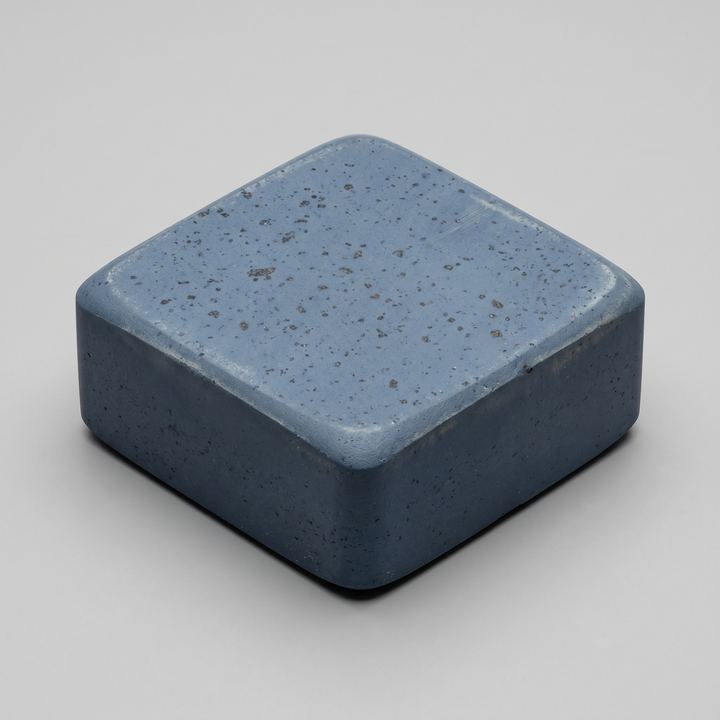
- forms at
- 130 °C · hotplate · no kiln
- replaces
- portland cement
- CO₂
- 89.1% lower than Portland cement (0.09 vs 0.83 kg CO₂/kg)
- energy
- 89.1% lower than Portland cement (0.60 vs 5.50 MJ/kg)
- compressive
- 250 MPa
- density
- 5.58 g/cm³
- crystal
- tetragonal
- band gap
- 0.00 eV
- cost
- €164.23/kg · €49.27 / 300 g batch
- confidence
- medium (synthesis route)
- potential
- 0.77 · env 1.00 · novel 1.00 · struct 0.50 · lineage 0.50 · supply 0.46
- flags
- zero kiln: Forming happens without firing — the material cures through chemistry at ambient or hotplate temperature. At building scale this removes the kiln from the supply chain: on-site casting, regional workshops, cold-country fabrication all become available.
Architectural potential
This is a cast, chemistry-formed solid in the flagship zero-kiln register, built up from solution at 130 °C and reaching 250 MPa of compressive strength — cement-level compression delivered without a single firing. Against Portland cement the embodied CO₂ drops by eighty-nine per cent, which is the argument the material carries into a building. Natural placements are interior floor tile in galleries and workshops where kiln access is absent, drop-cast thresholds and sill plates cast directly into plywood formwork, acoustic-wall inlay panels where iron-cobalt mass is wanted without firing risk, and cast laminates laid over timber substrates for thick feature cladding in exhibition architecture. The 70×70×37 mm slab sits squarely in the detail-and-tile register rather than in bulk wall-work: workshop batches top out at a kilogram, so the material belongs to signature floor patches, stair landings, and threshold pieces rather than to whole-room paving. Because forming happens on a hotplate, on-site casting and cold-country fabrication become feasible in a way Portland never allows. The caveat is hygiene and confidence: cobalt-heavy sulfide cutting releases odour under the saw, medium confidence on the strength estimate, and the workshop needs adequate ventilation to handle production safely.
Material character
The slab reads a deep saturated cobalt-blue body, noticeably darker than the purple-tinted polysulfides of the manganese siblings. At 5.58 g/cm³ it is the densest cast sulfide in the atlas; the 70×70×37 mm piece weighs close to a kilogram and resists the one-handed lift, firmly into the two-hand grip register. Surface finishes cast mold-matte with a slight meniscus sheen where the solution set against the mould wall; edges come as-cast, sharp and faintly reflective from the cobalt-sulfide matrix. Against the copper-red polysulfide sibling, the blue reads cooler, more mineral and less metallic, closer to a cold lapis than to a weathered patina.
Recipe
300 g batch · peak 130 °C| element | precursor | formula | mass | safety |
|---|---|---|---|---|
| Co | cobalt(II) oxide | CoO | 94.1 g | moderate |
| Fe | iron(III) oxide (red) | Fe2O3 | 5.9 g | safe |
- Pre-heatHotplate to 150 °C
- MeltSulfur liquefies at 115 °C; full liquid at 130 °C
- CastPour at 140–145 °C
- SetRoom temperature 30 min (firm) → 24 h (full strength)
Zero-kiln process — 130 °C hotplate cast only