Bi₄La₃Li₁₂Nd₅O₄₈W₈
rare earth oxide · rare earth ceramicBi4La3Li12Nd5O48W8 is a rare earth oxide suitable as rare earth ceramic. Color: yellow-photochromic. Fired at 1200°C from 5 precursors (WO3, Bi2O3, Nd2O3). Workshop batch: 100g at €23.78. Compressive strength ~100 MPa; estimated 0.90 kg CO₂/kg (+309% vs clay brick). Notable: photochromic. Confidence: medium.
- forms at
- 1200 °C · high-fire
- replaces
- clay brick
- CO₂
- 309% higher than clay brick (0.90 vs 0.22 kg CO₂/kg; 4.1× higher)
- energy
- 100% higher than clay brick (6.00 vs 3.00 MJ/kg; 2.0× higher)
- compressive
- 100 MPa
- density
- 0.70 g/cm³
- crystal
- triclinic
- band gap
- —
- cost
- €237.80/kg · €23.78 / 100 g batch
- confidence
- medium (synthesis route)
- potential
- 0.34 · env 0.00 · novel 0.90 · struct 0.20 · lineage 0.50 · supply 0.10
- flags
- photochromic: Darkens reversibly under UV. Glazing and surface layers that shade themselves on sunny days and clear when the sun drops — passive solar-gain control without mechanical shading.
Architectural potential
A photochromic, controlled-porosity sinter at softwood density makes this a natural candidate for passive self-shading façade cladding at full panel scale. The body darkens on the order of minutes under direct ultraviolet exposure toward a smoky amber and relaxes back to its pale-yellow baseline over tens of minutes in shadow, so a south-facing wall tiled in this material writes its own shading pattern through the day: the patches facing peak sun darken, the shaded corners stay bright, and the façade re-reads itself as the sun moves. Natural placements are south-facing office and residential cladding where mechanical shading is either unwanted or unaffordable; brise-soleil louvres whose darkening compounds with their geometric shading; and greenhouse and atrium roof panels where passive dimming improves plant health without running a control system. The 0.70 g/cm³ density — the result of a deliberate controlled-porosity sinter, not an artefact — means panel-scale specification without the load penalty of a dense rare-earth ceramic. The caveat is embodied cost: three times the CO₂ of clay brick, 100 g workshop batches, and rare-earth supply fragility keep even the lightest façade specification tied to signature elements rather than bulk cladding.
Material character
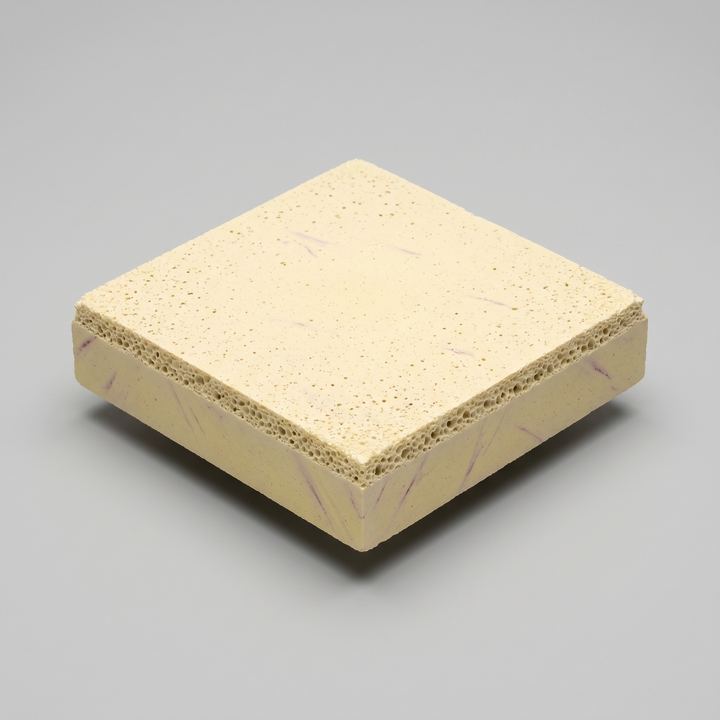
The face reads a pale yellow in the bleached photochromic baseline, with faint violet-rose accents from the neodymium sharp-line absorption showing mostly at oblique angles. The top face is matte bisque with visible pore openings from the controlled-porosity sinter; the diamond-sawn edges show a cellular cross-section that would pass, in photograph, for a dense foam rather than a tungstate ceramic. At 0.70 g/cm³ and 120×120×100 mm the slab handles like kiln-dried softwood, a single-hand lift despite its large footprint. Under direct sun the body darkens visibly — the camera records only the passive bleached state.
Recipe
100 g batch · peak 1200 °C| element | precursor | formula | mass | safety |
|---|---|---|---|---|
| Bi | bismuth(III) oxide (yellow) | Bi2O3 | 20.44 g | moderate |
| La | lanthanum oxide | La2O3 | 10.72 g | moderate |
| Li | lithium carbonate | Li2CO3 | 9.72 g | safe |
| Nd | neodymium oxide | Nd2O3 | 18.45 g | moderate |
| W | tungsten trioxide (yellow) | WO3 | 40.67 g | moderate |
- 1Ramp
- 2Hold
- 3Ramp
- 4Ramp
- 5Hold
- 6Ramp
- 7Ramp
Photochromic — reversibly darkens under UV exposure