AlCoFe₂O₁₂Pr₄
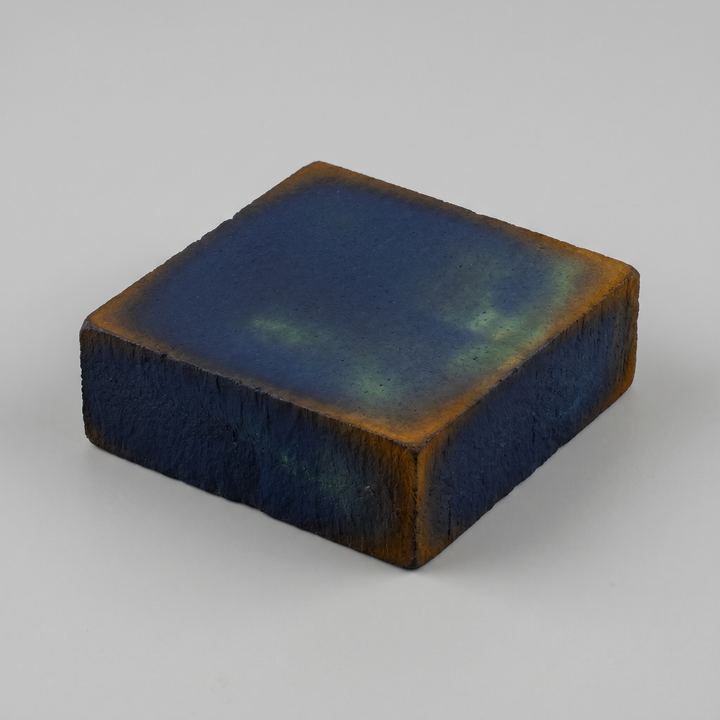
rare earth oxide · rare earth ceramicAl1Co1Fe2O12Pr4 is a rare earth oxide suitable as rare earth ceramic. Color: blue. Fired at 1200°C from 4 precursors (Pr6O11, Fe2O3, CoO). Workshop batch: 100g at €30.35. Compressive strength ~100 MPa; estimated 0.90 kg CO₂/kg (+309% vs clay brick). Notable: uv luminescent, visible absorber. Confidence: medium.
- forms at
- 1200 °C · high-fire
- replaces
- clay brick
- CO₂
- 309% higher than clay brick (0.90 vs 0.22 kg CO₂/kg; 4.1× higher)
- energy
- 100% higher than clay brick (6.00 vs 3.00 MJ/kg; 2.0× higher)
- compressive
- 100 MPa
- density
- 6.74 g/cm³
- crystal
- triclinic
- band gap
- 2.04 eV
- cost
- €303.50/kg · €30.35 / 100 g batch
- confidence
- medium (synthesis route)
- potential
- 0.43 · env 0.00 · novel 1.00 · struct 0.20 · lineage 0.50 · supply 0.50
- flags
- uv luminescent: Converts invisible ultraviolet into visible light. Signage panels, low-energy wayfinding tiles, emergency markings that draw their illumination from daylight rather than mains power. visible absorber: A real-colour solar-gain control layer. Where the body takes visible light into itself rather than reflecting it, the material becomes a selective heat collector — useful on thermal-mass walls, absorber panels, and warm-toned cladding.
Architectural potential
A praseodymium-cobalt-aluminate rare-earth ceramic whose architectural case is not mass but the paired luminescent and absorber chemistries it carries. At 100 MPa compression with 309 per cent higher embodied CO₂ than fired clay brick, bulk volume use is forbidden; the specification is paid for by a double function — ultraviolet excitation converts to visible emission during low-UV evening conditions, and the visible-absorber behaviour pulls solar gain into the body during the day. Natural placements are signature signage and wayfinding elements in cultural buildings: emergency markings in theatre foyers that glow under daylight-charged UV, threshold inlays in museum galleries that brighten in low light, low-energy wayfinding tiles in transit architecture, and accent cladding patches in entrance sequences where the same material reads as cool blue by day and warm emission at evening. In south-facing inserts the absorber behaviour doubles the piece as a passive heat collector. Against fired clay brick the argument is sensation — a wall that has a light life of its own. The caveat is cost and supply: €30.35 per 100 g batch, a 300 g workshop ceiling, and a 1200 °C fire with four rare-earth precursors. Specification is squarely at the single-tile or signature-strip scale.
Material character
The slab reads a saturated cobalt-blue with the faint violet cast characteristic of praseodymium-doped bodies — deeper and more pigmented than the grey-blues of the neodymium-family siblings, close to the cobalt palette of historic stained glass. At 6.74 g/cm³ in a 70×70×30 mm piece, the slab sits heavy for its footprint and asks for two hands at the catch. Skin matte from the sinter with a faint glass-ceramic sheen from the aluminate content; edges cold-cut, the kerf crisp. Under UV the body shifts into a warm peach-amber emission, visible even in low ambient light — a distinct double state, cool by day and glowing in the dusk.
Recipe
100 g batch · peak 1200 °C| element | precursor | formula | mass | safety |
|---|---|---|---|---|
| Al | calcined alumina | Al2O3 | 5.27 g | safe |
| Co | cobalt(II) oxide | CoO | 7.75 g | moderate |
| Fe | iron(III) oxide (red) | Fe2O3 | 16.52 g | safe |
| Pr | praseodymium oxide | Pr6O11 | 70.45 g | moderate |
- 1Ramp
- 2Hold
- 3Ramp
- 4Ramp
- 5Hold
- 6Ramp
- 7Ramp
UV-luminescent — emits visible light under 365 nm UV
Visible absorber — saturated color from bandgap in the visible range