C₆Cr₂₂Cu
metal pm only · sintered metalC6Cr22Cu1 is a metal pm only suitable as sintered-metal. Color: green-red-copper. Fired at 1100°C from 3 precursors (Cr, C, Cu). Workshop batch: 200g at €9.29. Compressive strength ~350 MPa; estimated 0.84 kg CO₂/kg (-53% vs structural steel). Notable: no special functions flagged. Confidence: medium.
- forms at
- 1100 °C · high-fire
- replaces
- structural steel
- CO₂
- 53.1% lower than structural steel (0.84 vs 1.80 kg CO₂/kg)
- energy
- 74.4% lower than structural steel (5.62 vs 26.00 MJ/kg)
- compressive
- 350 MPa
- density
- 7.24 g/cm³
- crystal
- cubic
- band gap
- 0.00 eV
- cost
- €46.45/kg · €9.29 / 200 g batch
- confidence
- medium (synthesis route)
- potential
- 0.45 · env 0.74 · novel 0.00 · struct 0.84 · lineage 0.20 · supply 0.50
Architectural potential
A carbon-rich chromium-copper sinter that carries real structural load at the detail scale: 350 megapascals of compression in a powder-pressed part, without the tooling cost of casting. Natural placements are façade clips and rainscreen brackets where corrosion resistance matters, furniture joints and connector nodes in exhibition fit-out, custom hardware for timber-glass assemblies in office interiors, and structural fittings for stair stringers and balustrade anchors. The chromium content pushes the body toward stainless behaviour while the copper phase tunes thermal conductivity, so radiator nodes and underfloor-heating manifolds are in scope where a single monolithic hardware piece is wanted. Against structural steel the embodied CO₂ drops by fifty-three per cent and firing energy by seventy-four per cent, which makes a real argument at repeat-hardware scale — the kind of project where hundreds of identical brackets would otherwise be cast or welded. Because the sinter accepts machining and finish-work cleanly, the part moves from furnace to site without intermediate hand-work. The caveat is reach: workshop batches cap at five hundred grams, so this is strictly the small part, and the near-zero bandgap at 0.002 eV makes it electrically conductive — a factor to design for in any application near electronics or grounding paths.
Material character
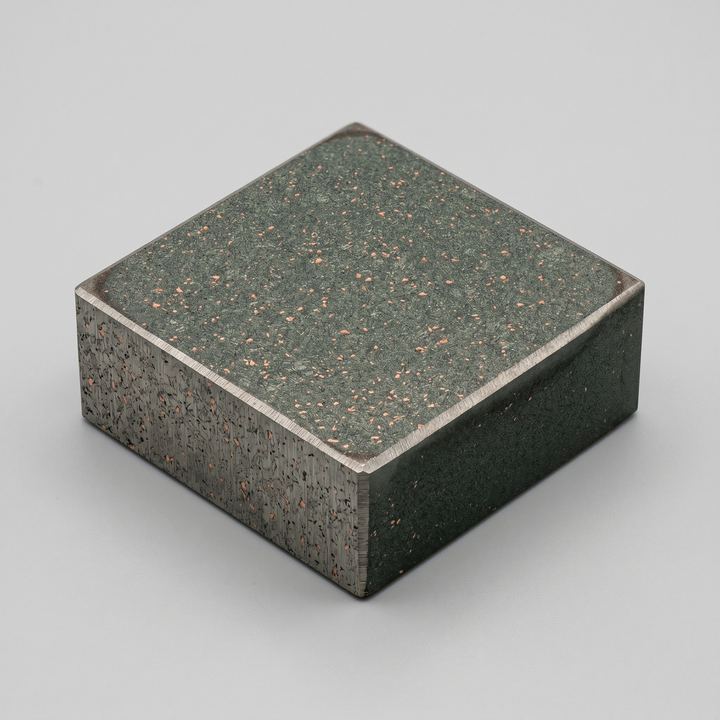
The slab reads green-red copper: a dominant olive-chromium green with copper warming bleeding through at edges and where the grain runs coarser. At 7.24 g/cm³ in a 70×70×28 mm block the weight sits firmly in one hand but asks for two at length — a compact, dense register that registers as metal immediately in the hand. Surface carries the characteristic sintered matte grain, finer than a cast face and less polished than a wrought one, with a slight chromium sheen under direct light. Edges come die-crisp from the press. Against a conventional stainless-steel sibling the copper face warms the colour palette noticeably and softens the acoustic ring.
Recipe
200 g batch · peak 1100 °C| element | precursor | formula | mass | safety |
|---|---|---|---|---|
| C | graphite powder | C | 5.63 g | safe |
| Cr | chromium metal | Cr | 89.4 g | safe |
| Cu | copper shot/powder | Cu | 4.97 g | safe |
- 1Ramp
- 2Hold
- 3Ramp
- 4Hold
- 5Ramp
- 6Ramp
- 7END