CuMn₂RuSb₁₂Sr
metal pm only · sintered metalCu1Mn2Ru1Sb12Sr1 is a metal pm only suitable as sintered-metal. Color: green-red-copper. Fired at 1100°C from 3 precursors (SrCO3, Mn, Cu). Workshop batch: 200g at €0.71. Compressive strength ~350 MPa; estimated 0.84 kg CO₂/kg (-53% vs structural steel). Notable: no special functions flagged. Confidence: medium.
- forms at
- 1100 °C · high-fire
- replaces
- structural steel
- CO₂
- 53.1% lower than structural steel (0.84 vs 1.80 kg CO₂/kg)
- energy
- 74.4% lower than structural steel (5.62 vs 26.00 MJ/kg)
- compressive
- 350 MPa
- density
- 7.30 g/cm³
- crystal
- triclinic
- band gap
- 0.00 eV
- cost
- €3.55/kg · €0.71 / 200 g batch
- confidence
- medium (synthesis route)
- potential
- 0.44 · env 0.74 · novel 0.00 · struct 0.84 · lineage 0.20 · supply 0.43
Architectural potential
An antimony-heavy sintered metal whose 350 MPa compressive strength and fifty-three-per-cent cut in embodied CO₂ against structural steel place it squarely in the connector and hardware register: powder-pressed brackets, fçade clips, furniture joints, balustrade fittings, and node pieces where a single-part monolithic geometry would otherwise need welding or milling. Fired at 1100 °C, the body accepts machining and finish-work cleanly and takes patina willingly, which lets the green-red-copper face carry its own architectural signature rather than being hidden behind paint. Natural placements are visible hardware in public interiors — handrail brackets in museums, fçade clips for terracotta rainscreen systems, connector nodes in timber-heavy pavilion construction, custom hinges and latches in exhibition architecture. Against cast or welded steel, the argument is geometry and carbon: complex node shapes without tooling a mould, half the embodied carbon, three-quarters less process energy. At 200 g per batch with a 500 g workshop ceiling, however, the reach is limited to single pieces or small runs. The caveat is cost in another register: antimony and ruthenium content push supply chain dependence on non-European sources, and safety-score concerns around antimony dust call for sealed sintering and careful extraction during the powder-handling stage.
Material character
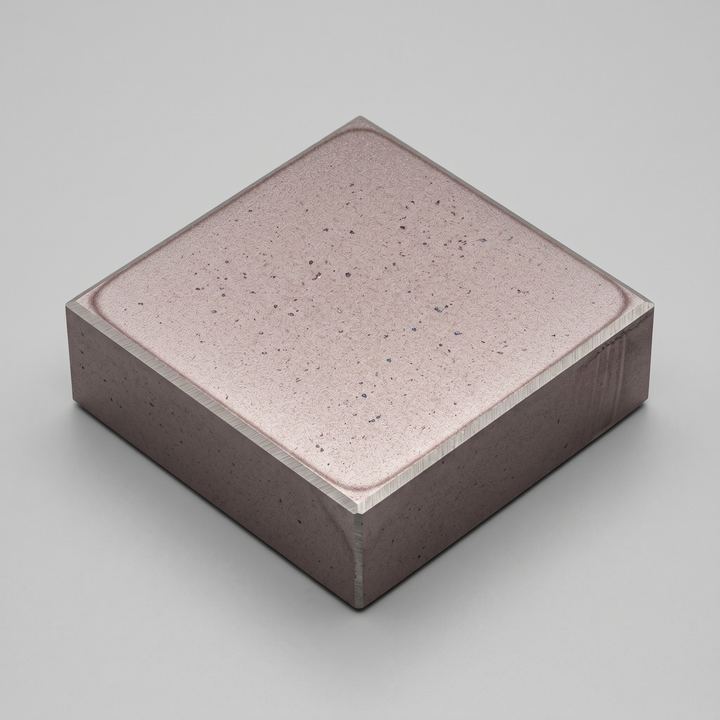
The slab carries the unmistakable green-red-copper shift of a copper-manganese alloy over an antimony-strontium base — a patina that reads bronze at shallow angles and flushes toward verdigris along the shadowed edges. At 7.30 g/cm³ in a 70×70×28 mm piece, the slab refuses the one-handed lift: it sits closer to a dense bronze casting than to an aluminium or sintered-iron component of the same footprint. Skin sintered-matte with the fine granular texture of a powder-pressed body, distinct from the smoother sheen of a cast metal. Edges cold-cut, with a slight burr from the diamond saw left along the kerf. Tapped, the body answers with the high metallic note of a dense sintered alloy.
Recipe
200 g batch · peak 1100 °C| element | precursor | formula | mass | safety |
|---|---|---|---|---|
| Cu | copper shot/powder | Cu | 19.79 g | safe |
| Mn | manganese flakes | Mn | 34.22 g | moderate |
| Sr | strontium carbonate (NEVER Sr metal) | SrCO3 | 45.98 g | safe |
- 1Ramp
- 2Hold
- 3Ramp
- 4Hold
- 5Ramp
- 6Ramp
- 7END