Ca₁₂Fe₅O₄₈Si₁₂V₃
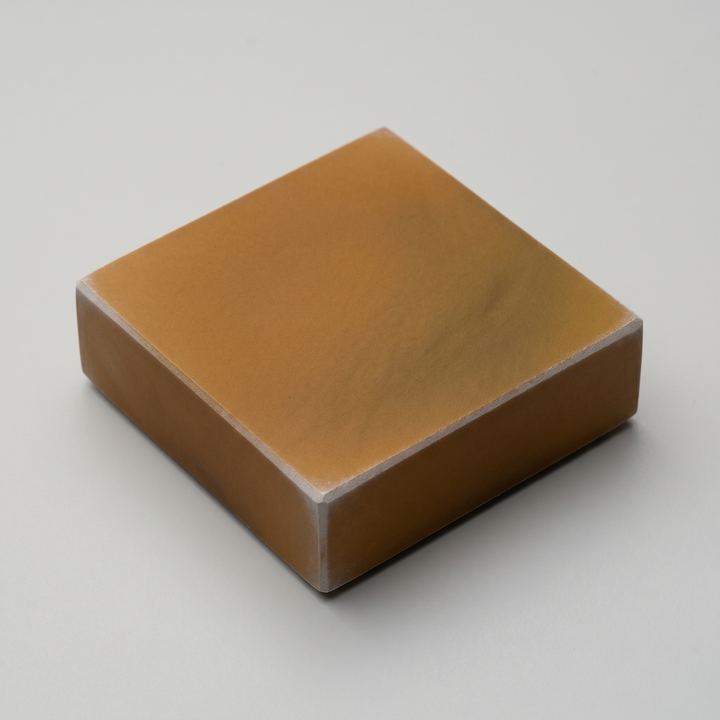
calcium silicate · cement alternativeCa12Fe5O48Si12V3 is a calcium silicate suitable as cement-alternative. Color: amber-brown. Fired at 1100°C from 4 precursors (CaCO3, SiO2, V2O5). Workshop batch: 1000g at €16.74. Compressive strength ~50 MPa; estimated 0.68 kg CO₂/kg (-19% vs Portland cement). Notable: no special functions flagged. Confidence: medium.
- forms at
- 1100 °C · high-fire
- replaces
- portland cement
- CO₂
- 18.7% lower than Portland cement (0.68 vs 0.83 kg CO₂/kg)
- energy
- 18.2% lower than Portland cement (4.50 vs 5.50 MJ/kg)
- compressive
- 50 MPa
- density
- 0.37 g/cm³
- crystal
- trigonal
- band gap
- —
- cost
- €16.74/kg · €16.74 / 1000 g batch
- confidence
- medium (synthesis route)
- potential
- 0.31 · env 0.23 · novel 0.00 · struct 0.15 · lineage 0.80 · supply 0.65
Architectural potential
A calcium-iron-vanadate silicate binder sitting in the post-Portland workshop register, with an eighteen-per-cent cut in embodied CO₂ against Portland cement at a familiar 1100 °C fire. The 50 MPa compression ceiling keeps specification within non-reinforced work: mortars, screeds, non-load-bearing slab-work, pavilion infill walls, landscape plinths, prefabricated cladding panels. The very low measured density at 0.37 g/cm³ across a 120×120×188 mm piece reads as a porous, aerated body — closer to an autoclaved aerated concrete than to a dense cement slab — so the natural placements shift toward thermally-insulating infill rather than surface mass: garden-room block, non-structural partition in retrofit housing, lightweight fçade panel behind a rainscreen, interior non-load-bearing wall in timber-framed construction. The Baubotanik-style ground plate and the light-frame landscape wall both suit this register. Against Portland cement the argument is modest but legitimate — a real carbon reduction with no change to workshop practice — and supply-chain reliance is effectively local at a score of 1.0. The caveat is the compressive ceiling: at 50 MPa the piece cannot carry reinforced structural load, and the aerated density makes surface toughness limited. Specification belongs firmly on the insulating-infill side of the concrete conversation.
Material character
The slab reads a muted amber-brown with rust undertones from the vanadium-iron content, closer to a weathered rendered wall than to a fresh cement face. At 0.37 g/cm³ in a 120×120×188 mm piece, the body is startlingly light for its bulk — an aerated, almost softwood register in the hand despite the considerable footprint, distinct from every dense cast sibling in the palette. Surface cold-pressed with fine porosity visible across the face; edges crumble slightly at the cut, closer to autoclaved aerated concrete than to a vitrified body. Fully opaque. Tapped, the body returns a soft, dull note — the characteristic acoustic of a closed-cell aerated silicate.
Recipe
1000 g batch · peak 1100 °C| element | precursor | formula | mass | safety |
|---|---|---|---|---|
| Ca | calcium carbonate / limestone | CaCO3 | 46.3 g | safe |
| Fe | iron(III) oxide (red) | Fe2O3 | 15.39 g | safe |
| Si | quartz flour / silica | SiO2 | 27.79 g | safe |
| V | vanadium pentoxide | V2O5 | 10.52 g | moderate |
- 1Ramp
- 2Hold
- 3Ramp
- 4Hold
- 6Ramp
- 7Hold