Ca₁₂O₄Si₃Sn
calcium silicate · cement alternativeCa12O4Si3Sn1 is a calcium silicate suitable as cement-alternative. Color: white-grey. Fired at 1100°C from 3 precursors (CaCO3, SiO2, SnO2). Workshop batch: 1000g at €9.98. Compressive strength ~50 MPa; estimated 0.68 kg CO₂/kg (-19% vs Portland cement). Notable: no special functions flagged. Confidence: high.
- forms at
- 1100 °C · high-fire
- replaces
- portland cement
- CO₂
- 18.7% lower than Portland cement (0.68 vs 0.83 kg CO₂/kg)
- energy
- 18.2% lower than Portland cement (4.50 vs 5.50 MJ/kg)
- compressive
- 50 MPa
- density
- 2.89 g/cm³
- crystal
- monoclinic
- band gap
- —
- cost
- €9.98/kg · €9.98 / 1000 g batch
- confidence
- high (synthesis route)
- potential
- 0.39 · env 0.23 · novel 0.00 · struct 0.15 · lineage 1.00 · supply 1.00
Architectural potential
A calcium-silicate binder with a small tin trace, offering a nineteen-per-cent cut in embodied CO₂ against Portland cement at a true workshop-scale kilogram batch. Compression sits at fifty megapascals — not a reinforced-structure body, but exactly the right register for pavilion walls, garden-architecture plinths, landscape retaining elements, non-reinforced slab toppings in retrofit floors, and prefabricated cladding panels where the load envelope is light and the environmental argument drives specification. The tectonic logic stays familiar to anyone who has placed concrete: the same pouring, the same formwork, the same trowelling; only the carbon footprint and the cost structure change. Against Portland cement the trade is clean — nineteen per cent less CO₂, eighteen per cent less firing energy, a perfect supply-chain score at 1.0, high confidence, and mature precursors (calcium carbonate, silica, tin oxide) available at industrial grade. This places the material realistically in student-run pavilion construction at ABK Stuttgart, in regional workshop production, and in small-scale retrofit carpentry where concrete is the incumbent. The caveat is that vitrification still happens at 1100 °C, so the kiln-free argument does not apply — the carbon cut comes from chemistry, not from the absence of firing, and a project has to be clear which trade it is making.
Material character
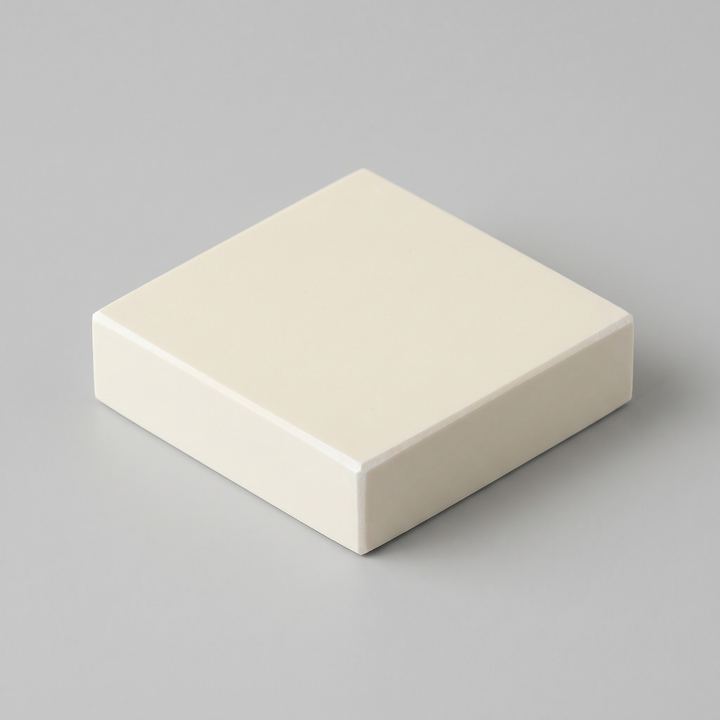
A clean white-grey body at 2.89 g/cm³ in an 85×85×48 mm slab — firms securely in two hands, a register close to a lean-mix concrete offcut of the same footprint. The tin trace gives the body a very subtle cooler undertone than a pure calcium-silicate sibling, visible only in direct side-light. Surface reads vitrified matte from the 1100 °C fire, with a quieter, less glassy finish than the potassium-fluxed calcium-silicates of the same family. Edges come cold-cut with kerf-whitening. Fully opaque. Against a Portland-cement offcut the acoustic ring is higher and cleaner when tapped, and the surface reads slightly harder under a fingernail — closer to fired stoneware than to cured concrete.
Recipe
1000 g batch · peak 1100 °C| element | precursor | formula | mass | safety |
|---|---|---|---|---|
| Ca | calcium carbonate / limestone | CaCO3 | 78.4 g | safe |
| Si | quartz flour / silica | SiO2 | 11.76 g | safe |
| Sn | tin(IV) oxide | SnO2 | 9.84 g | safe |
- 1Ramp
- 2Hold
- 3Ramp
- 4Hold
- 6Ramp
- 7Hold