Ca₁₇O₄₈P₈Si₄Sr₃
calcium phosphate · bioceramic whiteCa17O48P8Si4Sr3 is a calcium phosphate suitable as bioceramic-white. Color: white. Fired at 1100°C from 4 precursors (CaCO3, Ca3(PO4)2, SrCO3). Workshop batch: 500g at €11.69. Compressive strength ~100 MPa; estimated 0.82 kg CO₂/kg (-1% vs Portland cement). Notable: bioactive. Confidence: medium.
- forms at
- 1100 °C · high-fire
- replaces
- portland cement
- CO₂
- 0.6% lower than Portland cement (0.82 vs 0.83 kg CO₂/kg)
- energy
- matches Portland cement (5.50 MJ/kg)
- compressive
- 100 MPa
- density
- 3.14 g/cm³
- crystal
- triclinic
- band gap
- —
- cost
- €23.38/kg · €11.69 / 500 g batch
- confidence
- medium (synthesis route)
- potential
- 0.46 · env 0.01 · novel 0.80 · struct 0.20 · lineage 0.80 · supply 0.70
- flags
- bioactive: Actively hosts or supports biological activity on its surface. Bioreceptive cladding for moss and lichen, soil-contact interfaces that do not sterilise their neighbours, health-interior surfaces tuned for microbiome balance.
Architectural potential
This is a material for the living-surface register of architecture rather than for structure or envelope. Handled cold, the slab behaves like a dense sanitary-porcelain tile — rigid, chemically quiet, and indistinguishable from a high-end hospital floor. The moment it meets a biological fluid the chemistry begins: the strontium-substituted calcium-phosphate body grows a hydroxyapatite layer that integrates with bone and soft tissue rather than rejecting them. That capability points to three specific places. First, operating-theatre and dialysis-suite floor and wall tile, where a surface that tolerates aggressive cleaning and simultaneously welcomes human contact replaces today's antibacterial ceramics. Second, bioreceptive ground-level façade inserts on courtyards and soil-contact walls, where moss, lichen and rhizosphere colonisation are encouraged rather than suppressed. Third, clinical tissue-scaffolding surfaces fabricated in-house by hospital workshops using this chemistry at tile scale. It is not a building-volume material: 500 g workshop batches and only marginal CO₂ savings against Portland cement make bulk use uneconomic. The caveat is verification — the bioactive claim carries only medium confidence in the atlas and clinical certification would be a prerequisite for any medical-grade specification.
Material character
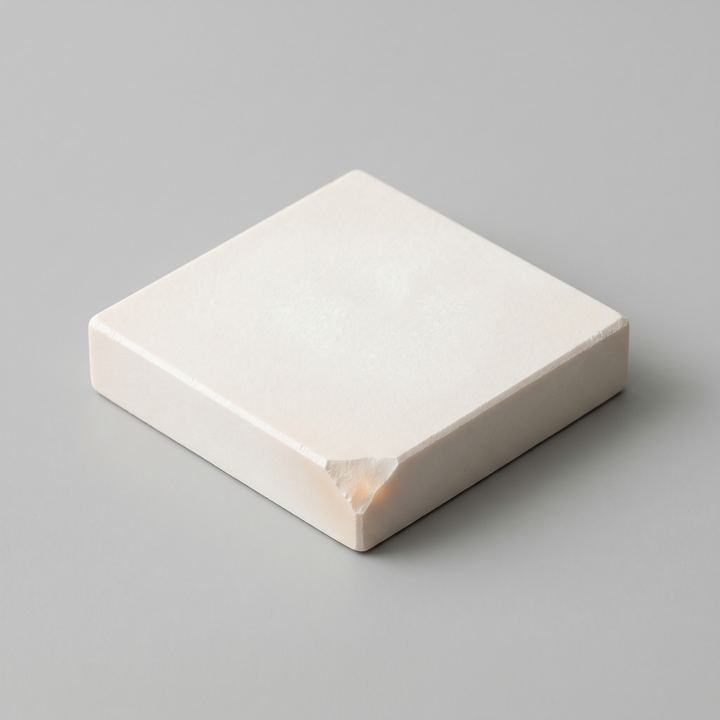
The slab reads warm pure white, closer to unglazed bone china than to modern sanitary ware, with the strontium shifting the whiteness a shade toward cream. The sintered skin is fine-grained and matte, the pore network too small to register to the eye. At 44 mm depth the body is fully opaque, but a chipped corner thins below 3 mm and admits a faint warm transmission that distinguishes this family from the sharper whites of alumina tile. Edges cold-cut, kerf whitened where diamond dust scored the saw line. Dense in the hand — heavier than window glass of the same volume and closer to a standard porcelain floor tile in both weight and acoustic ring.
Recipe
500 g batch · peak 1100 °C| element | precursor | formula | mass | safety |
|---|---|---|---|---|
| Ca | calcium carbonate / limestone | CaCO3 | 46.93 g | safe |
| P | tricalcium phosphate | Ca3(PO4)2 | 34.22 g | safe |
| Si | quartz flour / silica | SiO2 | 6.63 g | safe |
| Sr | strontium carbonate | SrCO3 | 12.22 g | safe |
- 1Ramp
- 2Hold
- 3Ramp
- 4Hold
- 5Ramp
- 6Hold
Bioactive — biocompatible, antibacterial (Cu-doped silicocarnotite)