CrFeK₂S₄
sulfide polysulfide · sulfide low tempCr1Fe1K2S4 is a sulfide polysulfide suitable as sulfide low temp. Color: yellow-orange. Fired at 130°C from 4 precursors (K2CO3, S, Fe2O3). Workshop batch: 500g at €7.48. Compressive strength ~250 MPa; estimated 0.09 kg CO₂/kg (-89% vs Portland cement). Notable: forms without a kiln. Confidence: high.
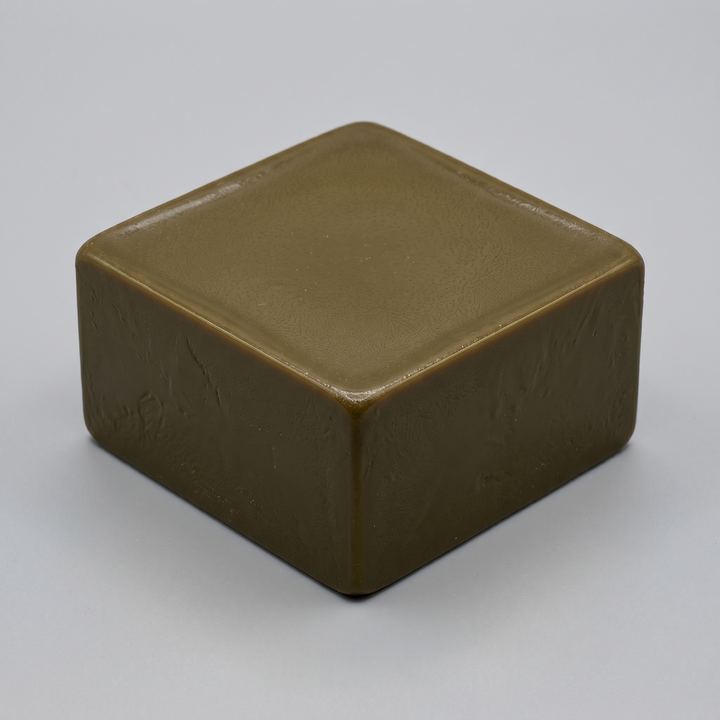
- forms at
- 130 °C · hotplate · no kiln
- replaces
- portland cement
- CO₂
- 89.1% lower than Portland cement (0.09 vs 0.83 kg CO₂/kg)
- energy
- 89.1% lower than Portland cement (0.60 vs 5.50 MJ/kg)
- compressive
- 250 MPa
- density
- 2.54 g/cm³
- crystal
- monoclinic
- band gap
- 0.00 eV
- cost
- €14.96/kg · €7.48 / 500 g batch
- confidence
- high (synthesis route)
- potential
- 0.83 · env 1.00 · novel 1.00 · struct 0.50 · lineage 0.70 · supply 0.68
- flags
- zero kiln: Forming happens without firing — the material cures through chemistry at ambient or hotplate temperature. At building scale this removes the kiln from the supply chain: on-site casting, regional workshops, cold-country fabrication all become available.
Architectural potential
A thick, light, cold-cast cement-replacement block at 250 MPa makes this material a candidate for interior load-capable partition walls and thick-slab thresholds in workshops without kiln access. The chromium-iron cross-linking of the sulfur chains lifts the compressive strength well above the polysulfide family baseline, while the potassium cation and the hotplate cure keep the slab in the zero-kiln chemistry register and preserve the eighty-nine-per-cent CO₂ advantage over Portland cement. Natural placements are interior partition walls in exhibition architecture where structural presence is wanted without a foundation upgrade; thick thresholds and sill plates in carpentry retrofits where a cement pour is impractical; interior acoustic infill slabs in recording studios and practice rooms, where the sulfide mass damps rather than reflects; and cast inlays in gallery-floor details, where the olive-brown body reads as a considered material choice rather than a compromise. The caveat is sulphide chemistry: saw-cutting releases detectable odour, the workshop needs active ventilation, and any specification for occupied or food-service interiors will need dedicated exhalation-product testing before proceeding.
Material character
The family data sheet lists the colour as yellow-orange, but in a mixed chromium-iron slab the combined d-d transitions pull the matrix into an olive-brown register with a slight green undertone where chromium dominates locally. The 250 MPa strength carries an audible signature: the slab rings slightly higher and duller than a pure polysulfide body when tapped. Surface is mold-matte with a glossier meniscus where the cast surface met air; edges as-cast, sharp at the rim. The α→β sulphur bloom is still present on the face but visually subdued by the darker matrix, reading as fine stipple under raking light rather than the clearer crystalline layer of the yellow-orange siblings.
Recipe
500 g batch · peak 130 °C| element | precursor | formula | mass | safety |
|---|---|---|---|---|
| Cr | chromium(III) oxide | Cr2O3 | 25.84 g | safe |
| Fe | iron(III) oxide (red) | Fe2O3 | 27.15 g | safe |
| K | potassium carbonate / potash | K2CO3 | 47.0 g | safe |
- Pre-heatHotplate to 150 °C
- MeltSulfur liquefies at 115 °C; full liquid at 130 °C
- CastPour at 140–145 °C
- SetRoom temperature 30 min (firm) → 24 h (full strength)
Zero-kiln process — 130 °C hotplate cast only