Ca₂Nb₂O₄₂P₁₂W₂
heavy oxide ceramic · thermal mass ceramicCa2Nb2O42P12W2 is a heavy oxide ceramic suitable as thermal mass ceramic. Color: neutral. Fired at 1250°C from 4 precursors (Ca3(PO4)2, WO3, Nb2O5). Workshop batch: 200g at €35.16. Compressive strength ~100 MPa; estimated 0.94 kg CO₂/kg (+326% vs clay brick). Notable: electrochromic tungstate. Confidence: medium.
- forms at
- 1250 °C · high-fire
- replaces
- clay brick
- CO₂
- 326% higher than clay brick (0.94 vs 0.22 kg CO₂/kg; 4.3× higher)
- energy
- 108% higher than clay brick (6.25 vs 3.00 MJ/kg; 2.1× higher)
- compressive
- 100 MPa
- density
- 3.07 g/cm³
- crystal
- triclinic
- band gap
- 2.22 eV
- cost
- €175.80/kg · €35.16 / 200 g batch
- confidence
- medium (synthesis route)
- potential
- 0.35 · env 0.00 · novel 1.00 · struct 0.20 · lineage 0.50 · supply 0.00
- flags
- electrochromic tungstate: A voltage-switchable optical chemistry. In thin-film form a small DC signal shifts transmission from clear to tinted blue, opening the door to dimmable glazing and responsive partitions that do not need mechanical shading.
Architectural potential
A thermal-mass ceramic with an electrochromic tungstate overlay, sibling to the potassium-tungstate variant but built on a calcium-niobium-phosphate backbone. The phosphate content lowers the effective firing window slightly and gives the body a slightly lighter hand-feel, but the dual function — diurnal thermal storage plus voltage-switchable tint — stays intact. Natural placements are double-skin façade infills in offices and schools where the morning-clear, afternoon-darken cycle is programmed against the solar path; trombe-wall inner faces in retrofit apartments where the wall reads from the circulation side; atrium-ceiling panels in civic buildings where the diurnal colour shift becomes part of the public reading of the space; and prototype skylight surrounds that combine radiant-heat capture with passive visual signalling. Compression at 100 MPa keeps the panel in the infill register rather than the structural one. The three-hundred-per-cent CO₂ cost against clay brick forbids any bulk use: the material is bought for the pairing of functions, and the argument is that one element replaces two separate systems. The caveat is the same pattern as its K-W sibling: €35.16 per 200 g batch, supply-chain score near zero on the tungsten content, workshop maximum of 500 g, and untested in architectural production beyond laboratory-scale prototypes. This sits in the same signature-tile register — one element per project, not a repeated envelope surface.
Material character
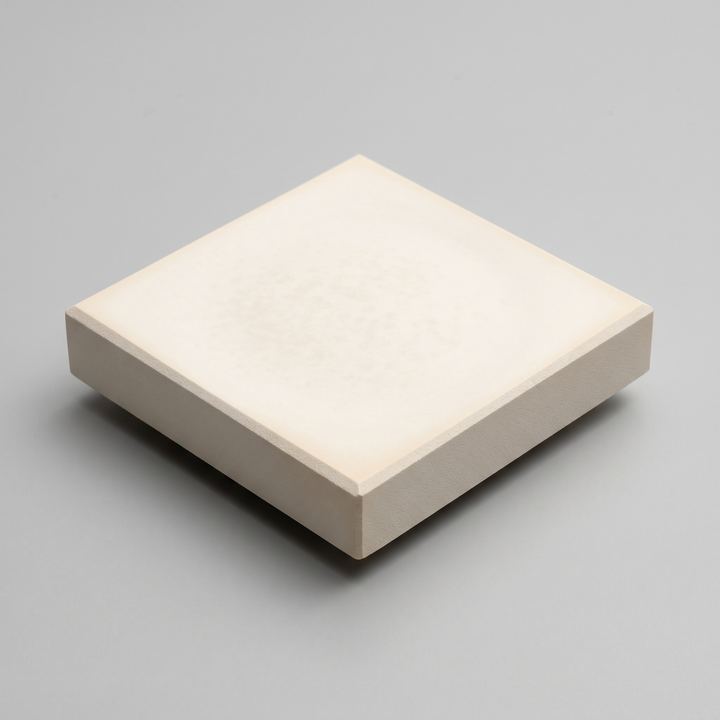
The fired body reads a neutral pale off-white with a faint cool grey undertone, lighter and cleaner than the potassium-tungstate sibling and closer to a fine porcelain in first reading. At 3.07 g/cm³ and 85×85×45 mm the slab is the thickest in the batch but handles lighter than its size suggests, a two-finger lift that reads closer to a dense fired tile than to a stone. Surface finishes vitrified-matte from the 1250 °C hold with a very fine closed grain; edges cold-cut, kerf-whitened. Under a small DC signal the face shifts to a pale slate-blue that reads more uniformly than in the potassium variant, a cleaner transition.
Recipe
200 g batch · peak 1250 °C| element | precursor | formula | mass | safety |
|---|---|---|---|---|
| Ca | calcium carbonate / limestone | CaCO3 | 7.17 g | safe |
| Nb | niobium pentoxide | Nb2O5 | 9.52 g | moderate |
| P | tricalcium phosphate | Ca3(PO4)2 | 66.69 g | safe |
| W | tungsten trioxide (yellow) | WO3 | 16.61 g | moderate |
- 1Ramp
- 2Hold
- 3Ramp
- 4Ramp
- 5Hold
- 6Ramp
- 7Ramp
Electrochromic — color switches under applied voltage (thin-film chemistry)