AlO₂₄Se₈VZr₂
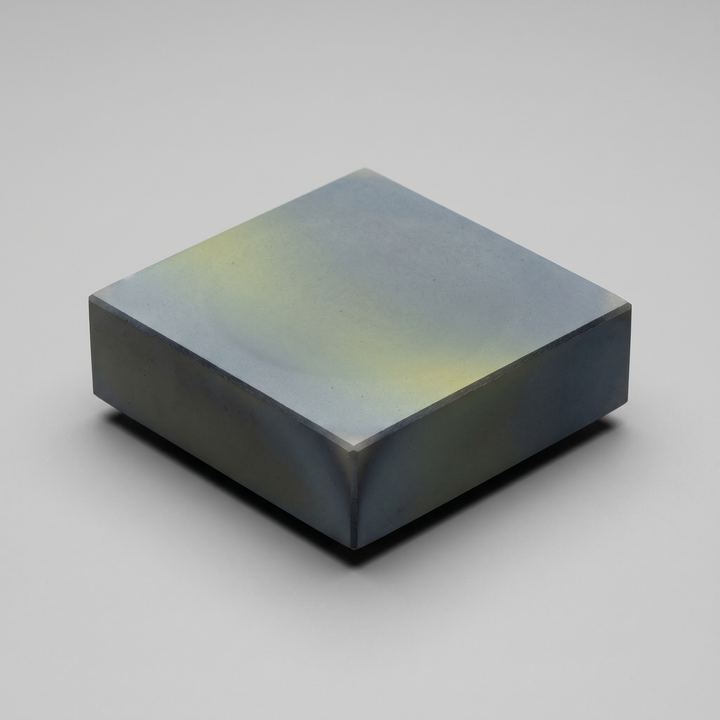
heavy oxide ceramic · thermal mass ceramicAl1O24Se8V1Zr2 is a heavy oxide ceramic suitable as thermal mass ceramic. Color: grey-blue. Fired at 1250°C from 4 precursors (Se, ZrO2, V2O5). Workshop batch: 200g at €8.82. Compressive strength ~300 MPa; estimated 0.94 kg CO₂/kg (+326% vs clay brick). Notable: visible absorber. Confidence: medium.
- forms at
- 1250 °C · high-fire
- replaces
- clay brick
- CO₂
- 326% higher than clay brick (0.94 vs 0.22 kg CO₂/kg; 4.3× higher)
- energy
- 108% higher than clay brick (6.25 vs 3.00 MJ/kg; 2.1× higher)
- compressive
- 300 MPa
- density
- 3.61 g/cm³
- crystal
- triclinic
- band gap
- 1.56 eV
- cost
- €44.10/kg · €8.82 / 200 g batch
- confidence
- medium (synthesis route)
- potential
- 0.28 · env 0.00 · novel 0.46 · struct 0.60 · lineage 0.50 · supply 0.00
- flags
- visible absorber: A real-colour solar-gain control layer. Where the body takes visible light into itself rather than reflecting it, the material becomes a selective heat collector — useful on thermal-mass walls, absorber panels, and warm-toned cladding.
Architectural potential
An aluminium-selenium-vanadium-zirconium heavy-oxide ceramic fired at 1250 °C, carrying an unusual 300 MPa of compression for its family and the visible-absorber flag. Three hundred megapascals lifts it out of the decorative register and into load-capable territory — a compressive performance a clay brick cannot approach, carried in a body designed to soak up solar gain rather than reflect it. The CO₂ runs more than four times that of clay brick, so the argument is thermal capture plus compression rather than environmental replacement. Natural placements are south-facing trombe-wall infill blocks where the grey-blue body is wanted as a visible thermal absorber, hypocaust floor-slab elements carrying passive solar heat into radiant release, thick thermal-mass courses in entry vestibules facing east or south, and bracket-stones in landscape architecture where compression and heat-battery behaviour are both desired. The 85×85×38 mm slab format and 500 g workshop ceiling keep specification at the single-element or small-run scale. The caveat is the selenium fraction: Se is both a supply-chain bottleneck (the score sits at zero) and a workshop-safety concern — peak firing has to happen in a well-ventilated kiln, with off-gas handling rather than open-air exhaust.
Material character
The slab reads a cool grey-blue with the muted mineral register of a heavy-oxide body rather than the saturated colour of a glass absorber. At 3.61 g/cm³ in an 85×85×38 mm format the piece takes a deliberate two-handed lift, noticeably lighter than the bismuth and tungsten siblings of the same family and closer to a fired stoneware paver in hand-feel. Surface vitrified matte from the 1250 °C fire; edges cold-cut, the kerf powder pale against the grey-blue body. A 1.56 eV absorption edge sits well below the visible band, so the body takes solar gain into itself in the expected visible-absorber way. Against the bismuth-yellow thermal-mass sibling the colour shift is complete.
Recipe
200 g batch · peak 1250 °C| element | precursor | formula | mass | safety |
|---|---|---|---|---|
| Al | calcined alumina | Al2O3 | 5.0 g | safe |
| Se | selenium (elemental) | Se | 61.93 g | moderate |
| V | vanadium pentoxide | V2O5 | 8.91 g | moderate |
| Zr | zirconium dioxide | ZrO2 | 24.16 g | safe |
- 1Ramp
- 2Hold
- 3Ramp
- 4Ramp
- 5Hold
- 6Ramp
- 7Ramp
Visible absorber — saturated color from bandgap in the visible range