Ca₄Co₂Fe₂O₁₆Si₄
calcium silicate · cement alternativeCa4Co2Fe2O16Si4 is a calcium silicate suitable as cement-alternative. Color: blue. Fired at 1100°C from 4 precursors (CaCO3, SiO2, CoO). Workshop batch: 1000g at €42.51. Compressive strength ~50 MPa; estimated 0.68 kg CO₂/kg (-19% vs Portland cement). Notable: no special functions flagged. Confidence: medium.
- forms at
- 1100 °C · high-fire
- replaces
- portland cement
- CO₂
- 18.7% lower than Portland cement (0.68 vs 0.83 kg CO₂/kg)
- energy
- 18.2% lower than Portland cement (4.50 vs 5.50 MJ/kg)
- compressive
- 50 MPa
- density
- 0.35 g/cm³
- crystal
- monoclinic
- band gap
- 2.77 eV
- cost
- €42.51/kg · €42.51 / 1000 g batch
- confidence
- medium (synthesis route)
- potential
- 0.31 · env 0.23 · novel 0.00 · struct 0.15 · lineage 0.80 · supply 0.65
Architectural potential
A cobalt-iron-modified calcium silicate fired at 1100 °C, 50 MPa, with a recorded density of 0.35 g/cm³ that flags the piece as a porous or foamed cast rather than a dense binder. Against Portland cement the embodied CO₂ is down eighteen per cent and energy down eighteen per cent, so the environmental argument is genuine though modest. At 50 MPa the piece sits firmly in the non-reinforced non-structural-topping register: pavilion wall infill panels, landscape retaining-wall blocks in garden rooms, floor screeds in retrofit carpentry over timber sub-floors, prefabricated cladding panels on light steel-frame additions, and cast plinths for outdoor sculpture. The cobalt-iron colouring is the specification difference — the client is buying a blue calcium-silicate binder for visible cast work rather than a plain grey one, which suits work where the binder is the finish and no render goes over it. The caveat is cost: €42.51 per 1 kg workshop batch brings the cobalt load into play at binder scale, an order of magnitude more than the plain white-grey sibling, and the low recorded density suggests a foamed or air-entrained mix that needs verification for exterior freeze-thaw work before any exposed landscape use.
Material character
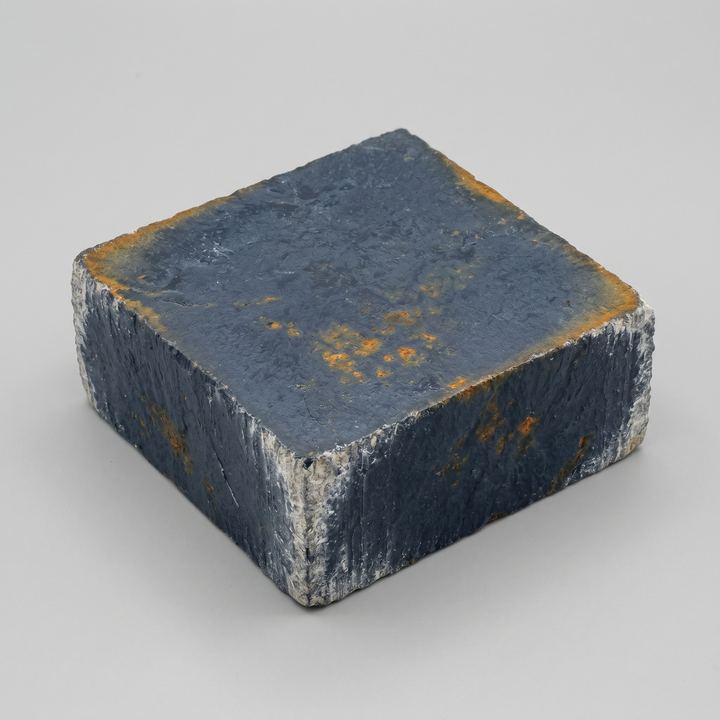
A saturated deep cobalt blue carried by the calcium-silicate matrix, reading more muted than a cobalt-blue soda-lime glass but clearly more saturated than a conventional pigmented concrete — the iron co-doping warms the blue slightly into a sea-green direction under raking light. At 0.35 g/cm³ and 120×120×197 mm the slab firms single-handed — a softwood register despite its block-sized footprint, the weight telling of a porous or foamed cast. Surface cold-pressed chalky, typical of ambient and low-fire calcium-silicate bodies; edges cold-cut, kerf whitened with carbonation powder. Fully opaque through its depth. Distinctly cooler in colour and noticeably lighter in the hand than the neutral Ca9Ce1O1Si6 sibling of the same family.
Recipe
1000 g batch · peak 1100 °C| element | precursor | formula | mass | safety |
|---|---|---|---|---|
| Ca | calcium carbonate / limestone | CaCO3 | 42.13 g | safe |
| Co | cobalt(II) oxide | CoO | 15.77 g | moderate |
| Fe | iron(III) oxide (red) | Fe2O3 | 16.81 g | safe |
| Si | quartz flour / silica | SiO2 | 25.29 g | safe |
- 1Ramp
- 2Hold
- 3Ramp
- 4Hold
- 6Ramp
- 7Hold