B₄Fe₈O₂₈P₄Sr₄
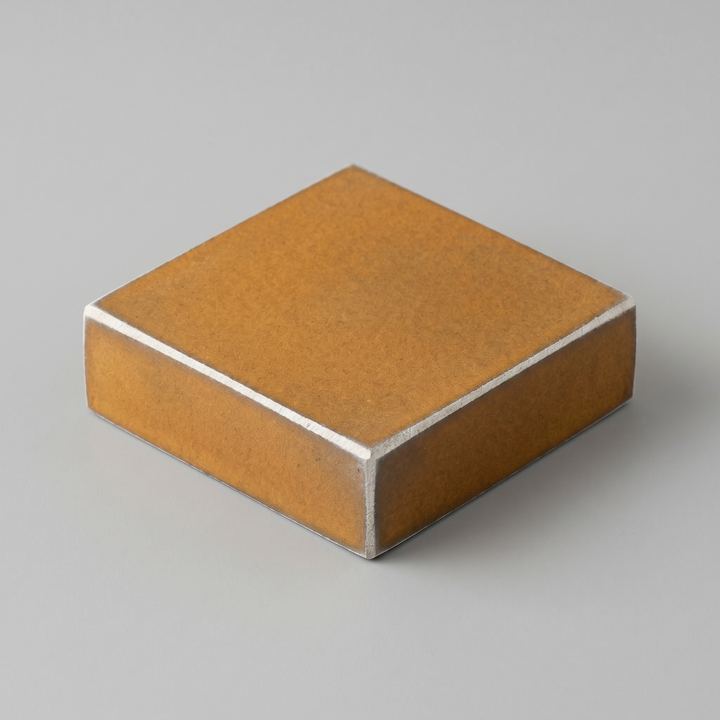
iron oxide ceramic · structural ceramicB4Fe8O28P4Sr4 is a iron oxide ceramic suitable as structural-ceramic. Color: amber-brown. Fired at 1100°C from 4 precursors (Ca3(PO4)2, SrCO3, Fe2O3). Workshop batch: 1000g at €22.80. Compressive strength ~100 MPa; estimated 0.79 kg CO₂/kg (+258% vs clay brick). Notable: magnetic ferrite. Confidence: medium.
- forms at
- 1100 °C · high-fire
- replaces
- clay brick
- CO₂
- 258% higher than clay brick (0.79 vs 0.22 kg CO₂/kg; 3.6× higher)
- energy
- 75% higher than clay brick (5.25 vs 3.00 MJ/kg; 1.8× higher)
- compressive
- 100 MPa
- density
- 4.00 g/cm³
- crystal
- monoclinic
- band gap
- —
- cost
- €22.80/kg · €22.80 / 1000 g batch
- confidence
- medium (synthesis route)
- potential
- 0.20 · env 0.00 · novel 0.30 · struct 0.30 · lineage 0.50 · supply 0.00
- flags
- magnetic ferrite: Permanent-magnetic behaviour embedded in the material itself. Hardware-free fastening, mountable tile surfaces, reconfigurable partitions that hold by magnetism — a niche but specific tectonic opening.
Architectural potential
The architectural register for this strontium-substituted iron-phosphate ferrite is magnetic-hardware-free wall construction at interior scale. The composition is a room-temperature magnetic ceramic — it deflects a small compass needle from a few centimetres away and registers unambiguously on a magnetometer, though it does not pick up casual ferrous objects. That changes the detail logic of a partition wall: mounting points come free of screws, reconfigurable interior panels latch magnetically to a base plate, and display walls in retail and exhibition can be re-planned without leaving fastener scars. Natural placements are gallery walls that accept magnetic-backed artwork directly without additional rail or hook systems, hospital-ward partitions that reconfigure overnight, retail and trade-fair interior surfaces intended to rehost content in days rather than weeks, and product-showcase plinths whose support rods click into place without tooling. The CO₂ balance — 258 % of fired clay brick — means this is never a bulk block. The caveat is the magnetic strength itself: at this composition the field is weak, strong enough to hold tile-scale inserts but not strong enough to support loads much above a few hundred grams per square decimetre without an added steel backing.
Material character
The face reads a warm amber with a faint cool cast that comes from the strontium in the matrix rather than from any glaze or surface treatment. Skin matte and vitrified, edges cold-cut with the usual kerf-whitening from the diamond saw. At 4.00 g/cm³ and 85×85×35 mm the slab is slightly heavier than an equivalent un-doped iron oxide ceramic. The magnetic behaviour is entirely invisible in the ambient image — a companion shot with a compass, or iron filings on top of the slab, is the only way to record the functional property, which is the reason the recipe card asks for both photographs.
Recipe
1000 g batch · peak 1100 °C| element | precursor | formula | mass | safety |
|---|---|---|---|---|
| B | boron oxide (or borax Na2B4O7) | B2O3 | 7.0 g | safe |
| Fe | iron(III) oxide (red) | Fe2O3 | 32.12 g | safe |
| P | tricalcium phosphate | Ca3(PO4)2 | 31.19 g | safe |
| Sr | strontium carbonate | SrCO3 | 29.69 g | safe |
- 1Ramp
- 2Hold
- 3Ramp
- 4Hold
- 6Ramp
- 7Hold
Magnetic — room-temperature magnetism from ferrite phase