Ca₄K₄O₁₈Si₆
calcium silicate · cement alternativeCa4K4O18Si6 is a calcium silicate suitable as cement-alternative. Color: white-grey. Fired at 1100°C from 3 precursors (CaCO3, SiO2, K2CO3). Workshop batch: 1000g at €6.37. Compressive strength ~500 MPa; estimated 0.68 kg CO₂/kg (-19% vs Portland cement). Notable: no special functions flagged. Confidence: high.
- forms at
- 1100 °C · high-fire
- replaces
- portland cement
- CO₂
- 18.7% lower than Portland cement (0.68 vs 0.83 kg CO₂/kg)
- energy
- 18.2% lower than Portland cement (4.50 vs 5.50 MJ/kg)
- compressive
- 500 MPa
- density
- 2.46 g/cm³
- crystal
- monoclinic
- band gap
- 4.11 eV
- cost
- €6.37/kg · €6.37 / 1000 g batch
- confidence
- high (synthesis route)
- potential
- 0.52 · env 0.23 · novel 0.00 · struct 1.00 · lineage 1.00 · supply 1.00
Architectural potential
This is the atlas's most serious candidate for a cement-replacement at real structural scale. Five hundred megapascals of compressive strength paired with an eighteen-per-cent cut in embodied CO₂ over Portland cement puts it directly into the conversation with concrete, not merely with render or mortar. At workshop batch size — a full kilogram, scalable to five — panel-work and non-reinforced slab-work are already feasible: prefab cladding panels, thermal-wall infills, floor screeds in retrofit, and site-cast foundation plinths for landscape architecture. Because the binder is wollastonite-type rather than Portland, the pouring logic and formwork stay familiar to anyone who has placed concrete, but the fire that accelerates the carbonation reaction in service is absent. Architecturally this is the low-CO₂ pavilion wall, the garden-room block, the Baubotanik-style ground plate where reinforcement is minimal and compression is the dominant load. The caveat is thermal: vitrification happens at 1100 °C, so the kiln-free argument does not apply. Against a fully ambient binder this material trades embodied energy for structural performance, and a project has to be clear which trade it is making.
Material character
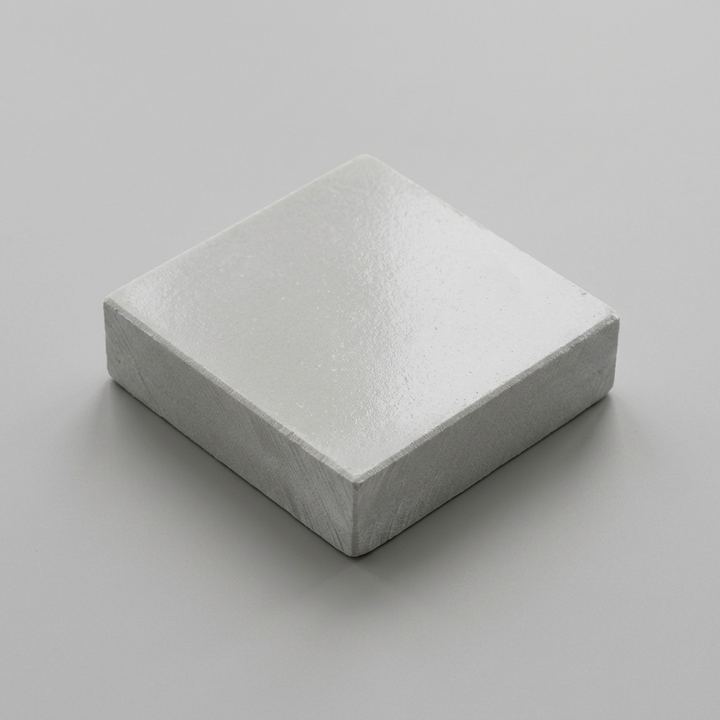
The slab reads a clean neutral white-grey with a barely perceptible warm cast from iron impurities in the potassium-feldspar precursor. The potassium flux drives the 1100 °C fire further than a pure calcium-silicate body would go: the skin finishes vitrified and glassy-matte, edging toward a partial glaze without ever crossing into full melt. Fully opaque through the 41 mm depth. Edges cold-cut, kerf-whitened. The slab is noticeably denser and firmer than un-fluxed wollastonite siblings and rings high and clean when tapped, a different acoustic signature from either Portland concrete or conventional fired brick.
Recipe
1000 g batch · peak 1100 °C| element | precursor | formula | mass | safety |
|---|---|---|---|---|
| Ca | calcium carbonate / limestone | CaCO3 | 38.6 g | safe |
| K | potassium carbonate / potash | K2CO3 | 26.65 g | safe |
| Si | quartz flour / silica | SiO2 | 34.75 g | safe |
- 1Ramp
- 2Hold
- 3Ramp
- 4Hold
- 6Ramp
- 7Hold