Ca₄O₁₂Sm₂V₂
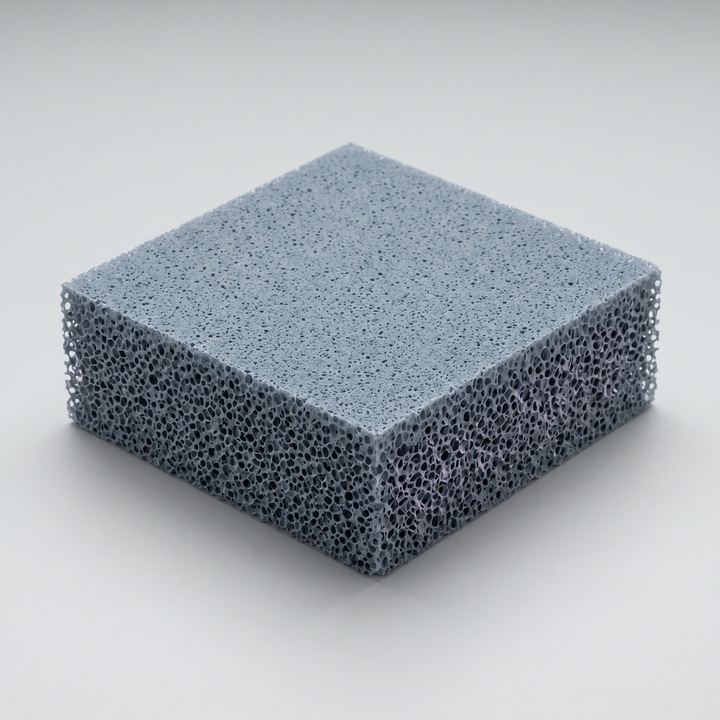
rare earth oxide · rare earth ceramicCa4O12Sm2V2 is a rare earth oxide suitable as rare earth ceramic. Color: grey-blue. Fired at 1200°C from 3 precursors (CaCO3, Sm2O3, V2O5). Workshop batch: 100g at €21.00. Compressive strength ~100 MPa; estimated 0.90 kg CO₂/kg (+309% vs clay brick). Notable: uv luminescent, visible absorber. Confidence: medium.
- forms at
- 1200 °C · high-fire
- replaces
- clay brick
- CO₂
- 309% higher than clay brick (0.90 vs 0.22 kg CO₂/kg; 4.1× higher)
- energy
- 100% higher than clay brick (6.00 vs 3.00 MJ/kg; 2.0× higher)
- compressive
- 100 MPa
- density
- 0.42 g/cm³
- crystal
- orthorhombic
- band gap
- 2.44 eV
- cost
- €210.00/kg · €21.00 / 100 g batch
- confidence
- medium (synthesis route)
- potential
- 0.37 · env 0.00 · novel 1.00 · struct 0.20 · lineage 0.50 · supply 0.10
- flags
- uv luminescent: Converts invisible ultraviolet into visible light. Signage panels, low-energy wayfinding tiles, emergency markings that draw their illumination from daylight rather than mains power. visible absorber: A real-colour solar-gain control layer. Where the body takes visible light into itself rather than reflecting it, the material becomes a selective heat collector — useful on thermal-mass walls, absorber panels, and warm-toned cladding.
Architectural potential
A samarium-vanadium calcium oxide in the functional-overlay ceramic register, carrying both UV-luminescent conversion and real-colour solar-gain absorption — a dual functional chemistry on one body. At 100 MPa and embodied CO₂ four times that of a fired clay brick, this is explicitly a functional-overlay material, not a volume element. Natural placements are south-facing absorber-panel inserts where the body takes visible light into itself and warms thermal-mass backings, accent cladding plaques that also emit under ambient daylight UV, warm-toned tile patches in thermal-wall compositions, and signage elements at named building moments. The 300 g workshop ceiling and the 0.14 supply-chain score keep the specification at patch scale. Against its rare-earth siblings the combined visible-absorber plus luminescent chemistry makes this the candidate where the design wants both a solar-thermal collecting surface and a UV-driven signal from the same tile. The caveat is the density figure: at 0.425 g/cm³ over a 120×120×163 mm slab the body is clearly under-densified — a porous or foamed variant rather than a fully sintered piece — which pulls the 100 MPa number into the upper-bound register and demands verification before any specification where compression matters.
Material character
The 120×120×163 mm slab reads a cool grey-blue dominated by the vanadium-oxide matrix, with faint warm flashes at the shadow edges where samarium contributes a subtle pink cast. Under 365 nm excitation the face lifts into a peach-orange glow against the slate body — a complex two-register colour, warm emission over cool ground. Surface is sintered matte with visible inter-particle porosity from the under-densified fire; edges cold-cut with a coarser-than-usual kerf. At 0.425 g/cm³ and this size the slab lifts surprisingly easily — a softwood-register weight in the hand, distinctly lighter than any of the dense rare-earth siblings in the palette.
Recipe
100 g batch · peak 1200 °C| element | precursor | formula | mass | safety |
|---|---|---|---|---|
| Ca | calcium carbonate / limestone | CaCO3 | 43.01 g | safe |
| Sm | samarium oxide | Sm2O3 | 37.46 g | moderate |
| V | vanadium pentoxide | V2O5 | 19.54 g | moderate |
- 1Ramp
- 2Hold
- 3Ramp
- 4Ramp
- 5Hold
- 6Ramp
- 7Ramp
UV-luminescent — emits visible light under 365 nm UV
Visible absorber — saturated color from bandgap in the visible range