Ca₆Fe₂O₁₆Si₄
calcium silicate · cement alternativeCa6Fe2O16Si4 is a calcium silicate suitable as cement-alternative. Color: amber-brown. Fired at 1100°C from 3 precursors (CaCO3, SiO2, Fe2O3). Workshop batch: 1000g at €3.63. Compressive strength ~50 MPa; estimated 0.68 kg CO₂/kg (-19% vs Portland cement). Notable: no special functions flagged. Confidence: high.
- forms at
- 1100 °C · high-fire
- replaces
- portland cement
- CO₂
- 18.7% lower than Portland cement (0.68 vs 0.83 kg CO₂/kg)
- energy
- 18.2% lower than Portland cement (4.50 vs 5.50 MJ/kg)
- compressive
- 50 MPa
- density
- 0.32 g/cm³
- crystal
- monoclinic
- band gap
- 3.53 eV
- cost
- €3.63/kg · €3.63 / 1000 g batch
- confidence
- high (synthesis route)
- potential
- 0.39 · env 0.23 · novel 0.00 · struct 0.15 · lineage 1.00 · supply 0.95
Architectural potential
A profoundly low-density iron-doped calcium-silicate binder at 0.317 g/cm³, behaving architecturally as an insulating foam-block rather than as a cast cement tile. At 50 MPa the compression register is firmly non-structural, and the amber-brown colour comes from the iron loading rather than from any pigment addition. Natural placements are insulating block cores in retrofit partition walls, lightweight block-work for interior room divisions, acoustic-absorbing wall cores in studio and concert-hall interiors, stair-soffit infill pieces where weight matters, and backing blocks behind heavier cladding. The 120×120×219 mm slab gives a meaningful block-scale piece — larger than most cast cement samples — which matters when the architectural specification is block-and-render rather than tile-and-inlay. Against Portland cement the CO₂ cut is eighteen per cent and the energy cut eighteen per cent; more importantly, at this density each cast block displaces ten times its weight in conventional concrete. The caveat is mechanical: at 0.317 g/cm³ the block cannot carry direct-hand-contact surfaces without a facing material, and saw-cutting produces a fine siliceous dust that requires wet-cut tooling. The 1100 °C kiln still sits in the supply chain, so the low-energy argument is not absolute.
Material character
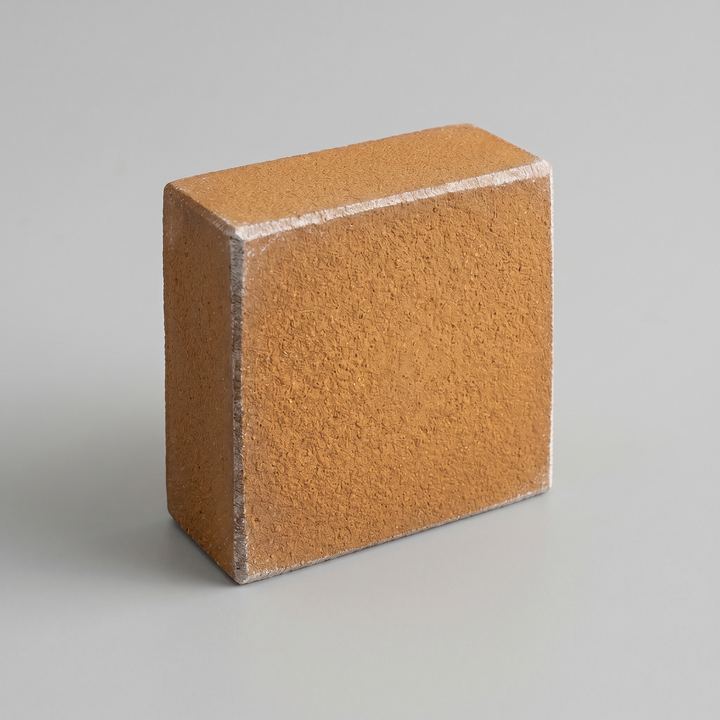
An amber-brown body carrying the iron loading as a warm earthen tone — closer to terracotta than to Portland, but lighter in colour-depth. At 0.317 g/cm³ and a 120×120×219 mm volume the block is extraordinarily light for its size, softwood register, one-handed lift despite the 3-litre volume. Surface reads cold-pressed chalky with an open-pore texture visible at the face; edges feather easily under thumbnail pressure. Tap response is dull and papery. Against a standard Portland concrete block of equivalent footprint the piece is roughly a twelfth of the weight, and the amber cast reads warmer than any grey-cement sibling in the palette.
Recipe
1000 g batch · peak 1100 °C| element | precursor | formula | mass | safety |
|---|---|---|---|---|
| Ca | calcium carbonate / limestone | CaCO3 | 60.02 g | safe |
| Fe | iron(III) oxide (red) | Fe2O3 | 15.96 g | safe |
| Si | quartz flour / silica | SiO2 | 24.02 g | safe |
- 1Ramp
- 2Hold
- 3Ramp
- 4Hold
- 6Ramp
- 7Hold