MgO₁₂Pr₄V₃
rare earth oxide · rare earth ceramicMg1O12Pr4V3 is a rare earth oxide suitable as rare earth ceramic. Color: grey-blue. Fired at 1200°C from 3 precursors (Pr6O11, V2O5, MgCO3). Workshop batch: 100g at €32.57. Compressive strength ~100 MPa; estimated 0.90 kg CO₂/kg (+309% vs clay brick). Notable: thermochromic VO2. Confidence: medium.
- forms at
- 1200 °C · high-fire
- replaces
- clay brick
- CO₂
- 309% higher than clay brick (0.90 vs 0.22 kg CO₂/kg; 4.1× higher)
- energy
- 100% higher than clay brick (6.00 vs 3.00 MJ/kg; 2.0× higher)
- compressive
- 100 MPa
- density
- 6.26 g/cm³
- crystal
- triclinic
- band gap
- 0.92 eV
- cost
- €325.70/kg · €32.57 / 100 g batch
- confidence
- medium (synthesis route)
- potential
- 0.34 · env 0.00 · novel 0.90 · struct 0.20 · lineage 0.50 · supply 0.10
- flags
- thermochromic VO2: Passive thermal-optical switching: transmission shifts near 68 °C without any driving signal. At building scale this gives a window that darkens as it heats, reducing solar gain without wiring or sensors.
Architectural potential
A praseodymium-vanadium-magnesium ceramic fired at 1200 °C, reaching 100 MPa at 6.26 g/cm³ — a dense but non-structural rare-earth body. The key capability is the vanadium-dioxide thermochromic transition: above sixty-eight degrees Celsius the V-site flips from semiconductor to metal and the surface darkens visibly; below it, the body clears again. In practice this is a passive solar-gain control surface that needs no wiring. Natural placements are south-facing glazing-adjacent tile patches in conservatories that darken during peak afternoon heat, skylight-perimeter tiles in atrium roofs that self-regulate thermal transmission, and external thermal-wall absorber inserts where the darkening cycle tracks the solar day. Praseodymium adds a secondary optical register — a faint colour-shift under different daylight temperatures — but the thermochromic behaviour is the architectural argument. Supplements conventional ceramic cladding; substitutes for motorised external blinds. Untested at envelope-run scale; the vanadium-dioxide transition cycles reliably in laboratory samples but long-term architectural fatigue is unverified past a decade. The caveat is cost and supply: €32.57 per 100 g batch, a 300 g workshop ceiling, supply-chain score at 0.14, and embodied CO₂ three hundred and nine per cent above clay brick. Specification belongs in the signature-patch register, not the cladding run.
Material character
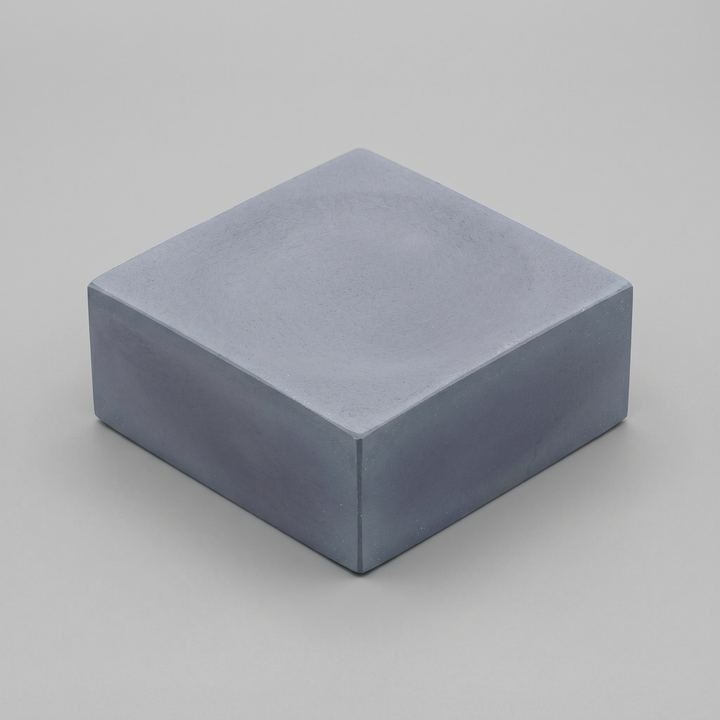
The face carries a grey-blue ground from the vanadium content, softened by a praseodymium lavender undertone that shifts register between daylight and tungsten illumination. At 6.26 g/cm³ in a 70×70×33 mm block the slab sits close in weight to the erbium-tungstate sibling from the same family — firmly two-handed, close to a dense architectural stone. Surface vitrified matte from the 1200 °C fire; edges cold-cut, carrying the diamond-kerf bloom. The at-rest colour is what the sample shows; the darkened above-transition state belongs in a heated companion image. Lower-ringing than the pure rare-earth siblings when tapped, the vanadium content damping the acoustic response.
Recipe
100 g batch · peak 1200 °C| element | precursor | formula | mass | safety |
|---|---|---|---|---|
| Mg | magnesium carbonate | MgCO3 | 8.12 g | safe |
| Pr | praseodymium oxide | Pr6O11 | 65.6 g | moderate |
| V | vanadium pentoxide | V2O5 | 26.28 g | moderate |
- 1Ramp
- 2Hold
- 3Ramp
- 4Ramp
- 5Hold
- 6Ramp
- 7Ramp
Thermochromic — VO₂ metal-insulator switch at ~68 °C