Ca₆O₁₆Si₄V₂
calcium silicate · cement alternativeCa6O16Si4V2 is a calcium silicate suitable as cement-alternative. Color: white-grey. Fired at 1100°C from 3 precursors (CaCO3, SiO2, V2O5). Workshop batch: 1000g at €28.29. Compressive strength ~50 MPa; estimated 0.68 kg CO₂/kg (-19% vs Portland cement). Notable: visible absorber. Confidence: high.
- forms at
- 1100 °C · high-fire
- replaces
- portland cement
- CO₂
- 18.7% lower than Portland cement (0.68 vs 0.83 kg CO₂/kg)
- energy
- 18.2% lower than Portland cement (4.50 vs 5.50 MJ/kg)
- compressive
- 50 MPa
- density
- 3.12 g/cm³
- crystal
- monoclinic
- band gap
- 2.19 eV
- cost
- €28.29/kg · €28.29 / 1000 g batch
- confidence
- high (synthesis route)
- potential
- 0.46 · env 0.23 · novel 0.46 · struct 0.15 · lineage 0.70 · supply 1.00
- flags
- visible absorber: A real-colour solar-gain control layer. Where the body takes visible light into itself rather than reflecting it, the material becomes a selective heat collector — useful on thermal-mass walls, absorber panels, and warm-toned cladding.
Architectural potential
This is a low-CO₂ calcium-silicate binder with vanadium-driven visible-absorber chemistry, 50 MPa of compression and a 19 per cent cut in embodied CO₂ against Portland cement. The compression figure places it in the binder-alternative register rather than the reinforced-structural one: thin prefab cladding panels, floor-topping screeds in retrofit, non-reinforced landscape walls, pavilion-scale garden rooms, and thermal-wall infills where the V-driven absorption turns the wall itself into a passive solar collector. Natural placements are south-facing thermal-wall infill blocks in passive-solar housing, warm-toned cladding panels on office and cultural buildings where the body's visible absorption does double service as a heat-collection layer, and floor-topping screeds in sunlit day-lit workshops. The visible-absorber behaviour adds a functional register on top of the carbon argument: not just a cleaner Portland, but a wall that works thermally. Against Portland cement the pouring and formwork logic stay familiar, so workshop workflows transfer directly. The caveat is thermal: firing happens at 1100 °C, so the kiln-free argument does not apply, and the CO₂ saving is delivered through chemistry rather than through ambient cure. High confidence and clean supply-chain and safety scores make the specification straightforward at pavilion and retrofit scale.
Material character
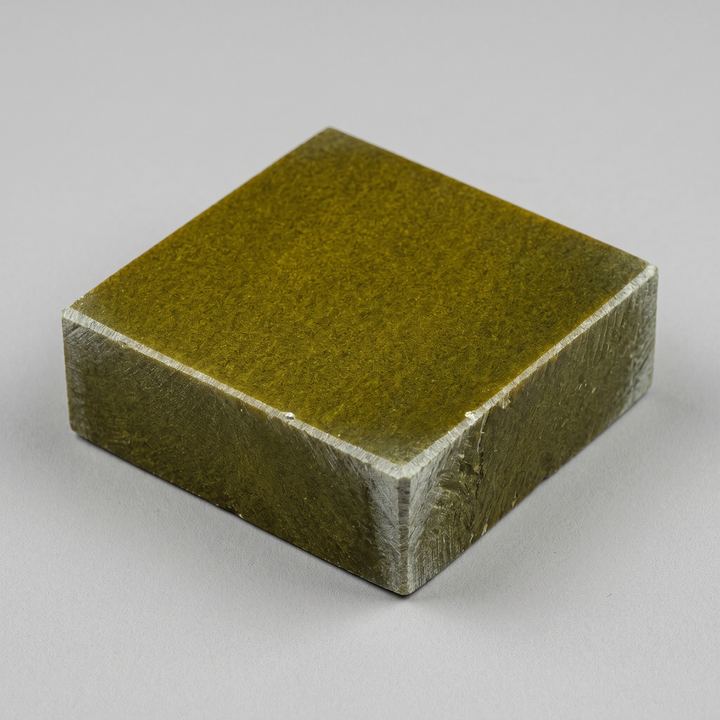
The slab reads a warm white-grey body with a subtle yellow-olive undertone from the vanadium content, distinct from the cooler neutral grey of the unadditived calcium-silicates. At 3.12 g/cm³ and 85×85×44 mm the piece sits comfortably for a two-hand lift, slightly denser than ordinary Portland concrete for the same volume. Skin finishes vitrified and glassy-matte from the 1100 °C fire, a tighter surface than ambient-cured concrete ever develops; edges cold-cut, kerf-whitened. Against Portland the tap-tone rings higher and cleaner, and the body under raking sun warms visibly — a hint of the absorber behaviour emerging as colour-depth rather than as temperature.
Recipe
1000 g batch · peak 1100 °C| element | precursor | formula | mass | safety |
|---|---|---|---|---|
| Ca | calcium carbonate / limestone | CaCO3 | 58.72 g | safe |
| Si | quartz flour / silica | SiO2 | 23.5 g | safe |
| V | vanadium pentoxide | V2O5 | 17.78 g | moderate |
- 1Ramp
- 2Hold
- 3Ramp
- 4Hold
- 6Ramp
- 7Hold
Visible absorber — saturated color from bandgap in the visible range