CoK₂O₈Si₃
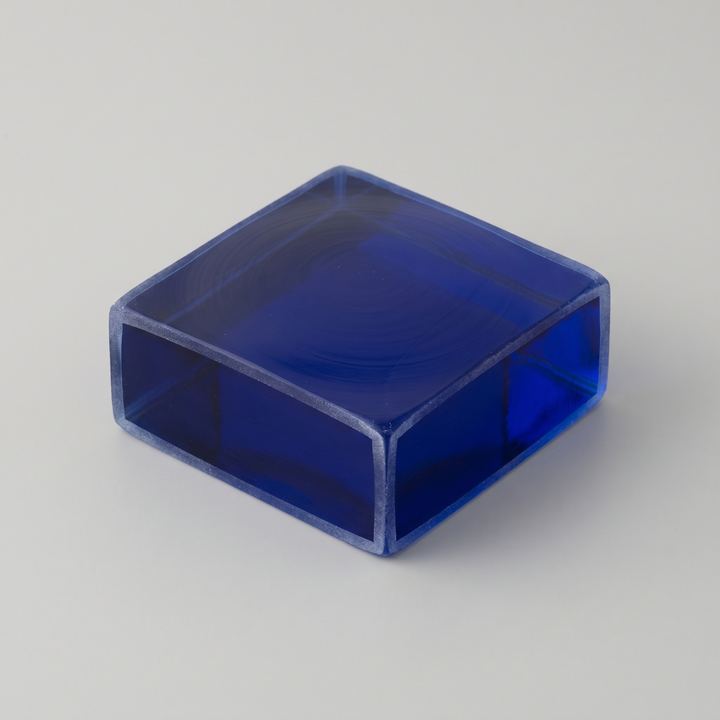
alkali silicate glass · structural translucent glassCo1K2O8Si3 is a alkali silicate glass suitable as structural translucent glass. Color: blue. Fired at 1150°C from 4 precursors (SiO2, K2CO3, CoO). Workshop batch: 400g at €19.58. Compressive strength ~500 MPa; estimated 0.84 kg CO₂/kg (-2% vs float glass). Notable: no special functions flagged. Confidence: high.
- forms at
- 1150 °C · high-fire
- replaces
- float glass
- CO₂
- 1.9% lower than float glass (0.84 vs 0.86 kg CO₂/kg)
- energy
- 62.5% lower than float glass (5.62 vs 15.00 MJ/kg)
- compressive
- 500 MPa
- density
- 2.73 g/cm³
- crystal
- triclinic
- band gap
- 3.12 eV
- cost
- €48.95/kg · €19.58 / 400 g batch
- confidence
- high (synthesis route)
- potential
- 0.68 · env 0.78 · novel 0.00 · struct 1.00 · lineage 1.00 · supply 1.00
Architectural potential
This is a load-bearing transparent glass with a deep cobalt-blue body, 500 MPa of compression delivered with a saturated chromatic register that reads immediately as pigment-depth rather than tint. Natural placements are structural stair treads in civic and ecclesiastical architecture where the blue carries liturgical and institutional weight, pressed-glass floor panels in museum and exhibition interiors where a signal colour is the design intention, transparent partitions in hospitality and wellness fit-outs where the cool blue counterweights warm interiors, and light-admitting piers in chapel and baptistry thresholds where the register of stained glass is translated into load-bearing solid. Against float glass the embodied CO₂ is level at minus two per cent; the argument here is chromatic and tectonic, not environmental. The sixty-three-per-cent reduction in forming energy against conventional float adds operational savings. High confidence and perfect supply-chain and safety scores. At €19.58 per 400 g batch this is among the costlier tinted glasses in the series — cobalt pricing drives the premium — so specification belongs to signature elements rather than bulk glazing. The caveat is colour-density control across batches: cobalt loading at this concentration is sensitive to precursor purity, and specification for matched panels wants per-batch colour sampling.
Material character
The slab reads a saturated deep cobalt-blue body, closer to medieval stained glass than to any modern tinted float — colour as pigment-depth rather than as surface filter. At 2.73 g/cm³ and 85×85×51 mm the piece lifts with the two-hand grip of its family, stable on the bench. Light through 51 mm reads deep cobalt from above, darkening almost to indigo along the long edge as path length extends. Surface finishes pressed-glass with fine anneal striae close to one long edge; cold-cut edges carry the lapidary bloom. The body is unmistakably more saturated than the Mn or V siblings — closer to lapis than to amethyst or slate.
Recipe
400 g batch · peak 1150 °C| element | precursor | formula | mass | safety |
|---|---|---|---|---|
| Co | cobalt(II) oxide | CoO | 19.05 g | moderate |
| K | potassium carbonate / potash | K2CO3 | 35.13 g | safe |
| Si | quartz flour / silica | SiO2 | 45.82 g | safe |
- 1Ramp
- 2Hold
- 3Ramp
- 4Hold
- 5Ramp
- 6Hold