CaEr₂La₇O₃Si₈
rare earth oxide · rare earth ceramicCa1Er2La7O3Si8 is a rare earth oxide suitable as rare earth ceramic. Color: neutral. Fired at 1200°C from 4 precursors (La2O3, SiO2, Er2O3). Workshop batch: 100g at €46.10. Compressive strength ~50 MPa; estimated 0.90 kg CO₂/kg (+309% vs clay brick). Notable: no special functions flagged. Confidence: medium.
- forms at
- 1200 °C · high-fire
- replaces
- clay brick
- CO₂
- 309% higher than clay brick (0.90 vs 0.22 kg CO₂/kg; 4.1× higher)
- energy
- 100% higher than clay brick (6.00 vs 3.00 MJ/kg; 2.0× higher)
- compressive
- 50 MPa
- density
- 5.91 g/cm³
- crystal
- orthorhombic
- band gap
- 0.00 eV
- cost
- €461.00/kg · €46.10 / 100 g batch
- confidence
- medium (synthesis route)
- potential
- 0.20 · env 0.00 · novel 0.00 · struct 0.10 · lineage 0.50 · supply 0.70
Architectural potential
A lanthanum-heavy rare-earth silicate with erbium and calcium as minor modifiers, fired at 1200 °C to 50 MPa at 5.91 g/cm³. No innovation flags accompany this entry, so the piece sits as a plain mass ceramic in a rare-earth matrix — which means the architectural argument has to be paid for in register rather than in function. The 50 MPa compression rules out any structural role; this is a surface or inlay tile at most. Natural placements are accent inlay patches in gallery thresholds where the dense rare-earth matrix reads as a quiet slow stone in contrast to the lighter carrier tile around it, detail insets in museum plinths, and small-area floor patterns in ritual interiors where the weight underfoot is the point. Against clay brick the carbon trade is three-times negative and no functional argument offsets it, which makes this one of the harder entries in the batch to specify honestly. Cost is the real caveat at €46.10 per 100 g batch, backed by a 300 g workshop ceiling — the piece lives in the single-signature-tile register and nothing larger. Untested in architectural production beyond the laboratory sample; a project using it does so as deliberate material research, not as a drop-in cladding.
Material character
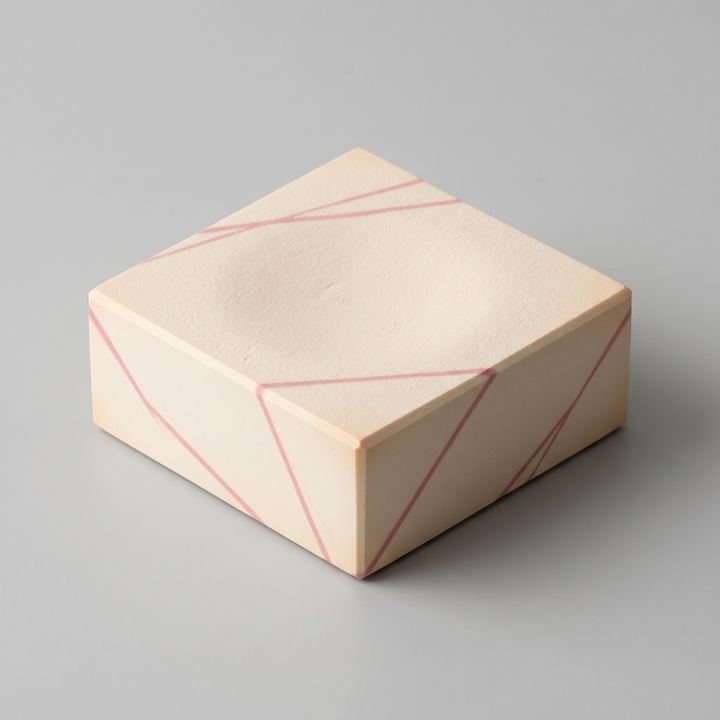
Neutral reading — a warm off-white to pale fawn, carried by lanthanum silicate with the faintest rose undertone from the erbium fraction under daylight, a colour shift that only registers when a sample sits against a pure white reference. At 5.91 g/cm³ and 70×70×35 mm the slab is heavy for its footprint, insisting on two-handed lift off the bench, denser in hand than a standard fired-earthenware tile of the same face and close to the weight of a basalt cobble. Skin vitrified matte from the 1200 °C fire, close to a satin finish without crossing into glaze. Edges cold-cut, kerf pale. Fully opaque. Quieter in the hand than the vanadium-loaded Gd7O12V1 sibling — same firing tier, different colour temperament.
Recipe
100 g batch · peak 1200 °C| element | precursor | formula | mass | safety |
|---|---|---|---|---|
| Ca | calcium carbonate / limestone | CaCO3 | 4.76 g | safe |
| Er | erbium oxide | Er2O3 | 18.18 g | moderate |
| La | lanthanum oxide | La2O3 | 54.21 g | moderate |
| Si | quartz flour / silica | SiO2 | 22.85 g | safe |
- 1Ramp
- 2Hold
- 3Ramp
- 4Ramp
- 5Hold
- 6Ramp
- 7Ramp