Co₂Cu₂Mn₂S₈
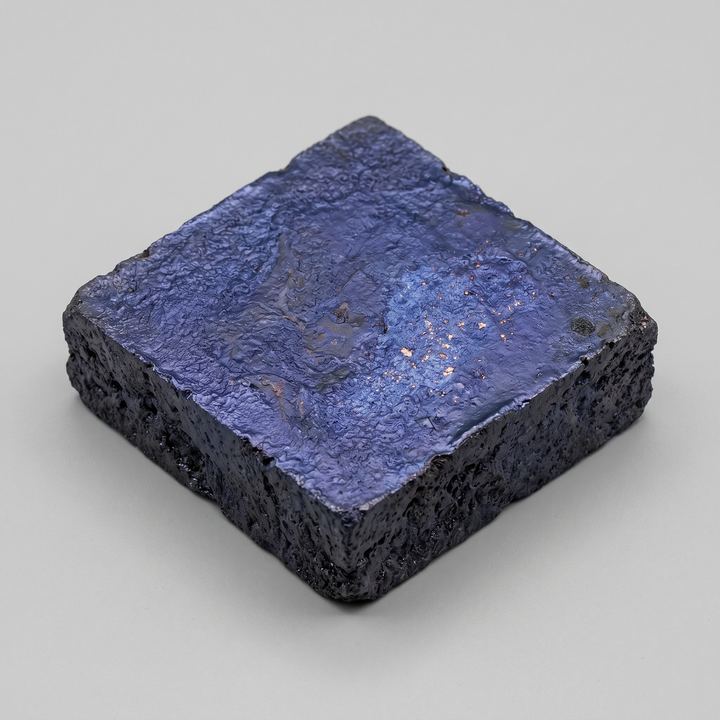
sulfide metal composite · sulfide low tempCo2Cu2Mn2S8 is a sulfide metal composite suitable as sulfide low temp. Color: blue. Fired at 130°C from 4 precursors (S, MnO2, CuO). Workshop batch: 300g at €20.16. Compressive strength ~350 MPa; estimated 0.09 kg CO₂/kg (-89% vs Portland cement). Notable: forms without a kiln. Confidence: medium.
- forms at
- 130 °C · hotplate · no kiln
- replaces
- portland cement
- CO₂
- 89.1% lower than Portland cement (0.09 vs 0.83 kg CO₂/kg)
- energy
- 89.1% lower than Portland cement (0.60 vs 5.50 MJ/kg)
- compressive
- 350 MPa
- density
- 4.55 g/cm³
- crystal
- orthorhombic
- band gap
- 0.00 eV
- cost
- €67.20/kg · €20.16 / 300 g batch
- confidence
- medium (synthesis route)
- potential
- 0.80 · env 1.00 · novel 1.00 · struct 0.70 · lineage 0.50 · supply 0.46
- flags
- zero kiln: Forming happens without firing — the material cures through chemistry at ambient or hotplate temperature. At building scale this removes the kiln from the supply chain: on-site casting, regional workshops, cold-country fabrication all become available.
Architectural potential
A cobalt-copper-manganese polysulphide cast at 130 °C, 350 MPa of compression, and the highest pigment saturation in the zero-kiln palette — a deep colourist-grade blue that does not exist in the fired-ceramic register without cobalt-heavy glazing. The structural number puts it at cement-level compression, the forming step removes the kiln from the supply chain, and the blue shifts the material's architectural argument into the colour-of-the-building register: cast interior floor tile for a small chapel or meditation room, pigment-grade wall infill blocks for a colourist-driven gallery fit-out, thick threshold plates for a swimming-bath entry sequence, and cast acoustic panels for a dedicated listening room where the sound-deadening mass and the cobalt blue are specified together. Against Portland cement the CO₂ cut is eighty-nine per cent, so the environmental argument is real even at this cost tier. The caveat is cobalt: €20.16 per 300 g batch is the highest in the zero-kiln group, the cobalt supply chain carries well-known ethical provenance issues that have to be addressed explicitly in the specification rather than absorbed silently into the binder-cost line, and any scale-up past workshop batch should be assumed to need independent provenance auditing.
Material character
A saturated cobalt blue matrix, darker and cooler than any fired cobalt-aluminate ceramic — the sulphide chemistry shifts the absorption edge enough to lose the grey haze that a kilned body inevitably carries. At 4.56 g/cm³ and 85×85×30 mm the slab is firm two-handed, slightly thinner in hand than its polysulphide siblings at the same footprint. Surface mold-matte with the expected meniscus sheen; edges as-cast, sharp, with a faint darker-blue rim where the melt pooled against the form. A fine sulphur bloom crystallises unevenly across the cure — silver flecks against the deep blue body, distinctly more visible here than on the yellow-orange siblings in the same family.
Recipe
300 g batch · peak 130 °C| element | precursor | formula | mass | safety |
|---|---|---|---|---|
| Co | cobalt(II) oxide | CoO | 31.04 g | moderate |
| Cu | copper(II) oxide (black) | CuO | 32.95 g | safe |
| Mn | manganese dioxide | MnO2 | 36.01 g | moderate |
- Pre-heatHotplate to 150 °C
- MeltSulfur liquefies at 115 °C; full liquid at 130 °C
- CastPour at 140–145 °C
- SetRoom temperature 30 min (firm) → 24 h (full strength)
Zero-kiln process — 130 °C hotplate cast only