CoFeK₂P₂
metal pm only · sintered metalCo1Fe1K2P2 is a metal pm only suitable as sintered-metal. Color: neutral. Fired at 1100°C from 4 precursors (Fe3P, K2CO3, Co). Workshop batch: 200g at €7.06. Compressive strength ~250 MPa; estimated 0.84 kg CO₂/kg (-53% vs structural steel). Notable: no special functions flagged. Confidence: medium.
- forms at
- 1100 °C · high-fire
- replaces
- structural steel
- CO₂
- 53.1% lower than structural steel (0.84 vs 1.80 kg CO₂/kg)
- energy
- 74.4% lower than structural steel (5.62 vs 26.00 MJ/kg)
- compressive
- 250 MPa
- density
- 2.86 g/cm³
- crystal
- tetragonal
- band gap
- 0.00 eV
- cost
- €35.30/kg · €7.06 / 200 g batch
- confidence
- medium (synthesis route)
- potential
- 0.42 · env 0.74 · novel 0.00 · struct 0.60 · lineage 0.20 · supply 0.50
Architectural potential
A cobalt-iron-potassium phosphide sintered at 1100 °C — the most neutral-toned of the powder-pressed metals in this batch and the one closest to a general-purpose hardware body. Two hundred and fifty megapascals of compression is a step below the zirconium variant but still in the cast-iron register, and the fifty-three-per-cent CO₂ cut against structural steel remains intact. Place it where the hardware needs to disappear into the detail rather than announce itself: structural brackets in painted finishes, furniture cleats and shelf brackets, door-frame anchors, stair-stringer clips, balustrade posts in utilitarian fit-out. The neutral colour makes it a drop-in substitute for cast-iron hardware in heritage retrofits where the visual register has to match existing ironwork. Cost at €7.06 per 200 g batch sits mid-range for the family, with a 500 g workshop ceiling that keeps production in the per-piece register — a single stair detail or one set of connector clips rather than a façade run. The caveat is the two-hundred-and-fifty-megapascal figure itself: adequate for secondary structural hardware and robust for most non-seismic fittings, but below the threshold where it could replace hot-rolled steel in primary frames, so first-use projects should keep it in brackets, clips and nodes rather than primary members.
Material character
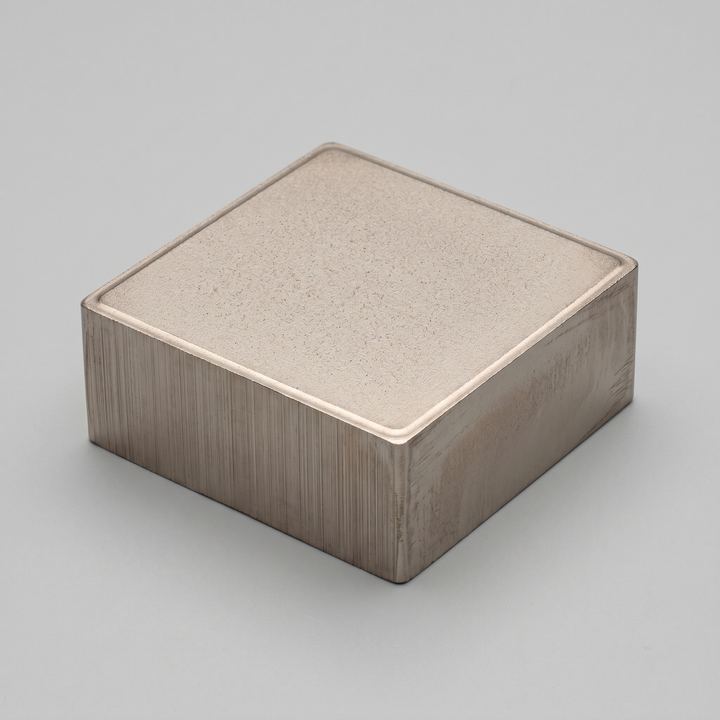
The slab reads an even cool grey with a barely perceptible warm cast from the iron content — unmistakably the neutral powder-pressed register rather than anything copper-toned. At 2.86 g/cm³ over 85×85×48 mm the piece lifts single-handed with a firm two-finger grip, closer in weight-feel to aluminium billet than to the phosphide-heavy zirconium sibling. Surface matte with the regular fine grain of a sintered pressing; edges as-pressed, squared but not razor-sharp. Rings cleanly but short under a tap — the acoustic signature of a dense powder-consolidated body rather than a solid cast. A step lighter and duller-toned than the copper-bearing sinters in the same family.
Recipe
200 g batch · peak 1100 °C| element | precursor | formula | mass | safety |
|---|---|---|---|---|
| Co | cobalt powder | Co | 9.07 g | moderate |
| Fe | iron powder -325 mesh | Fe | 8.59 g | moderate |
| K | potassium carbonate (NEVER elemental K) | K2CO3 | 21.26 g | safe |
| P | ferrophosphorus (liquid-phase sintering aid) | Fe3P | 61.08 g | safe |
- 1Ramp
- 2Hold
- 3Ramp
- 4Hold
- 5Ramp
- 6Ramp
- 7END