Cu₂K₄S₃₂
sulfide polysulfide · sulfide low tempCu2K4S32 is a sulfide polysulfide suitable as sulfide low temp. Color: green-red-copper. Fired at 130°C from 3 precursors (S, K2CO3, CuO). Workshop batch: 500g at €5.55. Compressive strength ~50 MPa; estimated 0.09 kg CO₂/kg (-89% vs Portland cement). Notable: forms without a kiln. Confidence: high.
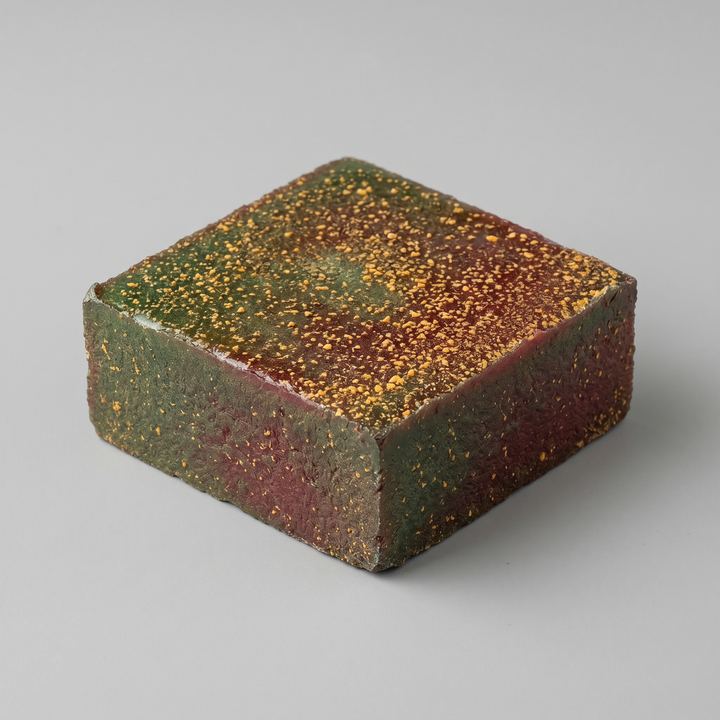
- forms at
- 130 °C · hotplate · no kiln
- replaces
- portland cement
- CO₂
- 89.1% lower than Portland cement (0.09 vs 0.83 kg CO₂/kg)
- energy
- 89.1% lower than Portland cement (0.60 vs 5.50 MJ/kg)
- compressive
- 50 MPa
- density
- 2.17 g/cm³
- crystal
- tetragonal
- band gap
- —
- cost
- €11.10/kg · €5.55 / 500 g batch
- confidence
- high (synthesis route)
- potential
- 0.82 · env 1.00 · novel 1.00 · struct 0.10 · lineage 1.00 · supply 0.68
- flags
- zero kiln: Forming happens without firing — the material cures through chemistry at ambient or hotplate temperature. At building scale this removes the kiln from the supply chain: on-site casting, regional workshops, cold-country fabrication all become available.
Architectural potential
At 50 MPa this is the lightweight, low-compression end of the cold-cast sulfide family, which re-casts it in architecture as a surface-and-cladding material rather than a structural one. The softwood-scale density and the zero-kiln chemistry mean full wall-area coverage becomes possible without load penalty to the substrate behind it: tall gallery walls, ceiling-plane inlays, acoustic-absorber panels in lobbies and auditoria, and decorative-cladding tiles in exhibition architecture are the natural placements. The copper-potassium polysulfide surface bloom is denser and more crystalline here than in its sodium cousin, so the face reads as a more active light-response surface — a slab whose visible texture varies with raking light and time of day. The eighty-nine-per-cent cut in embodied CO₂ against Portland cement applies even at tile scale, so specifying this material in place of a traditional cement-based tile delivers a real environmental argument. The caveat is the low compressive strength: at 50 MPa the slab will not carry any structural load and needs a rigid substrate behind it, so this is a surface specification rather than a block one.
Material character
The slab lifts startlingly light for its size — the eye expects cement-block weight and the hand encounters something closer to kiln-dried pine. At 2.17 g/cm³ this is the lowest density in the cold-cast sulfide palette, a clear step down from the sodium cousin and a deliberate tectonic signal. The green-red copper shimmer is warmer in daylight than the Na-based equivalent because the potassium cation stabilises a marginally longer sulphur chain, shifting matrix absorption slightly toward yellow. The α→β sulfur bloom has deposited a more visible crystalline stipple across the face than in the Na version. Surface mold-matte with meniscus; edges sharp as-cast. Sulphide odour legible under saw-cut.
Recipe
500 g batch · peak 130 °C| element | precursor | formula | mass | safety |
|---|---|---|---|---|
| Cu | copper(II) oxide (black) | CuO | 36.53 g | safe |
| K | potassium carbonate / potash | K2CO3 | 63.47 g | safe |
- Pre-heatHotplate to 150 °C
- MeltSulfur liquefies at 115 °C; full liquid at 130 °C
- CastPour at 140–145 °C
- SetRoom temperature 30 min (firm) → 24 h (full strength)
Zero-kiln process — 130 °C hotplate cast only