CaCuZn₄
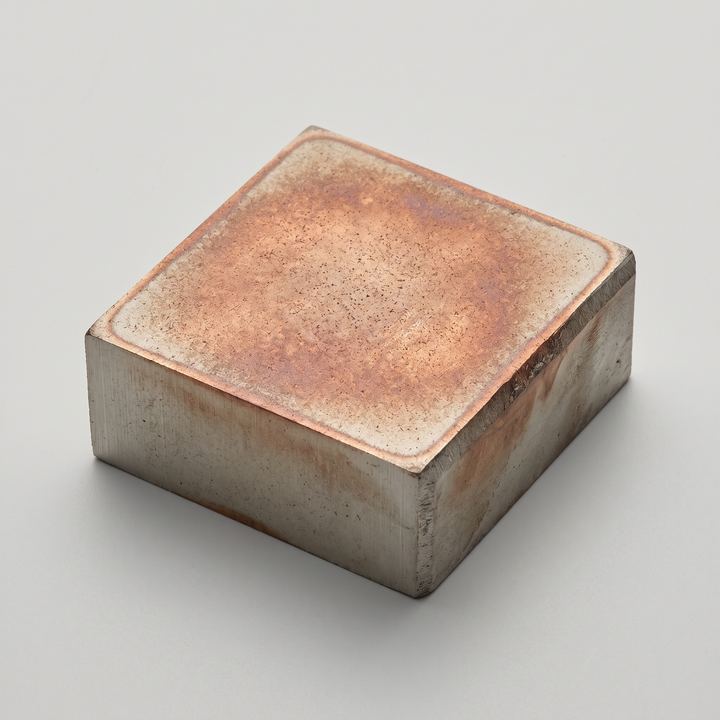
metal pm only · sintered metalCa1Cu1Zn4 is a metal pm only suitable as sintered-metal. Color: green-red-copper. Fired at 1100°C from 3 precursors (Zn, Cu, Ca). Workshop batch: 200g at €2.86. Compressive strength ~350 MPa; estimated 0.84 kg CO₂/kg (-53% vs structural steel). Notable: no special functions flagged. Confidence: medium.
- forms at
- 1100 °C · high-fire
- replaces
- structural steel
- CO₂
- 53.1% lower than structural steel (0.84 vs 1.80 kg CO₂/kg)
- energy
- 74.4% lower than structural steel (5.62 vs 26.00 MJ/kg)
- compressive
- 350 MPa
- density
- 5.78 g/cm³
- crystal
- orthorhombic
- band gap
- 0.00 eV
- cost
- €14.30/kg · €2.86 / 200 g batch
- confidence
- medium (synthesis route)
- potential
- 0.45 · env 0.74 · novel 0.00 · struct 0.84 · lineage 0.20 · supply 0.50
Architectural potential
A zinc-dominant brass-register sintered part, suited to visible hardware where the copper-green-red colour reading is as much the argument as the mechanical capacity. Three hundred and fifty megapascals of compression lifts it above the ordinary bracket duty into the structural-fitting zone: truss nodes for timber roof frames, compression column-feet in pavilion structures, cast-weight connector bodies, door and gate hardware, decorative-structural joint plates where the metal is meant to read. Against structural steel the CO₂ drop is fifty-three per cent and the energy budget falls by nearly three-quarters, so on a project that wants a visible brass-coloured fitting without the patina schedule of cast bronze, the case is both visual and environmental. The zinc-heavy 4:1 ratio with calcium trace gives the body its warm coppery-green undertone after atmospheric exposure, closer to unpatinated bronze than to yellow brass. Natural placements are handrail brackets in public stairs, balustrade joints in gallery architecture, furniture connectors in interior joinery, and visible façade clips on timber rainscreens. Making-culture is industrial sinter: powder press, furnace cycle, then machining. The caveat is batch: 200 g standard, 500 g maximum per workshop run, and €2.86 per batch brings the per-bracket cost into a register comparable to architectural bronze hardware rather than bulk steelwork.
Material character
A warm green-red-copper body that reads heavier on the red face at direct view and shifts to a faint olive-green at shallow angle — the zinc-calcium-copper ternary does not produce a single flat colour but a gentle two-tone field. At 5.78 g/cm³ the 70×70×35 mm slab is substantial but single-hand-portable, noticeably lighter than the iron-manganese-silicide siblings and distinctly heavier than aluminium stock. Surface reads sintered matte with a fine even grain, edges as-sintered with machining crispness at the ninety. Against cast bronze the body is drier in appearance, less reflective, and the tap is quieter — the powder route's characteristic acoustic signature.
Recipe
200 g batch · peak 1100 °C| element | precursor | formula | mass | safety |
|---|---|---|---|---|
| Ca | calcium granules | Ca | 10.98 g | moderate |
| Cu | copper shot/powder | Cu | 17.4 g | safe |
| Zn | zinc ingot/powder | Zn | 71.62 g | moderate |
- 1Ramp
- 2Hold
- 3Ramp
- 4Hold
- 5Ramp
- 6Ramp
- 7END