FeMn₁₁Si₁₆Zr₈
metal pm only · sintered metalFe1Mn11Si16Zr8 is a metal pm only suitable as sintered-metal. Color: neutral. Fired at 1100°C from 3 precursors (Mn, Si, Fe). Workshop batch: 200g at €2.35. Compressive strength ~50 MPa; estimated 0.84 kg CO₂/kg (-53% vs structural steel). Notable: shape memory FeMnSi. Confidence: medium.
- forms at
- 1100 °C · high-fire
- replaces
- structural steel
- CO₂
- 53.1% lower than structural steel (0.84 vs 1.80 kg CO₂/kg)
- energy
- 74.4% lower than structural steel (5.62 vs 26.00 MJ/kg)
- compressive
- 50 MPa
- density
- 6.08 g/cm³
- crystal
- triclinic
- band gap
- inf eV
- cost
- €11.75/kg · €2.35 / 200 g batch
- confidence
- medium (synthesis route)
- potential
- 0.54 · env 0.74 · novel 0.80 · struct 0.12 · lineage 0.20 · supply 0.46
- flags
- shape memory FeMnSi: Deforms on cue and snaps back to a remembered shape when warmed. Deployable canopies, self-tensioning fasteners, seismic-damping brackets, and geometry-changing envelopes all become mechanically possible.
Architectural potential
A silicon-and-zirconium-rich sintered metal body with manganese carrying the Fe-Mn-Si shape-memory chemistry at low iron content. At only 50 MPa of compressive strength this is emphatically not a load-bearing element — the high silicate fraction leaves the sinter brittle in compression — but the shape-memory capability survives the chemistry shift. Its architectural place is the non-structural responsive surface: decorative tile panels that flex subtly with temperature change, ornamental balustrade inserts that adjust their geometry seasonally, interior cladding tiles in atria where warm daylight triggers a visible surface deformation. It belongs as a signalling element rather than a bearing one — a surface whose geometry tells the occupant something about the thermal state of the room. Supplements conventional cladding rather than replacing it, and a zirconium-rich body resists corrosion better than the pure Fe-Mn-Si sibling, so exterior-facing panels stay feasible. Against structural steel the embodied CO₂ falls fifty-three per cent. The caveat is cycling: shape-memory transitions fatigue the grain structure over thousands of cycles, so a tile that moves daily will need replacement within a decade, and architectural specification has to budget for that replacement rhythm from the outset.
Material character
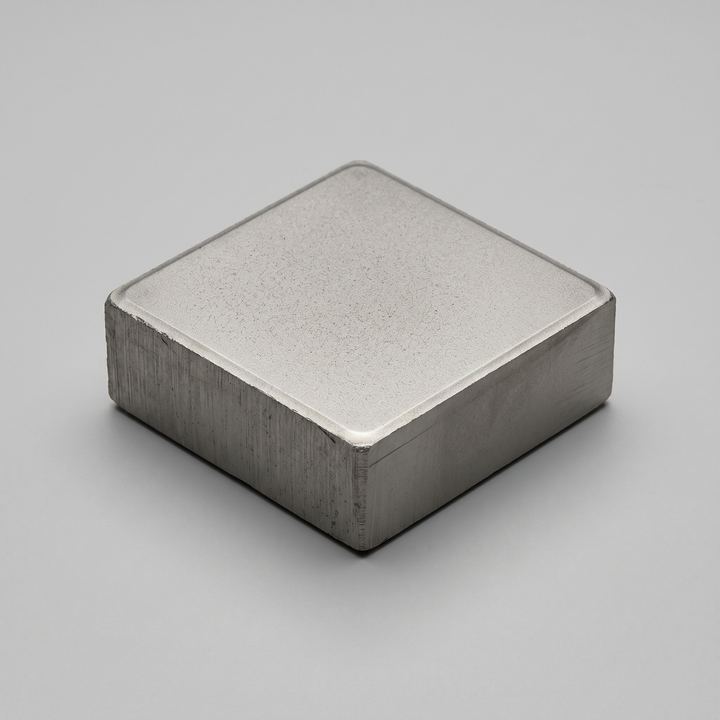
At 6.079 g/cm³ in a 70×70×34 mm block the slab sits between the dense ruthenium variant and the strontium-lightened copper-sinter — firmly two-handed but not the dead weight of the high-ruthenium sibling. Neutral warm-grey face, the zirconium lending a faint pearlescent sheen where polished, the silicon content giving a slightly duller matte than the iron-dominant sinters of the same family. Edges cold-machined, the chamfer kerf-bright where the diamond wheel left its finish. Rings lower and flatter than its Fe-Ru sibling when tapped, the higher silicate fraction damping the resonance. Closer in hand-feel to a dense ceramic than to a forged steel plate.
Recipe
200 g batch · peak 1100 °C| element | precursor | formula | mass | safety |
|---|---|---|---|---|
| Fe | iron powder -325 mesh | Fe | 5.03 g | moderate |
| Mn | manganese flakes | Mn | 54.47 g | moderate |
| Si | silicon granules | Si | 40.5 g | safe |
- 1Ramp
- 2Hold
- 3Ramp
- 4Hold
- 5Ramp
- 6Ramp
- 7END
Shape-memory — deformed body recovers on heating (Fe-Mn-Si)