Fe₂Na₄O₂₀Si₈
alkali silicate glass · structural translucent glassFe2Na4O20Si8 is a alkali silicate glass suitable as structural translucent glass. Color: amber-brown. Fired at 1150°C from 4 precursors (SiO2, Na2CO3, Fe2O3). Workshop batch: 400g at €1.74. Compressive strength ~500 MPa; estimated 0.84 kg CO₂/kg (-2% vs float glass). Notable: no special functions flagged. Confidence: high.
- forms at
- 1150 °C · high-fire
- replaces
- float glass
- CO₂
- 1.9% lower than float glass (0.84 vs 0.86 kg CO₂/kg)
- energy
- 62.5% lower than float glass (5.62 vs 15.00 MJ/kg)
- compressive
- 500 MPa
- density
- 2.70 g/cm³
- crystal
- triclinic
- band gap
- 2.93 eV
- cost
- €4.35/kg · €1.74 / 400 g batch
- confidence
- high (synthesis route)
- potential
- 0.68 · env 0.78 · novel 0.00 · struct 1.00 · lineage 1.00 · supply 1.00
Architectural potential
A soda-lime-silicate glass loaded with iron to saturate the amber-brown register, fired at 1150 °C and reaching 500 MPa of compression at 2.70 g/cm³ — structural territory for a glass, which lifts it out of sheet-glazing use and into the load bearing translucent element register. Near-parity on embodied CO₂ against float glass (within 2 per cent) and a sixty-two-per-cent cut in energy means the environmental argument is carried by process rather than by chemistry: the glass is made, but with markedly less heat. Natural placements are pressed glass stair treads in public entry halls where the amber cast warms the daylight descending through the stair, floor panels walked on from above in exhibition mezzanines, transparent partition modules in restaurant interiors where the iron-amber reads as vintage rather than tinted, and pressed-glass beams in small-span pavilions. Against float glass the colour is a specification choice, not a defect — the designer is using iron amber as the point. The caveat is geometry: annealing and edge conditioning belong to the tectonic as they do for any soda-lime-silicate, and pressed-glass stair treads demand a post-annealing polish and tempered edge before going underfoot. At €1.74 per 400 g and a 5 kg workshop ceiling, this is the most scalable structural glass in the batch.
Material character
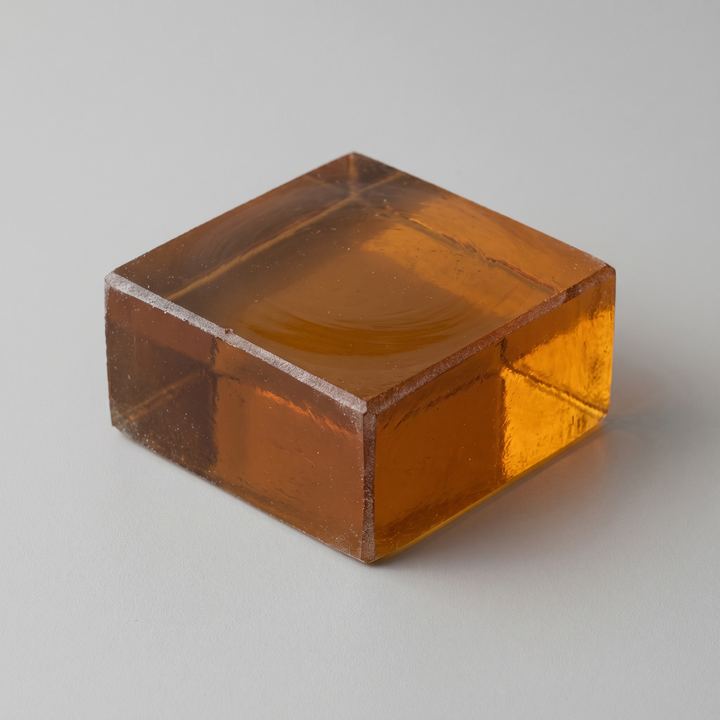
Saturated amber-brown through the 51 mm depth — iron oxide drives the body well past tinted into colour-as-material, darker along the long edge where the slab thickens into 85 mm of sighted glass. Pressed-glass surface with the shallow crown of a gravity-flat top face and two thin anneal striae traceable on close reading. Cold-cut edges carry the usual lapidary bloom. At 2.70 g/cm³ and 85×85×51 mm the slab sits stably one-handed on the bench, close in weight to an equivalent soda-lime plate but denser in hand through its thick cross-section. A distinct colour step up from cobalt-blue siblings in the same family.
Recipe
400 g batch · peak 1150 °C| element | precursor | formula | mass | safety |
|---|---|---|---|---|
| Fe | iron(III) oxide (red) | Fe2O3 | 18.74 g | safe |
| Na | sodium carbonate / soda ash | Na2CO3 | 24.87 g | safe |
| Si | quartz flour / silica | SiO2 | 56.39 g | safe |
- 1Ramp
- 2Hold
- 3Ramp
- 4Hold
- 5Ramp
- 6Hold