Bi₄Na₄O₁₆Si₄
alkali silicate glass · structural translucent glassBi4Na4O16Si4 is a alkali silicate glass suitable as structural translucent glass. Color: clear. Fired at 1150°C from 4 precursors (Bi2O3, SiO2, Na2CO3). Workshop batch: 400g at €14.80. Compressive strength ~500 MPa; estimated 0.84 kg CO₂/kg (-2% vs float glass). Notable: no special functions flagged. Confidence: high.
- forms at
- 1150 °C · high-fire
- replaces
- float glass
- CO₂
- 1.9% lower than float glass (0.84 vs 0.86 kg CO₂/kg)
- energy
- 62.5% lower than float glass (5.62 vs 15.00 MJ/kg)
- compressive
- 500 MPa
- density
- 5.34 g/cm³
- crystal
- orthorhombic
- band gap
- 3.36 eV
- cost
- €37.00/kg · €14.80 / 400 g batch
- confidence
- high (synthesis route)
- potential
- 0.64 · env 0.78 · novel 0.00 · struct 1.00 · lineage 0.70 · supply 1.00
Architectural potential
A bismuth-sodium silicate glass fired at 1150 °C — a clear, load-bearing translucent at five hundred megapascals of compression, firmly in the walked-on and leaned-on register. Architectural placements are the classic structural-glass catalogue: stair treads with light coming up through the riser, floor panels in mezzanine galleries and public atria, transparent partitions that carry their own plane-load, pressed-glass beams in pavilions, and column-like light-admitting piers where the element both structures and illuminates. The energy overhead drops by sixty-two per cent against float glass because the bismuth flux lowers the melt viscosity, while embodied CO₂ is essentially unchanged — the substitution argument is thermal, not carbonaceous. Specify it where an integrated transparent load-path is wanted and where conventional steel-plus-glazing would separate structure from skin. A 400 g standard batch scales cleanly to five kilograms of workshop production, so slab-level tread runs and small glass beam elements are feasible without industrial casting. Still in the soda-silicate family, so annealing schedules and edge conditioning remain part of the detail. The caveat is cost and specification discipline: at €14.80 per 400 g the material is not bulk glazing, and bismuth's density lifts the slab's weight above ordinary float — every structural detail has to account for a heavier sheet than a glazier would expect.
Material character
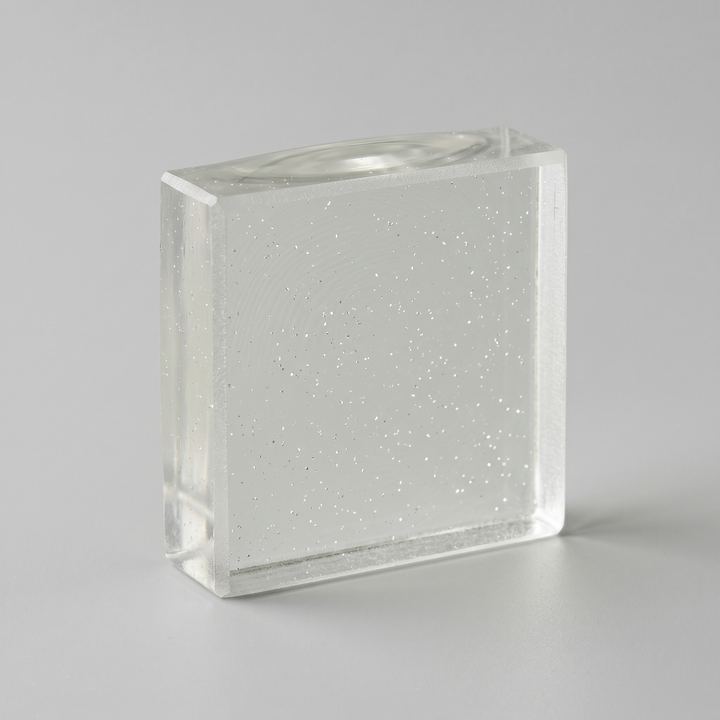
The slab reads clear with a faint cool cast from sodium and the high bismuth content lifting the refractive register — distinctly more luminous in oblique light than an ordinary soda-lime pane, catching sharp internal reflections along the cold-cut edge. At 5.34 g/cm³ over 70×70×38 mm the piece is startlingly heavy for its clear body, sitting into the bench with a two-hand lift — a density-per-volume shift that the eye does not anticipate. Surface pressed-glass with the fine convex crown of a cast pane; edges cold-cut, lapidary-bloomed, ringing clean and long under a tap. A noticeably denser, slower-ringing body than a soda-lime sibling.
Recipe
400 g batch · peak 1150 °C| element | precursor | formula | mass | safety |
|---|---|---|---|---|
| Bi | bismuth(III) oxide (yellow) | Bi2O3 | 67.32 g | moderate |
| Na | sodium carbonate / soda ash | Na2CO3 | 15.31 g | safe |
| Si | quartz flour / silica | SiO2 | 17.36 g | safe |
- 1Ramp
- 2Hold
- 3Ramp
- 4Hold
- 5Ramp
- 6Hold