Fe₂O₁₂Sr₄TiW
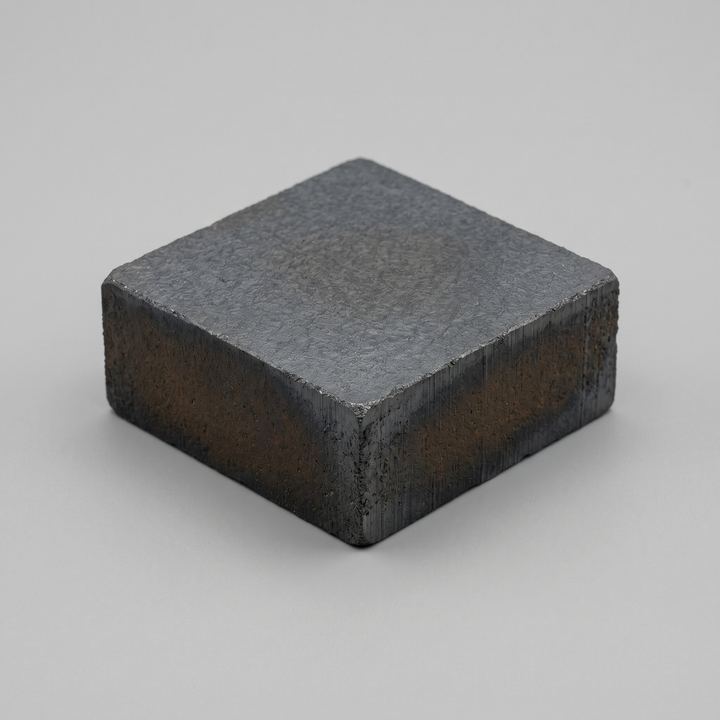
perovskite ceramic · functional ceramicFe2O12Sr4Ti1W1 is a perovskite ceramic suitable as functional-ceramic. Color: amber-brown. Fired at 1300°C from 4 precursors (SrCO3, WO3, Fe2O3). Workshop batch: 200g at €23.51. Compressive strength ~100 MPa; estimated 0.97 kg CO₂/kg (+343% vs clay brick). Notable: visible absorber. Confidence: medium.
- forms at
- 1300 °C · extreme-fire
- replaces
- clay brick
- CO₂
- 343% higher than clay brick (0.97 vs 0.22 kg CO₂/kg; 4.4× higher)
- energy
- 117% higher than clay brick (6.50 vs 3.00 MJ/kg; 2.2× higher)
- compressive
- 100 MPa
- density
- 5.84 g/cm³
- crystal
- triclinic
- band gap
- 1.82 eV
- cost
- €117.55/kg · €23.51 / 200 g batch
- confidence
- medium (synthesis route)
- potential
- 0.22 · env 0.00 · novel 0.46 · struct 0.20 · lineage 0.50 · supply 0.00
- flags
- visible absorber: A real-colour solar-gain control layer. Where the body takes visible light into itself rather than reflecting it, the material becomes a selective heat collector — useful on thermal-mass walls, absorber panels, and warm-toned cladding.
Architectural potential
A strontium-titanate-ferrite-tungstate perovskite with a visible-absorber face: the body takes in visible light as heat rather than reflecting it, so the slab becomes a selective solar-gain collector in a thin-section surface element. Natural placements are south-facing absorber-tile patches on thermal-mass walls in passive-solar architecture, small-area warm-toned cladding inserts on trombe walls, rooftop solar-gain patches beside skylights, and threshold plates on south-facing entry sequences where the amber-brown colour and the heat uptake are the architectural argument together. At 100 megapascals of compression the body is strictly a surface element — active coating, responsive cladding insert, absorber-tile patch — rather than a structural wall. The caveats compound severely. Embodied CO₂ runs 343 per cent higher than fired clay brick, the supply-chain score sits at zero, safety score drops to 0.65 (iron-tungstate firing releases fine particulates), and the extreme 1300 °C peak puts production into specialist-kiln territory only. Workshop batches cap at 500 g. Specification belongs entirely in the signature-insert register: one absorber-tile patch in a passive-solar facade, paid for by the coupled colour-plus-heat behaviour, never as a continuous cladding. Confidence on the capability remains medium pending architectural-scale verification of the absorber performance.
Material character
A rich amber-brown body at 5.84 g/cm³ in a 70×70×35 mm slab — the iron-tungstate signature, distinct from the cobalt-blue and chromium-green siblings elsewhere in the perovskite and iron-oxide groups. The slab firms two-handed, noticeably denser than the mid-range ceramics in this batch. Surface sits vitrified matte from the 1300 °C fire, with a slight metallic oxide sheen where the iron-rich phase concentrates at the skin. Edges cold-cut with diamond-kerf whitening. Fully opaque; under direct sunlight the visible-absorber face warms palpably within minutes of exposure. Against a plain strontium-titanate perovskite the iron and tungsten together drive the colour firmly into amber-brown territory rather than the cleaner blues of the base family.
Recipe
200 g batch · peak 1300 °C| element | precursor | formula | mass | safety |
|---|---|---|---|---|
| Fe | iron(III) oxide (red) | Fe2O3 | 15.04 g | safe |
| Sr | strontium carbonate | SrCO3 | 55.61 g | safe |
| Ti | titanium dioxide (rutile) | TiO2 | 7.52 g | safe |
| W | tungsten trioxide (yellow) | WO3 | 21.83 g | moderate |
- 1Ramp
- 2Hold
- 3Ramp
- 4Ramp
- 5Hold
- 6Ramp
- 7Ramp
Visible absorber — saturated color from bandgap in the visible range