Ca₁₂Cr₃Fe₅O₄₈Si₁₂
calcium silicate · cement alternativeCa12Cr3Fe5O48Si12 is a calcium silicate suitable as cement-alternative. Color: green. Fired at 1100°C from 4 precursors (CaCO3, SiO2, Fe2O3). Workshop batch: 1000g at €6.04. Compressive strength ~50 MPa; estimated 0.68 kg CO₂/kg (-19% vs Portland cement). Notable: no special functions flagged. Confidence: medium.
- forms at
- 1100 °C · high-fire
- replaces
- portland cement
- CO₂
- 18.7% lower than Portland cement (0.68 vs 0.83 kg CO₂/kg)
- energy
- 18.2% lower than Portland cement (4.50 vs 5.50 MJ/kg)
- compressive
- 50 MPa
- density
- 3.71 g/cm³
- crystal
- trigonal
- band gap
- —
- cost
- €6.04/kg · €6.04 / 1000 g batch
- confidence
- medium (synthesis route)
- potential
- 0.31 · env 0.23 · novel 0.00 · struct 0.15 · lineage 0.80 · supply 0.65
Architectural potential
A calcium-chromium-iron silicate binder at the post-Portland workshop register, with an eighteen-per-cent cut in embodied CO₂ against Portland cement and a 50 MPa compressive ceiling that keeps the specification on the non-reinforced side of the concrete conversation. At 3.71 g/cm³ the body is dense where the iron-vanadate sibling is aerated, so the architectural reach is different: surface mass rather than insulating infill. Natural placements are prefabricated non-load-bearing cladding panels in pavilion architecture, site-cast floor screeds in retrofit housing, landscape walls and garden-room blocks, and non-structural wall panels in exhibition spaces where the green chromium face is wanted as an architectural signature. The colour is the specification argument at least as much as the carbon one: chromium-pigmented low-carbon binder surfaces read cleanly in courtyard paving, garden terrace walls, and interior feature walls in galleries and cultural buildings. Against Portland cement the environmental saving is modest but real, and at a supply-chain score of 1.0 the precursors are locally available. The caveat is the compressive ceiling — reinforced structural use is forbidden, and thin-section work must stay decorative rather than bear load. Specification sits with the low-CO₂ pavilion wall, the landscape plinth, the coloured garden-room block.
Material character
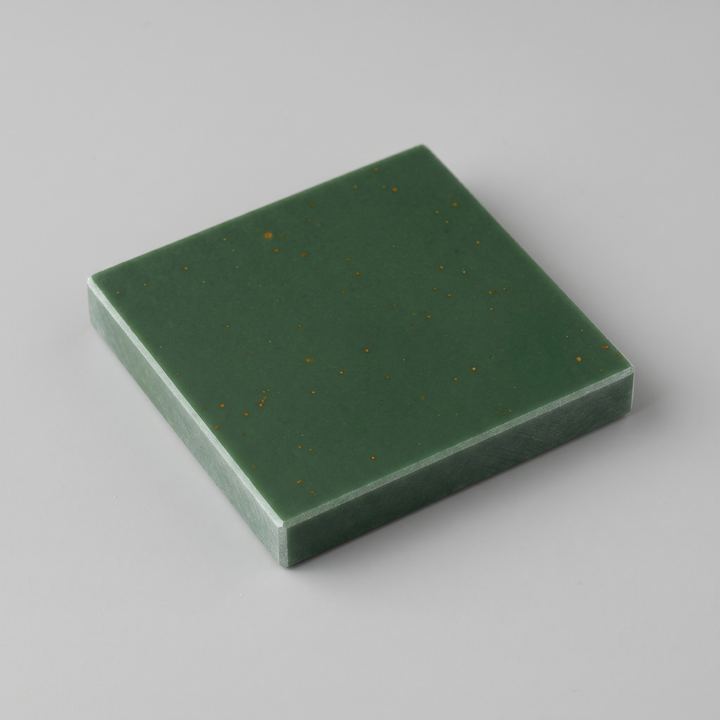
The slab reads a muted sage-green from the chromium content on the iron-silicate base, distinct from the amber-brown of its vanadium sibling and closer to the tone of weathered copper roofing than to any standard cement palette. At 3.71 g/cm³ in an 85×85×37 mm piece, the body sits in a firm two-handed register — denser than the iron-vanadate sibling by a factor of ten at a smaller footprint, much closer in hand-feel to a dense rendered surface than to an aerated block. Surface cold-pressed with a fine even matte; edges cold-cut, the kerf retaining the greenish chromium cast. Fully opaque. Tapped, the body answers with a clean mid-range note.
Recipe
1000 g batch · peak 1100 °C| element | precursor | formula | mass | safety |
|---|---|---|---|---|
| Ca | calcium carbonate / limestone | CaCO3 | 47.12 g | safe |
| Cr | chromium(III) oxide | Cr2O3 | 8.94 g | safe |
| Fe | iron(III) oxide (red) | Fe2O3 | 15.66 g | safe |
| Si | quartz flour / silica | SiO2 | 28.28 g | safe |
- 1Ramp
- 2Hold
- 3Ramp
- 4Hold
- 6Ramp
- 7Hold