Fe₆Mn₂Na₆O₁₆
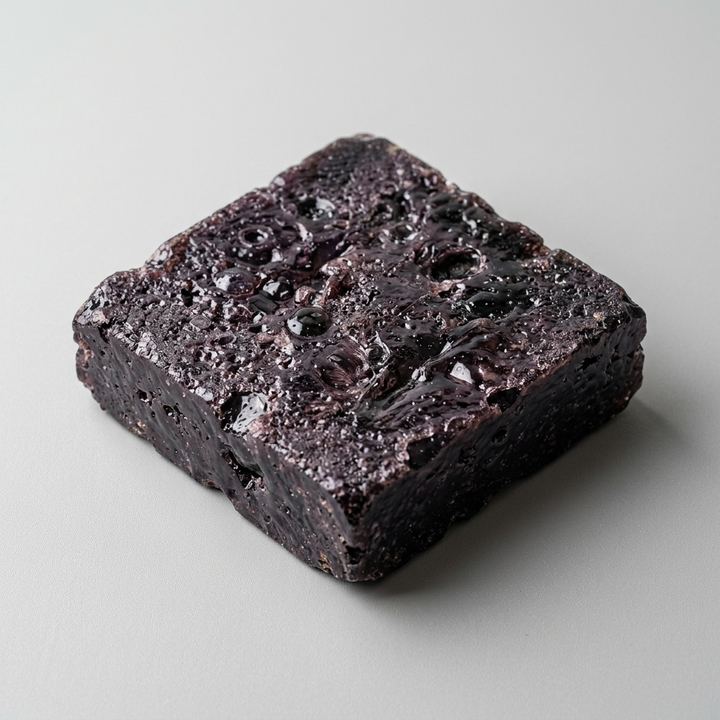
iron oxide ceramic · structural ceramicFe6Mn2Na6O16 is a iron oxide ceramic suitable as structural-ceramic. Color: purple-brown. Fired at 1100°C from 3 precursors (Na2CO3, Fe2O3, MnO2). Workshop batch: 1000g at €3.32. Compressive strength ~100 MPa; estimated 0.79 kg CO₂/kg (+258% vs clay brick). Notable: visible absorber. Confidence: high.
- forms at
- 1100 °C · high-fire
- replaces
- clay brick
- CO₂
- 258% higher than clay brick (0.79 vs 0.22 kg CO₂/kg; 3.6× higher)
- energy
- 75% higher than clay brick (5.25 vs 3.00 MJ/kg; 1.8× higher)
- compressive
- 100 MPa
- density
- 4.04 g/cm³
- crystal
- trigonal
- band gap
- 1.57 eV
- cost
- €3.32/kg · €3.32 / 1000 g batch
- confidence
- high (synthesis route)
- potential
- 0.31 · env 0.00 · novel 0.46 · struct 0.30 · lineage 1.00 · supply 0.00
- flags
- visible absorber: A real-colour solar-gain control layer. Where the body takes visible light into itself rather than reflecting it, the material becomes a selective heat collector — useful on thermal-mass walls, absorber panels, and warm-toned cladding.
Architectural potential
A sodium-iron-manganate structural ceramic fired at 1100 °C, 100 MPa of compression, and a deep purple-brown body that carries the visible-absorber chemistry of a manganese-iron oxide. At block and tile scale this belongs to structural masonry with a thermal intent: absorber-face bricks for south-facing garden walls, dark-toned cladding blocks for pavilion façades that gather solar gain rather than rejecting it, paving units for courtyards meant to warm under the day, and thick threshold tiles at orangery entries. Against clay brick the compression is higher but the embodied CO₂ runs 258 per cent higher, so this cannot be used as bulk masonry — it is the absorber face of a composite wall, a single course of dark skin against a lime-mortared clay body behind. The 1 kg workshop batch and €3.32 price open up enough production for a pavilion-scale demonstration wall, which is where this material earns its specification. The HIGH-confidence rating on the compression figure makes the load path legible. The caveat is supply-chain: the score sits at zero for this precursor mix, so procurement is a bespoke exercise and not a catalogue order.
Material character
A deep purple-brown face characteristic of high-manganese iron oxides — darker than a hematite-only body, cooler than a pure-manganate one, closer in tone to an oxidised basalt. At 4.04 g/cm³ and 85×85×34 mm the slab sits firm two-handed, heavier in hand than a fired clay tile of the same footprint but lighter than the zirconium-grade ceramics nearby. Surface carries the vitrified skin of a high-fire oxide, satin-matte with a faint metallic sheen where iron migrated to the outermost micron during fire. Edges cold-cut, the kerf powder red-brown. Against a plain hematite brick the body is darker, denser, and the ring under tap is higher and cleaner.
Recipe
1000 g batch · peak 1100 °C| element | precursor | formula | mass | safety |
|---|---|---|---|---|
| Fe | iron(III) oxide (red) | Fe2O3 | 49.34 g | safe |
| Mn | manganese dioxide | MnO2 | 17.91 g | moderate |
| Na | sodium carbonate / soda ash | Na2CO3 | 32.75 g | safe |
- 1Ramp
- 2Hold
- 3Ramp
- 4Hold
- 6Ramp
- 7Hold
Visible absorber — saturated color from bandgap in the visible range