Eu₄O₁₆Si₄V₄
rare earth oxide · rare earth ceramicEu4O16Si4V4 is a rare earth oxide suitable as rare earth ceramic. Color: grey-blue. Fired at 1200°C from 3 precursors (Eu2O3, V2O5, SiO2). Workshop batch: 100g at €92.69. Compressive strength ~100 MPa; estimated 0.90 kg CO₂/kg (+309% vs clay brick). Notable: thermochromic VO2. Confidence: medium.
- forms at
- 1200 °C · high-fire
- replaces
- clay brick
- CO₂
- 309% higher than clay brick (0.90 vs 0.22 kg CO₂/kg; 4.1× higher)
- energy
- 100% higher than clay brick (6.00 vs 3.00 MJ/kg; 2.0× higher)
- compressive
- 100 MPa
- density
- 4.99 g/cm³
- crystal
- orthorhombic
- band gap
- 0.02 eV
- cost
- €926.90/kg · €92.69 / 100 g batch
- confidence
- medium (synthesis route)
- potential
- 0.34 · env 0.00 · novel 0.90 · struct 0.20 · lineage 0.50 · supply 0.05
- flags
- thermochromic VO2: Passive thermal-optical switching: transmission shifts near 68 °C without any driving signal. At building scale this gives a window that darkens as it heats, reducing solar gain without wiring or sensors.
Architectural potential
A europium-vanadium silicate fired at 1200 °C — a rare-earth ceramic carrying thermochromic vanadium-dioxide chemistry, with the europium sitting as a potential luminescent reserve that the data does not flag as the primary behaviour. The embodied CO₂ runs more than four times that of clay brick and compression tops out at one hundred megapascals, so every placement has to be paid for by the thermal switching. Natural placements are passive solar-control tiles in south-facing greenhouse and conservatory roofs, thermally-active cladding patches around rooftop skylights in atria, and self-regulating accent tile runs in double-skin office façades where the surface reads one state in morning shadow and another in midday sun. The material differs from the perovskite sibling in this batch mainly in chemistry register: silicate-based rather than titanate-based, with the europium open as a future sensor-integration path. Untested at building scale in production architecture. The 100 g workshop batch at €92.69 is the most expensive in this batch by a significant margin — europium commands a premium — and the 300 g ceiling forbids anything beyond the small patch, the signature insert, or the test panel. The caveat is cost itself: specification has to be proportional to the thermal-optical argument, and any bulk or repeated use collapses the project economics.
Material character
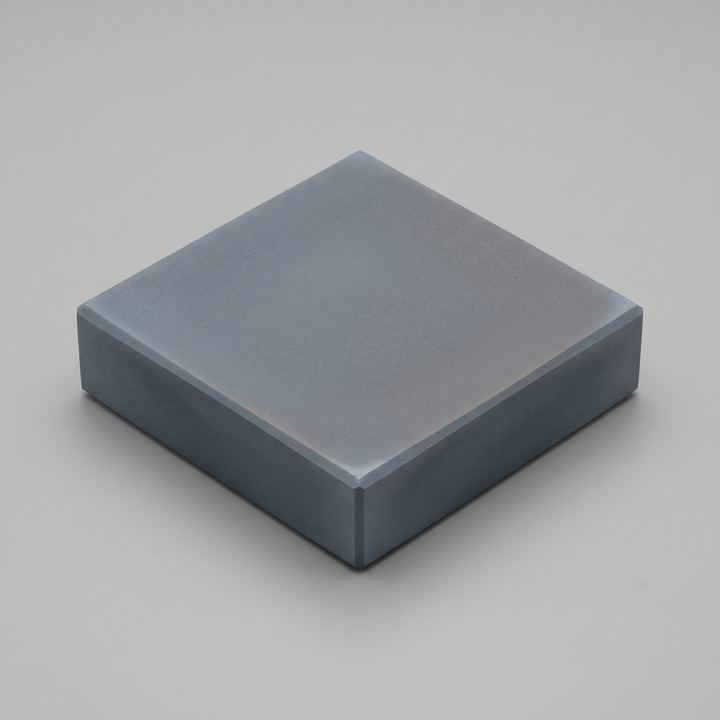
The slab reads a cool grey-blue, the vanadium content driving the matrix toward slate and the europium sitting quietly without announcing itself in visible light — the luminescent reserve is an ultraviolet story, not a daylight one. At 4.99 g/cm³ over 85×85×28 mm the piece is solid in the hand, heavy for its relatively thin section and resisting a one-handed lift. Surface matte from the sinter, finely grained; edges cold-cut, kerf-whitened. Fully opaque. Against the perovskite thermochromic sibling in the same batch it reads more blue-shifted and slightly chalkier in the hand, the silicate matrix giving a softer, mattier finish than the denser titanate body.
Recipe
100 g batch · peak 1200 °C| element | precursor | formula | mass | safety |
|---|---|---|---|---|
| Eu | europium oxide | Eu2O3 | 53.81 g | moderate |
| Si | quartz flour / silica | SiO2 | 18.37 g | safe |
| V | vanadium pentoxide | V2O5 | 27.81 g | moderate |
- 1Ramp
- 2Hold
- 3Ramp
- 4Ramp
- 5Hold
- 6Ramp
- 7Ramp
Thermochromic — VO₂ metal-insulator switch at ~68 °C