Fe₈K₄₀S₃₂
sulfide polysulfide · sulfide low tempFe8K40S32 is a sulfide polysulfide suitable as sulfide low temp. Color: yellow-orange. Fired at 130°C from 3 precursors (K2CO3, S, Fe2O3). Workshop batch: 500g at €6.69. Compressive strength ~50 MPa; estimated 0.09 kg CO₂/kg (-89% vs Portland cement). Notable: forms without a kiln. Confidence: high.
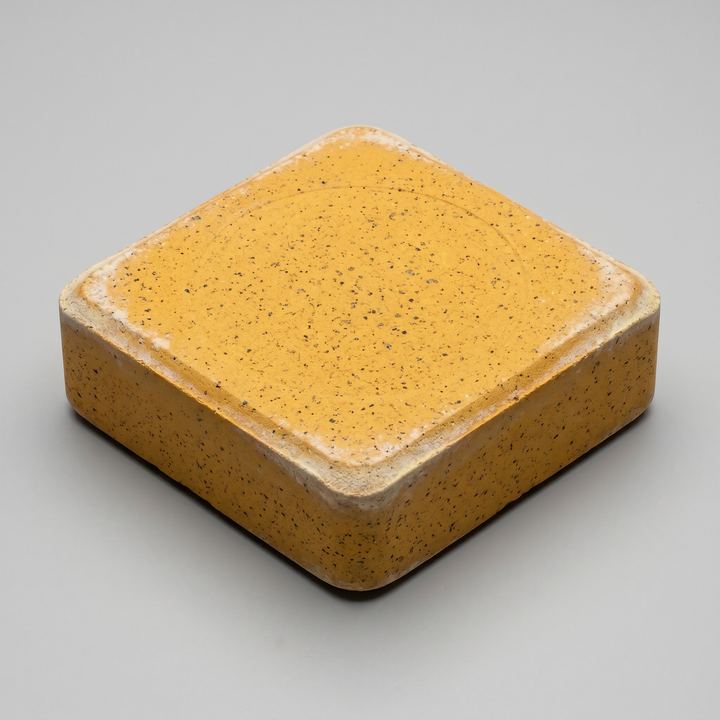
- forms at
- 130 °C · hotplate · no kiln
- replaces
- portland cement
- CO₂
- 89.1% lower than Portland cement (0.09 vs 0.83 kg CO₂/kg)
- energy
- 89.1% lower than Portland cement (0.60 vs 5.50 MJ/kg)
- compressive
- 50 MPa
- density
- 2.22 g/cm³
- crystal
- orthorhombic
- band gap
- —
- cost
- €13.38/kg · €6.69 / 500 g batch
- confidence
- high (synthesis route)
- potential
- 0.77 · env 1.00 · novel 1.00 · struct 0.10 · lineage 0.70 · supply 0.68
- flags
- zero kiln: Forming happens without firing — the material cures through chemistry at ambient or hotplate temperature. At building scale this removes the kiln from the supply chain: on-site casting, regional workshops, cold-country fabrication all become available.
Architectural potential
An iron-rich potassium polysulfide cast at 130 °C on a hotplate, this sits at the detail and tile end of the kiln-free register. Fifty megapascals of compressive strength is modest — not a load-carrying figure — so the real architectural argument is the eighty-nine-per-cent cut in embodied CO₂ against Portland cement combined with forming that never needs a kiln. Place it where mass and colour matter but structure does not: interior wall tile in galleries and chapels, cast thresholds and sill plates, inlay panels for acoustic walls, warm-cast floor tiles in studios and kindergartens, and sculpted signage or wayfinding blocks in civic interiors. The 500 g standard batch scales to a two-kilogram workshop ceiling, so each piece is an individually cast element rather than a production run — the logic is closer to a ceramicist's studio than a concrete precast yard. Against Portland cement the supplement-or-replace framing applies only in thin, non-structural roles: cladding skins, surface panels, repair patches on retrofit brickwork. The caveat is ventilation: any saw-cutting or drilling of a cured polysulfide releases sulphide odour, so the workshop needs extraction and the site detailing has to anticipate fabrication before, not after, installation.
Material character
The slab reads a saturated yellow-orange, closer to orpiment pigment than to the copper-red of manganese-heavy polysulfide siblings — the high potassium-to-iron ratio bleaches the matrix toward sulfur's native colour. At 2.22 g/cm³ and 100×100×45 mm, the piece lifts single-handed with a firm two-finger grip, noticeably lighter than the copper-manganese cast at the same family's top end. Surface cold-cast mold-matte with a faint meniscus along one face; edges as-cast, slightly rounded where the mold released. Fully opaque. A fine secondary sulfur bloom settles in the low spots after curing, catching raking light as a powdery sheen the camera struggles to resolve.
Recipe
500 g batch · peak 130 °C| element | precursor | formula | mass | safety |
|---|---|---|---|---|
| Fe | iron(III) oxide (red) | Fe2O3 | 18.77 g | safe |
| K | potassium carbonate / potash | K2CO3 | 81.23 g | safe |
- Pre-heatHotplate to 150 °C
- MeltSulfur liquefies at 115 °C; full liquid at 130 °C
- CastPour at 140–145 °C
- SetRoom temperature 30 min (firm) → 24 h (full strength)
Zero-kiln process — 130 °C hotplate cast only