Fe₄S₃Se
sulfide metal composite · sulfide low tempFe4S3Se1 is a sulfide metal composite suitable as sulfide low temp. Color: yellow-orange. Fired at 130°C from 3 precursors (Fe2O3, S, Se). Workshop batch: 300g at €5.26. Compressive strength ~250 MPa; estimated 0.09 kg CO₂/kg (-89% vs Portland cement). Notable: forms without a kiln. Confidence: medium.
- forms at
- 130 °C · hotplate · no kiln
- replaces
- portland cement
- CO₂
- 89.1% lower than Portland cement (0.09 vs 0.83 kg CO₂/kg)
- energy
- 89.1% lower than Portland cement (0.60 vs 5.50 MJ/kg)
- compressive
- 250 MPa
- density
- 4.52 g/cm³
- crystal
- tetragonal
- band gap
- 0.02 eV
- cost
- €17.53/kg · €5.26 / 300 g batch
- confidence
- medium (synthesis route)
- potential
- 0.77 · env 1.00 · novel 1.00 · struct 0.50 · lineage 0.50 · supply 0.46
- flags
- zero kiln: Forming happens without firing — the material cures through chemistry at ambient or hotplate temperature. At building scale this removes the kiln from the supply chain: on-site casting, regional workshops, cold-country fabrication all become available.
Architectural potential
A selenium-doped iron-sulphide cast below the boiling point of water: 130 °C on a hotplate, 250 MPa of compression, and an eighty-nine-per-cent cut in embodied CO₂ against Portland cement. At batch sizes that scale to a kilogram, this is detail-register architecture — drop-cast thresholds in a retrofit shop floor, acoustic inlay panels in a small auditorium, cast sill plates for an off-grid cabin, specialty tiles for an exhibition bay where temperature-sensitive inclusions (pressed flora, resin dowels, paper fragments) need to survive the forming step. Where the nearest analog is cement, the argument is not supplement but displacement: the building still gets stone-register mass and compressive load at tile and threshold scale, but the kiln leaves the supply chain entirely. Natural placements are gallery plinths, dark-room counter-tops, monastery floor inlays, and compression-loaded hardware for self-built pavilion work. The selenium content sits at the edge of precursor cost — €5.26 per 300 g batch is lenient, but the material is not bulk-usable beyond a kilogram of workshop batch. The caveat is workshop hygiene: heated iron-sulphide releases H₂S traces during cure, so a fume hood and trained handler belong in the specification rather than an informal studio.
Material character
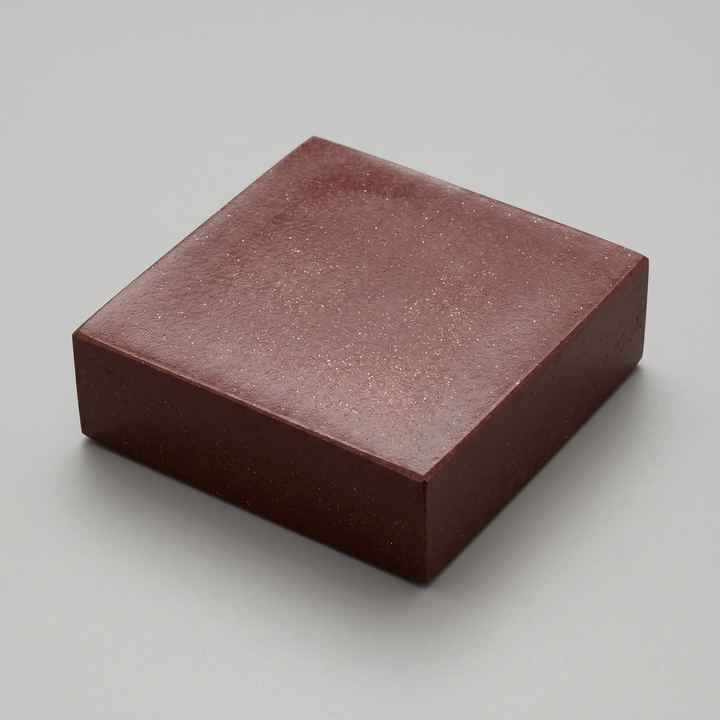
The slab reads a warm yellow-orange from the pyrite-family matrix, shifted slightly browner than a pure FeS₂ body by the selenium fraction. At 4.52 g/cm³ and 85×85×31 mm the slab is firm two-handed in the lift — heavier than its mass suggests because the density sits high for its thickness. Surface mold-matte with the faint meniscus sheen of a cast rather than pressed piece; edges as-cast, slightly sharp, with a thin selenium-red rim where the melt pooled against the form. Against a pure iron-sulphide sibling the colour runs deeper and the fracture surface is glassier: selenium pushes the matrix toward a metallic lustre under raking light.
Recipe
300 g batch · peak 130 °C| element | precursor | formula | mass | safety |
|---|---|---|---|---|
| Fe | iron(III) oxide (red) | Fe2O3 | 80.18 g | safe |
| Se | selenium (elemental) | Se | 19.82 g | moderate |
- Pre-heatHotplate to 150 °C
- MeltSulfur liquefies at 115 °C; full liquid at 130 °C
- CastPour at 140–145 °C
- SetRoom temperature 30 min (firm) → 24 h (full strength)
Zero-kiln process — 130 °C hotplate cast only