Gd₂MoO₁₂Sr₄Ti
perovskite ceramic · functional ceramicGd2Mo1O12Sr4Ti1 is a perovskite ceramic suitable as functional-ceramic. Color: neutral. Fired at 1300°C from 4 precursors (SrCO3, Gd2O3, MoO3). Workshop batch: 200g at €42.65. Compressive strength ~100 MPa; estimated 0.97 kg CO₂/kg (+343% vs clay brick). Notable: no special functions flagged. Confidence: medium.
- forms at
- 1300 °C · extreme-fire
- replaces
- clay brick
- CO₂
- 343% higher than clay brick (0.97 vs 0.22 kg CO₂/kg; 4.4× higher)
- energy
- 117% higher than clay brick (6.50 vs 3.00 MJ/kg; 2.2× higher)
- compressive
- 100 MPa
- density
- 5.77 g/cm³
- crystal
- triclinic
- band gap
- 0.00 eV
- cost
- €213.25/kg · €42.65 / 200 g batch
- confidence
- medium (synthesis route)
- potential
- 0.12 · env 0.00 · novel 0.00 · struct 0.20 · lineage 0.50 · supply 0.10
Architectural potential
This is a high-fire perovskite ceramic carrying no declared switching behaviour in the atlas data — the bandgap is effectively closed at 0.001 eV, pointing to a near-metallic electronic register rather than to any thermochromic or electrochromic function. Against clay brick the embodied CO₂ runs plus 343 per cent at only 100 MPa of compression, which forbids any volume use in building-scale masonry. Natural placements are research-tile patches for capability testing, one-off sensor substrates integrated into cladding for piezo- or magnetic-response experiments, small-area functional overlays on conventional stone or glazing cladding, and decorative plinth inserts where the gadolinium-strontium-titanate chemistry is part of the design's conceptual argument. At 200 g workshop batches and 1300 °C peak firing, production sits firmly in the laboratory-ceramic register. Without a specified functional flag the material is untested in architectural production in any self-evident way: specifiers would have to propose and verify a functional behaviour — dielectric, magnetic, or high-frequency response — before committing to a placement. The caveat is compounded: CO₂ punishment at 343 per cent against clay brick, a supply-chain score of 0.14 for rare-earth sourcing, and no built precedent to draw on for detailed specification.
Material character
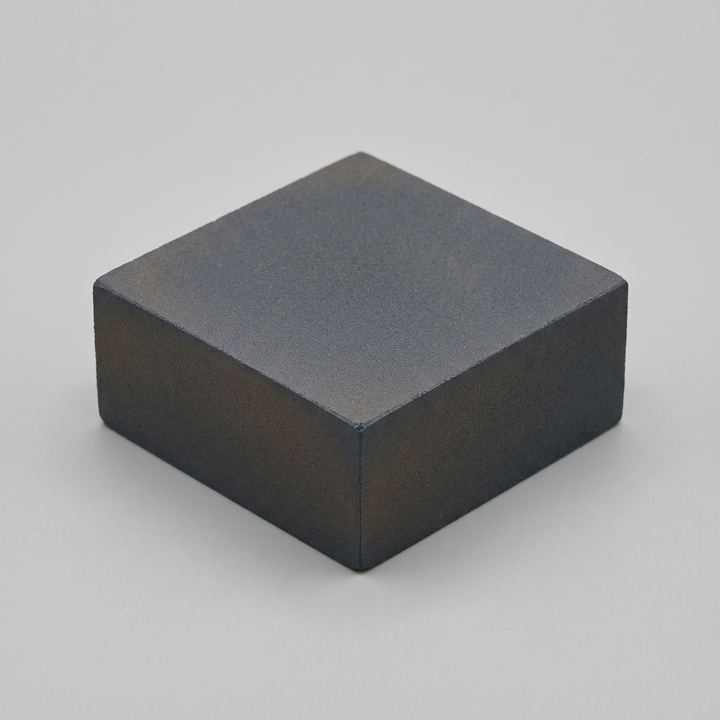
The slab reads a neutral grey body with a faint warm cast that rare-earth titanate chemistry tends to carry at high fire — closer to fired mullite than to any cobalt or vanadium perovskite. At 5.77 g/cm³ and 70×70×35 mm the piece is dense and cold, a firm two-hand lift that sits heavier than any of the soda-silicate glasses for the same face. Skin finishes vitrified matte from the 1300 °C fire, a tighter surface than the 1150 °C siblings; edges cold-cut, the diamond-saw powder left along the kerf. Fully opaque. Against the V-titanate perovskite sibling the body lacks the slate-blue register — it sits in a neutral stone-grey instead.
Recipe
200 g batch · peak 1300 °C| element | precursor | formula | mass | safety |
|---|---|---|---|---|
| Gd | gadolinium oxide | Gd2O3 | 30.8 g | moderate |
| Mo | molybdenum trioxide | MoO3 | 12.23 g | moderate |
| Sr | strontium carbonate | SrCO3 | 50.18 g | safe |
| Ti | titanium dioxide (rutile) | TiO2 | 6.79 g | safe |
- 1Ramp
- 2Hold
- 3Ramp
- 4Ramp
- 5Hold
- 6Ramp
- 7Ramp