KLi₃S₄Si
sulfide polysulfide · sulfide low tempK1Li3S4Si1 is a sulfide polysulfide suitable as sulfide low temp. Color: yellow-orange. Fired at 130°C from 4 precursors (S, Li2CO3, K2CO3). Workshop batch: 500g at €26.71. Compressive strength ~50 MPa; estimated 0.09 kg CO₂/kg (-89% vs Portland cement). Notable: forms without a kiln. Confidence: high.
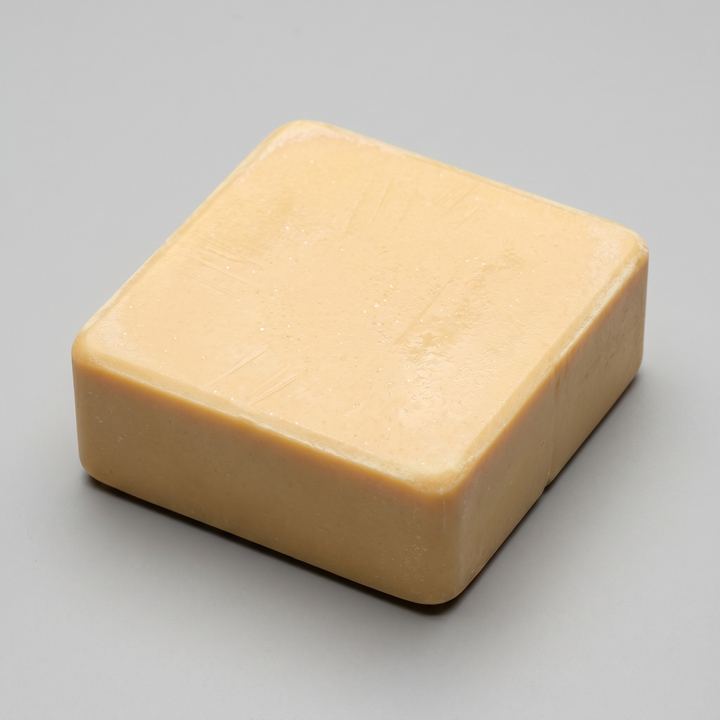
- forms at
- 130 °C · hotplate · no kiln
- replaces
- portland cement
- CO₂
- 89.1% lower than Portland cement (0.09 vs 0.83 kg CO₂/kg)
- energy
- 89.1% lower than Portland cement (0.60 vs 5.50 MJ/kg)
- compressive
- 50 MPa
- density
- 1.63 g/cm³
- crystal
- cubic
- band gap
- 3.60 eV
- cost
- €53.42/kg · €26.71 / 500 g batch
- confidence
- high (synthesis route)
- potential
- 0.71 · env 1.00 · novel 1.00 · struct 0.10 · lineage 0.70 · supply 0.27
- flags
- zero kiln: Forming happens without firing — the material cures through chemistry at ambient or hotplate temperature. At building scale this removes the kiln from the supply chain: on-site casting, regional workshops, cold-country fabrication all become available.
Architectural potential
A zero-kiln cast-sulphide at the lighter end of the family, this belongs firmly in the detail and tile register rather than the structural one. Fifty megapascals is surface-tile strength, not load-bearing strength, so the argument is not structural substitution but thin-section cladding with an eighty-nine-per-cent CO₂ cut against Portland cement. Forming at 130 °C on a hotplate opens geometries that would never survive a kiln: drop-cast thresholds carrying embedded timber inlays, slip-cast bath-house splashbacks, acoustic-tile arrays in studios and schools, and chemistry-set workshop pieces poured in silicone moulds with plant fibres or textile layers laminated into the mix. The silicate-lithium skeleton gives the body a slightly ceramic register, warmer in hand than the heavier copper-sulphides while keeping the low-firing logic intact. Natural placements are studio bathrooms, gallery thresholds, and small-footprint pavilion floor-tiles where the kiln-free making-culture reads as part of the project argument. At 1.63 g/cm³ the tile handles closer to a dense softwood than to a stone. The caveat is workshop hygiene: lithium-sulphide dust and saw-cut sulphide odour both require proper ventilation and protective equipment, so production sits closer to a wet-chemistry workbench than to a tile studio. Cost at €26.71 per 500 g also keeps it off the bulk-tile register.
Material character
The slab reads a soft yellow-orange with a lemon cast from the potassium-lithium silicate matrix, brighter and less sulphurous than the copper-heavy siblings in the family. At 1.63 g/cm³ and 100×100×61 mm the 1 kg tile firms in a single hand — a softwood register, not a stone one — and the depth reads deliberate, almost block-like, rather than panel-thin. Surface is cold-cast mould-matte with a faint meniscus gloss where the pour met the silicone; edges come as-cast with a slightly rounded arris. A fine sulphur bloom crystallises unevenly across the face over the first days, legible under raking light as a faint silver dust.
Recipe
500 g batch · peak 130 °C| element | precursor | formula | mass | safety |
|---|---|---|---|---|
| K | potassium carbonate / potash | K2CO3 | 28.79 g | safe |
| Li | lithium carbonate | Li2CO3 | 46.18 g | safe |
| Si | quartz flour / silica | SiO2 | 25.03 g | safe |
- Pre-heatHotplate to 150 °C
- MeltSulfur liquefies at 115 °C; full liquid at 130 °C
- CastPour at 140–145 °C
- SetRoom temperature 30 min (firm) → 24 h (full strength)
Zero-kiln process — 130 °C hotplate cast only