K₂MnO₈Si₃
alkali silicate glass · structural translucent glassK2Mn1O8Si3 is a alkali silicate glass suitable as structural translucent glass. Color: purple-brown. Fired at 1150°C from 4 precursors (SiO2, K2CO3, MnO2). Workshop batch: 400g at €4.47. Compressive strength ~500 MPa; estimated 0.84 kg CO₂/kg (-2% vs float glass). Notable: no special functions flagged. Confidence: high.
- forms at
- 1150 °C · high-fire
- replaces
- float glass
- CO₂
- 1.9% lower than float glass (0.84 vs 0.86 kg CO₂/kg)
- energy
- 62.5% lower than float glass (5.62 vs 15.00 MJ/kg)
- compressive
- 500 MPa
- density
- 2.64 g/cm³
- crystal
- triclinic
- band gap
- 2.84 eV
- cost
- €11.17/kg · €4.47 / 400 g batch
- confidence
- high (synthesis route)
- potential
- 0.64 · env 0.78 · novel 0.00 · struct 1.00 · lineage 0.70 · supply 1.00
Architectural potential
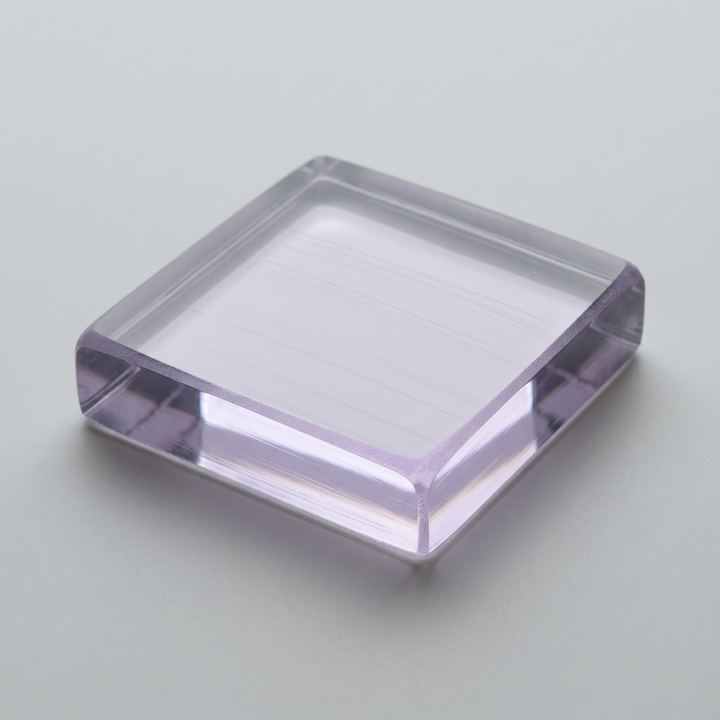
A manganese-doped alkali-silicate glass fired at 1150 °C, carrying 500 MPa of compression and a purple-brown body from the manganese-silicate chromophore. Like its iron and cobalt siblings, the architectural reach is the full load-bearing translucent register, but the colour positions the material for programmes where warm mass-transmission is wanted rather than clarity or blue. Natural placements are pressed-glass stair treads and thresholds in crematoria and memorial interiors, warm purple-brown glazing mullions in bathhouse and spa architecture, amber-shifted light-wells in entrance halls, and monolithic piers in gallery-to-sanctuary thresholds where the colour is the architectural signal. Against float glass the CO₂ sits two per cent lower and the energy sixty-two per cent lower. The 52 mm slab depth is the thickest in the alkali-silicate group of this batch, which pushes the body into true translucent-mass rather than tinted-sheet reading. The caveat is colour reproducibility: manganese silicate is notoriously batch-sensitive — small shifts in the potassium-to-manganese ratio swing the body from red-brown toward grey-violet, so any multi-slab assembly needs its firings traced back to a single precursor lot.
Material character
The slab reads a warm purple-brown with a measurable 2.84 eV absorption edge — saturated enough to stain the view through the 52 mm long edge, softer across the 85 mm face. At 2.64 g/cm³ in an 85×85×52 mm format the piece takes a deliberate two-handed lift, heavier and thicker-feeling than its iron-amber cousin. Cold-cut edges carry the usual lapidary bloom; the pressed top face sits under a low crown with two thin anneal striae. Against the cobalt-blue sibling the colour shift is complete — where cobalt reads clean-band, manganese reads complex, with red and purple reading differently along the two axes.
Recipe
400 g batch · peak 1150 °C| element | precursor | formula | mass | safety |
|---|---|---|---|---|
| K | potassium carbonate / potash | K2CO3 | 34.09 g | safe |
| Mn | manganese dioxide | MnO2 | 21.45 g | moderate |
| Si | quartz flour / silica | SiO2 | 44.46 g | safe |
- 1Ramp
- 2Hold
- 3Ramp
- 4Hold
- 5Ramp
- 6Hold