Al₂O₂₄Se₈W₂
heavy oxide ceramic · thermal mass ceramicAl2O24Se8W2 is a heavy oxide ceramic suitable as thermal mass ceramic. Color: neutral. Fired at 1250°C from 3 precursors (Se, WO3, Al2O3). Workshop batch: 200g at €30.41. Compressive strength ~100 MPa; estimated 0.94 kg CO₂/kg (+326% vs clay brick). Notable: electrochromic tungstate. Confidence: medium.
- forms at
- 1250 °C · high-fire
- replaces
- clay brick
- CO₂
- 326% higher than clay brick (0.94 vs 0.22 kg CO₂/kg; 4.3× higher)
- energy
- 108% higher than clay brick (6.25 vs 3.00 MJ/kg; 2.1× higher)
- compressive
- 100 MPa
- density
- 0.44 g/cm³
- crystal
- monoclinic
- band gap
- 2.24 eV
- cost
- €152.05/kg · €30.41 / 200 g batch
- confidence
- medium (synthesis route)
- potential
- 0.35 · env 0.00 · novel 1.00 · struct 0.20 · lineage 0.50 · supply 0.00
- flags
- electrochromic tungstate: A voltage-switchable optical chemistry. In thin-film form a small DC signal shifts transmission from clear to tinted blue, opening the door to dimmable glazing and responsive partitions that do not need mechanical shading.
Architectural potential
An ultra-light tungsten-aluminate ceramic carrying electrochromic capability — the material only makes architectural sense as a switchable surface layer, not as a thermal-mass volume element despite its family classification. At 0.44 g/cm³ and a 120×120×158 mm block the body reads as a porous insulation-register ceramic, not a dense heat reservoir, so the thermal battery argument its family suggests does not apply at this density. What lifts it out of niche curiosity is the tungstate chemistry: a small DC signal shifts transmission from clear to tinted blue, opening dimmable glazing and responsive partitions that do not need mechanical shading. Natural placements are thin-section switchable patches — skylight inserts that darken on voltage, partition glazing in offices and meeting rooms, responsive cladding panels where solar gain control is wanted without louvres. Against clay brick the embodied CO₂ runs four times higher, so the material is unusable in volume and has to earn its specification at the detail and glazing-patch scale. The caveat stack is serious: €30.41 per 200 g batch, 500 g workshop maximum, supply-chain score 0.0 from tungsten and selenium precursor rarity, and the electrochromic layer's architectural precedent sits in thin-film deposition rather than sintered ceramic — specification here is untested in architectural production and needs prototype verification.
Material character
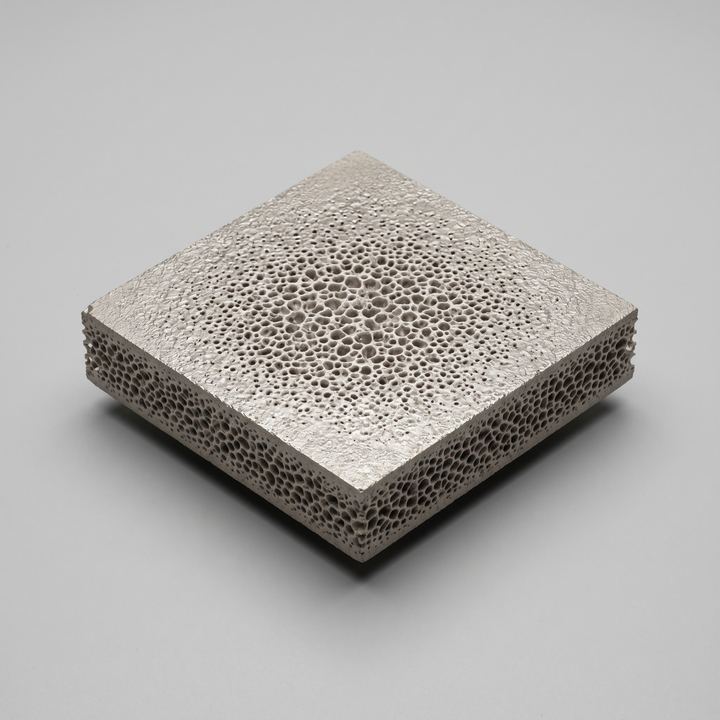
A neutral grey-white body with the loose, powdery-looking surface that extreme-low-density sinters carry — not the fine matte of a dense oxide ceramic but something closer to a baked aerated insulator. At 0.44 g/cm³ and 120×120×158 mm the block is the lightest in the heavy-oxide set, single-hand-liftable with an almost disorienting absence of weight for the size. Skin reads matte with visible pore texture at close range, a genuine open porosity rather than the speckle of a dense body. Edges come cold-cut with powdery kerf residue. Against the Bi-Sr sibling, the body is visibly drier, lighter and acoustically deader on the tap.
Recipe
200 g batch · peak 1250 °C| element | precursor | formula | mass | safety |
|---|---|---|---|---|
| Al | calcined alumina | Al2O3 | 8.52 g | safe |
| Se | selenium (elemental) | Se | 52.76 g | moderate |
| W | tungsten trioxide (yellow) | WO3 | 38.72 g | moderate |
- 1Ramp
- 2Hold
- 3Ramp
- 4Ramp
- 5Hold
- 6Ramp
- 7Ramp
Electrochromic — color switches under applied voltage (thin-film chemistry)