K₂Mn₆S₆
sulfide polysulfide · sulfide low tempK2Mn6S6 is a sulfide polysulfide suitable as sulfide low temp. Color: yellow-orange. Fired at 130°C from 3 precursors (MnO2, S, K2CO3). Workshop batch: 500g at €10.76. Compressive strength ~150 MPa; estimated 0.09 kg CO₂/kg (-89% vs Portland cement). Notable: forms without a kiln. Confidence: high.
- forms at
- 130 °C · hotplate · no kiln
- replaces
- portland cement
- CO₂
- 89.1% lower than Portland cement (0.09 vs 0.83 kg CO₂/kg)
- energy
- 89.1% lower than Portland cement (0.60 vs 5.50 MJ/kg)
- compressive
- 150 MPa
- density
- 3.81 g/cm³
- crystal
- hexagonal
- band gap
- 0.02 eV
- cost
- €21.52/kg · €10.76 / 500 g batch
- confidence
- high (synthesis route)
- potential
- 0.74 · env 1.00 · novel 1.00 · struct 0.30 · lineage 0.70 · supply 0.27
- flags
- zero kiln: Forming happens without firing — the material cures through chemistry at ambient or hotplate temperature. At building scale this removes the kiln from the supply chain: on-site casting, regional workshops, cold-country fabrication all become available.
Architectural potential
A manganese-rich polysulphide cast at 130 °C with potassium as the network modifier — 150 MPa of compression, an eighty-nine-per-cent reduction in embodied CO₂ against Portland cement, and the broadest workshop reach in this sub-family at 2 kg maximum batch. The size ceiling opens up pavilion-floor tile, cast threshold plates, interior dado panels and dense-acoustic infill blocks for studio partition walls. Against cement the argument is displacement rather than supplementation: the same pouring logic, the same plywood formwork, none of the kiln. Natural placements are workshop-cast floor pavers for a rural cultural centre, cast inlay panels for a library bay, and compression-loaded block-work for a cold-country self-build where kiln fuel is simply unavailable. The HIGH-confidence rating on the 150 MPa figure makes this one of the more specifiable zero-kiln candidates across the atlas. The caveat is supply: the supply-chain score sits at 0.29 because manganese-sulphide precursor routes are thinly served outside the battery industry, so a project that specifies this binder commits to a dedicated supplier relationship and a procurement lead well beyond what a workshop-scale studio normally plans for.
Material character
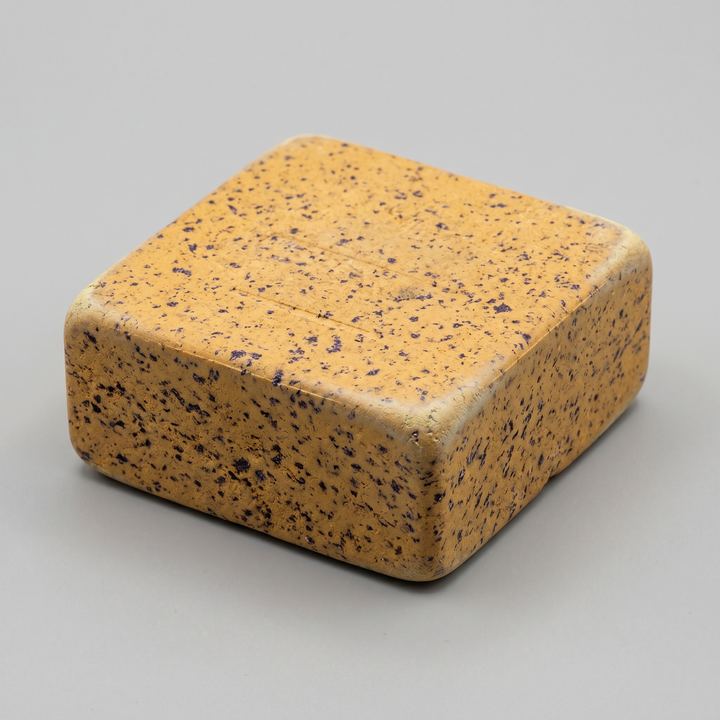
A saturated yellow-orange face characteristic of the polysulphide family, held slightly cooler than the copper variants by the potassium flux. At 3.81 g/cm³ the 85×85×36 mm slab is firm two-handed — slightly less dense-feeling than the copper-heavy siblings but noticeably more massive than a fired clay tile of the same footprint. Surface mold-matte with the clean meniscus sheen of a polysulphide cast; edges as-cast, slightly sharp. A fine sulphur bloom crystallises unevenly across the face under cure, visible as a pale silver dusting at raking angles. Against a copper-manganese sibling the bloom is brighter and the body runs clearer yellow rather than brown-red.
Recipe
500 g batch · peak 130 °C| element | precursor | formula | mass | safety |
|---|---|---|---|---|
| K | potassium carbonate / potash | K2CO3 | 20.95 g | safe |
| Mn | manganese dioxide | MnO2 | 79.05 g | moderate |
- Pre-heatHotplate to 150 °C
- MeltSulfur liquefies at 115 °C; full liquid at 130 °C
- CastPour at 140–145 °C
- SetRoom temperature 30 min (firm) → 24 h (full strength)
Zero-kiln process — 130 °C hotplate cast only