K₄Mo₂O₁₈Si₆
alkali silicate glass · structural translucent glassK4Mo2O18Si6 is a alkali silicate glass suitable as structural translucent glass. Color: clear. Fired at 1150°C from 4 precursors (SiO2, MoO3, K2CO3). Workshop batch: 400g at €23.58. Compressive strength ~500 MPa; estimated 0.84 kg CO₂/kg (-2% vs float glass). Notable: no special functions flagged. Confidence: high.
- forms at
- 1150 °C · high-fire
- replaces
- float glass
- CO₂
- 1.9% lower than float glass (0.84 vs 0.86 kg CO₂/kg)
- energy
- 62.5% lower than float glass (5.62 vs 15.00 MJ/kg)
- compressive
- 500 MPa
- density
- 3.11 g/cm³
- crystal
- hexagonal
- band gap
- 1.75 eV
- cost
- €58.95/kg · €23.58 / 400 g batch
- confidence
- high (synthesis route)
- potential
- 0.64 · env 0.78 · novel 0.00 · struct 1.00 · lineage 0.70 · supply 1.00
Architectural potential
A potassium-molybdate silicate glass reaching 500 MPa of compression with a clear, colourless body — a structural translucent element that sits squarely in the pressed-glass pier and stair-tread register. At 1150 °C it melts and anneals cleanly, and the 400 g batch with a 5 kg workshop ceiling allows meaningful runs: a set of transparent treads, a series of partition beams, a pressed column-like pier. Natural placements are inhabitable-clarity applications where the glass has to work as both daylight admitter and load-carrying element: stair treads walked on from above in residential or studio architecture, light-well piers in galleries, floor panels in atrium inserts, transparent screens in bath-house and spa interiors, pressed-glass beams in small civic pavilions. Against float glass the embodied CO₂ is essentially neutral and the energy overhead two-thirds lower, so the specification is environmentally clean. Compared to the vanadium-bearing sibling in the same family, this body stays colourless rather than absorbing visible light — a different architectural argument, privileging clarity over thermal behaviour. The caveat is annealing and cost: at 45 mm depth the slow cool is non-negotiable, edge conditioning must be specified from the outset, and at €23.58 per 400 g batch the molybdate content pushes the piece toward signature-element use rather than bulk partition glazing.
Material character
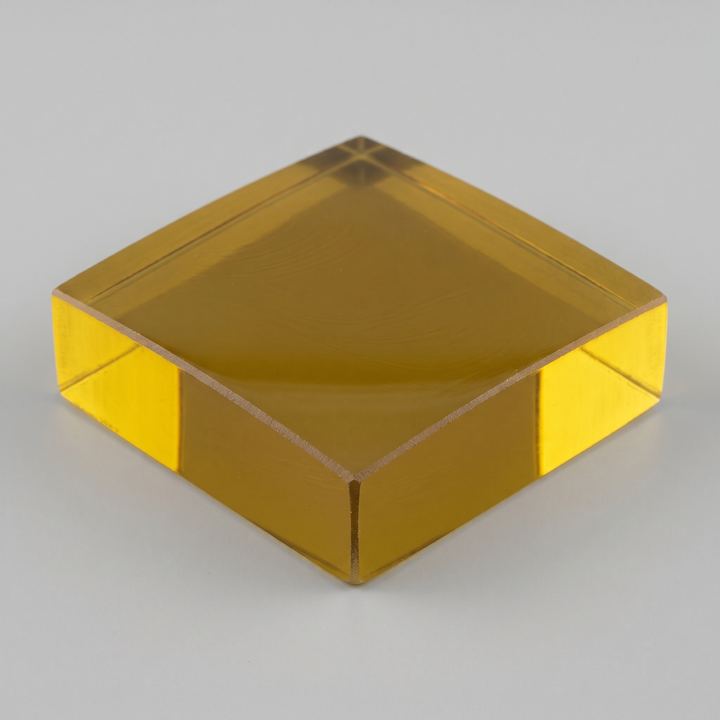
The slab reads clear with only the faintest warm cast from residual molybdate content, brighter and less tinted than the grey-blue vanadium sibling in the same family. At 3.11 g/cm³ in an 85×85×45 mm piece, the body sits heavier than ordinary soda-lime glass of the same dimensions — a firm two-handed lift, closer in register to lead crystal than to float stock. Translucent through the full 45 mm, passing daylight with a very slight golden tone along the long edge. Surface carries the pressed-glass sheen with visible anneal striae close to one long edge; cold-cut edges show lapidary bloom and expect polishing as part of the tectonic.
Recipe
400 g batch · peak 1150 °C| element | precursor | formula | mass | safety |
|---|---|---|---|---|
| K | potassium carbonate / potash | K2CO3 | 29.89 g | safe |
| Mo | molybdenum trioxide | MoO3 | 31.13 g | moderate |
| Si | quartz flour / silica | SiO2 | 38.98 g | safe |
- 1Ramp
- 2Hold
- 3Ramp
- 4Hold
- 5Ramp
- 6Hold