Ca₂₀O₄₈P₇Si₄V
calcium phosphate · bioceramic whiteCa20O48P7Si4V1 is a calcium phosphate suitable as bioceramic-white. Color: white. Fired at 1100°C from 4 precursors (CaCO3, Ca3(PO4)2, SiO2). Workshop batch: 500g at €11.89. Compressive strength ~100 MPa; estimated 0.82 kg CO₂/kg (-1% vs Portland cement). Notable: bioactive. Confidence: medium.
- forms at
- 1100 °C · high-fire
- replaces
- portland cement
- CO₂
- 0.6% lower than Portland cement (0.82 vs 0.83 kg CO₂/kg)
- energy
- matches Portland cement (5.50 MJ/kg)
- compressive
- 100 MPa
- density
- 2.97 g/cm³
- crystal
- triclinic
- band gap
- 3.52 eV
- cost
- €23.78/kg · €11.89 / 500 g batch
- confidence
- medium (synthesis route)
- potential
- 0.46 · env 0.01 · novel 0.80 · struct 0.20 · lineage 0.80 · supply 0.70
- flags
- bioactive: Actively hosts or supports biological activity on its surface. Bioreceptive cladding for moss and lichen, soil-contact interfaces that do not sterilise their neighbours, health-interior surfaces tuned for microbiome balance.
Architectural potential
A calcium-phosphate bioceramic in the white-hydroxyapatite register, tuned for surfaces that host rather than resist biological activity. At 100 MPa and 2.97 g/cm³ the compression register is non-structural, and the architectural argument rests on the bioactive chemistry: the phosphate body invites microflora, moss, lichen and plant-root anchors rather than sterilising its neighbours. Natural placements are healthcare-interior floor and wall tiles in recovery rooms, bioreceptive cladding panels on north-facing courtyard walls where moisture supports lichen growth, soil-contact base plinths in garden-court architecture, and tissue-compatible threshold pieces in rehabilitation interiors. The vanadium doping adds a faint trace-mineral signature that literature suggests promotes a subset of beneficial surface microbiota. Against Portland cement the CO₂ is essentially neutral (minus 0.6 per cent) and energy is identical, so the environmental argument is absent — the specification hinges entirely on the living-surface register. The 500 g batch and 2000 g workshop ceiling put the material in tile and small-panel scale rather than wall-element. The caveat is biological verification: the bioactive claim needs culture-test validation per batch before hospital-interior specification, so the tile is untested at full clinical grade and sits in the experimental bioreceptive register rather than the medically certified one.
Material character
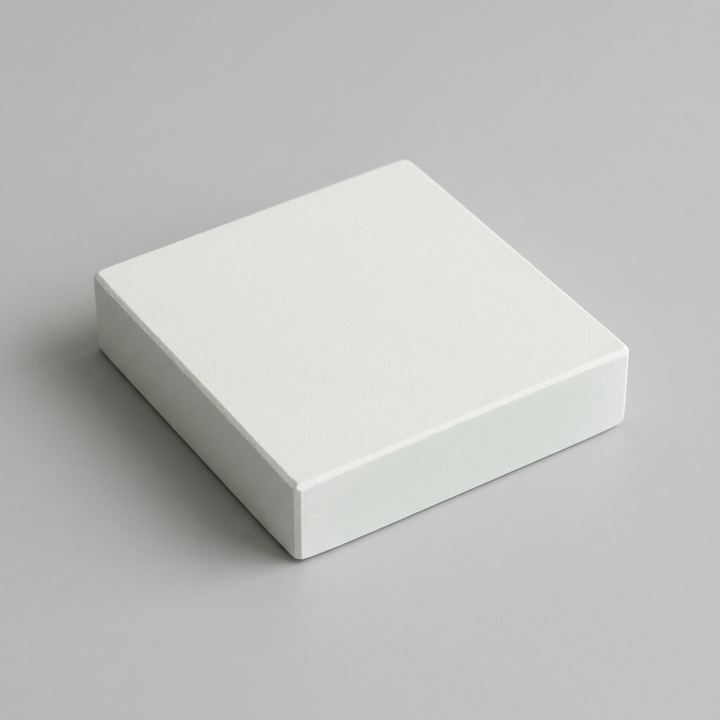
A clean white body with a faintly warm phosphate undertone, closer to bone-china colour than to dental-grade hydroxyapatite. At 2.97 g/cm³ and 85×85×47 mm the slab is firm two-handed, a weight register between a fired clay tile and a dense sintered porcelain. Surface fires to a smooth low-porosity skin with a characteristic apatite sheen visible under raking light — matte but with a subsurface glow the eye reads as slightly translucent. Edges cold-cut with a fine white kerf dust. Against a pure Portland concrete tile the body reads whiter and smoother, and under moist conditions the surface wets and holds water longer than cement would — the bioactive signature in hand.
Recipe
500 g batch · peak 1100 °C| element | precursor | formula | mass | safety |
|---|---|---|---|---|
| Ca | calcium carbonate / limestone | CaCO3 | 58.55 g | safe |
| P | tricalcium phosphate | Ca3(PO4)2 | 31.76 g | safe |
| Si | quartz flour / silica | SiO2 | 7.03 g | safe |
| V | vanadium pentoxide | V2O5 | 2.66 g | moderate |
- 1Ramp
- 2Hold
- 3Ramp
- 4Hold
- 5Ramp
- 6Hold
Bioactive — biocompatible, antibacterial (Cu-doped silicocarnotite)