LaMn₂O₁₄W₃Y₂
heavy oxide ceramic · thermal mass ceramicLa1Mn2O14W3Y2 is a heavy oxide ceramic suitable as thermal mass ceramic. Color: purple-brown. Fired at 1250°C from 4 precursors (WO3, Y2O3, MnO2). Workshop batch: 200g at €49.34. Compressive strength ~100 MPa; estimated 0.94 kg CO₂/kg (+326% vs clay brick). Notable: electrochromic tungstate. Confidence: medium.
- forms at
- 1250 °C · high-fire
- replaces
- clay brick
- CO₂
- 326% higher than clay brick (0.94 vs 0.22 kg CO₂/kg; 4.3× higher)
- energy
- 108% higher than clay brick (6.25 vs 3.00 MJ/kg; 2.1× higher)
- compressive
- 100 MPa
- density
- 6.95 g/cm³
- crystal
- monoclinic
- band gap
- 2.01 eV
- cost
- €246.70/kg · €49.34 / 200 g batch
- confidence
- medium (synthesis route)
- potential
- 0.35 · env 0.00 · novel 1.00 · struct 0.20 · lineage 0.50 · supply 0.00
- flags
- electrochromic tungstate: A voltage-switchable optical chemistry. In thin-film form a small DC signal shifts transmission from clear to tinted blue, opening the door to dimmable glazing and responsive partitions that do not need mechanical shading.
Architectural potential
A lanthanum-tungsten heavy-oxide ceramic, fired at 1250 °C, carrying 100 MPa of compression and an electrochromic tungstate layer. The CO₂ runs at more than four times that of a fired clay brick, so the argument for its use rests entirely on the voltage-switchable chemistry rather than on bulk. A small DC signal shifts the transmission of the tungstate surface from clear to tinted blue — a dimmable layer that does not need mechanical shading or motorised louvres. Natural placements are responsive partition inserts in dividable office suites, switchable skylight tiles in atria where occupancy-based dimming is wanted, small-area electrochromic panels at balustrade height in reading rooms, and signature accent tiles in exhibition architecture where the curator controls the ambient transmission from the gallery console. Dense (6.95 g/cm³) and expensive (€49.34 per 200 g), this is a signature-element material. Against float glass with a laminated electrochromic stack the argument is monolithic tectonics — the chromism lives in the ceramic body itself rather than in a sandwich. The caveat is supply and verification: the supply-chain score sits at zero, tungsten and lanthanum are both subject to export-control pressure, and the switching cycle-life under architectural exposure remains untested in architectural production.
Material character
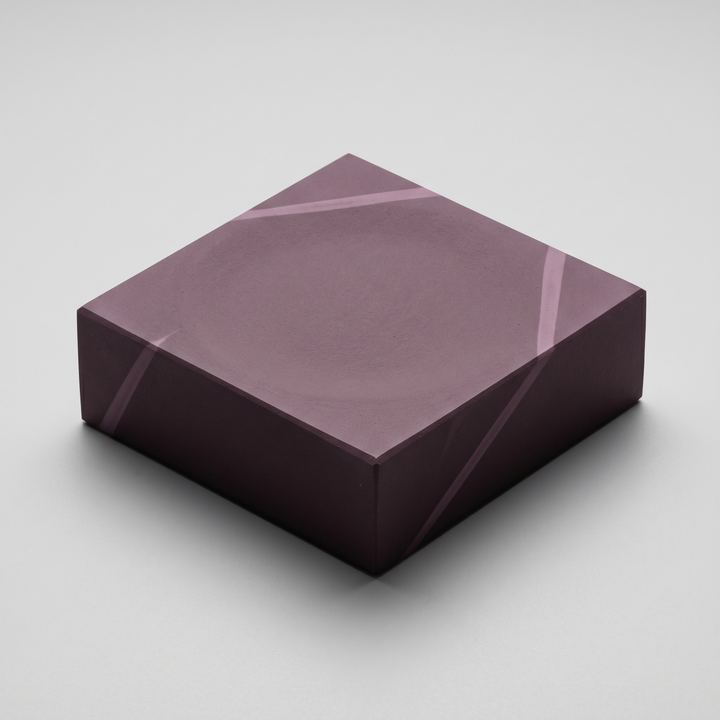
The slab reads a deep purple-brown with a measurable 2.01 eV absorption edge, carrying the Mn-W signature rather than the cleaner single-ion purples of manganese-silicate glass. At 6.95 g/cm³ in a 70×70×29 mm format the slab is heavy for its footprint — close in hand-feel to a granite paver, distinctly heavier than the alkali-silicate siblings of the atlas. Surface vitrified matte from the peak fire; cold-cut edges with the diamond-saw powder left along the kerf. Fully opaque; the tungstate response is a surface rather than a volume signal. Against the B-Fe-W-O sibling the body is deeper and cooler in tone.
Recipe
200 g batch · peak 1250 °C| element | precursor | formula | mass | safety |
|---|---|---|---|---|
| La | lanthanum oxide | La2O3 | 12.95 g | moderate |
| Mn | manganese dioxide | MnO2 | 13.82 g | moderate |
| W | tungsten trioxide (yellow) | WO3 | 55.28 g | moderate |
| Y | yttrium oxide | Y2O3 | 17.95 g | moderate |
- 1Ramp
- 2Hold
- 3Ramp
- 4Ramp
- 5Hold
- 6Ramp
- 7Ramp
Electrochromic — color switches under applied voltage (thin-film chemistry)