O₂₄Sb₄Sn₄V₄
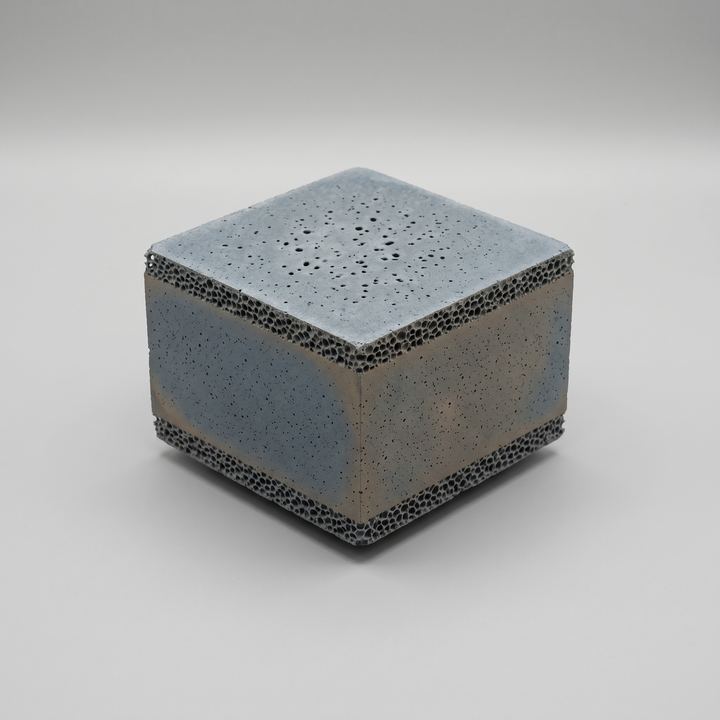
heavy oxide ceramic · thermal mass ceramicO24Sb4Sn4V4 is a heavy oxide ceramic suitable as thermal mass ceramic. Color: grey-blue. Fired at 1250°C from 3 precursors (SnO2, Sb2O3, V2O5). Workshop batch: 200g at €9.28. Compressive strength ~100 MPa; estimated 0.94 kg CO₂/kg (+326% vs clay brick). Notable: thermochromic VO2. Confidence: medium.
- forms at
- 1250 °C · high-fire
- replaces
- clay brick
- CO₂
- 326% higher than clay brick (0.94 vs 0.22 kg CO₂/kg; 4.3× higher)
- energy
- 108% higher than clay brick (6.25 vs 3.00 MJ/kg; 2.1× higher)
- compressive
- 100 MPa
- density
- 0.60 g/cm³
- crystal
- tetragonal
- band gap
- 0.86 eV
- cost
- €46.40/kg · €9.28 / 200 g batch
- confidence
- medium (synthesis route)
- potential
- 0.33 · env 0.00 · novel 0.90 · struct 0.20 · lineage 0.50 · supply 0.00
- flags
- thermochromic VO2: Passive thermal-optical switching: transmission shifts near 68 °C without any driving signal. At building scale this gives a window that darkens as it heats, reducing solar gain without wiring or sensors.
Architectural potential
An antimony-tin-vanadate heavy-oxide ceramic with a thermochromic vanadium-dioxide face: transmission shifts passively near 68 °C, so the body darkens as it heats without wiring or sensors. Paired with its thermal-mass function this is a self-metering thermal battery — a trombe-wall that senses its own load. Natural placements are south-facing glazing inserts in greenhouses and conservatories, thermally-active ceiling tile patterns in atria that shift register through the day, rooftop solar-gain patches around skylight perimeters, and summer-overheat-vulnerable conservatory walls that dim themselves in afternoon heat. The 100 MPa compression keeps this in the tile-and-infill register. At 0.60 g/cm³ in a 120×120×115 mm slab the body is unusually light for a heavy-oxide ceramic — a porosity-driven density well outside the typical range that flags verification before structural specification. The caveats compound heavily. Embodied CO₂ runs three and a quarter times higher than fired clay brick, the supply-chain score sits at zero, and confidence on the density is medium. Specification belongs in the self-regulating signature-tile register: one or two patches in a passive-solar field where the self-darkening is the architectural argument, never a bulk cladding or continuous thermal mass volume.
Material character
At 0.60 g/cm³ in a 120×120×115 mm slab the weight contradicts the eye: the block is large and visibly ceramic, yet lifts single-handed with a register closer to softwood than to any fired body of its size. Colour reads a muted grey-blue with olive undertones at shadow angles, the vanadium signature cooling the tin-antimony base. Surface carries a sintered ceramic grain visibly coarser than a dense stannate sibling, reading porous at the micro-scale. Edges cold-cut with kerf-whitening. At room temperature the body holds its grey-blue; above 68 °C it shifts to a darker opaque state. Against a dense tin-antimonate sibling the lightness is the defining feature.
Recipe
200 g batch · peak 1250 °C| element | precursor | formula | mass | safety |
|---|---|---|---|---|
| Sb | antimony trioxide | Sb2O3 | 37.62 g | moderate |
| Sn | tin(IV) oxide | SnO2 | 38.9 g | safe |
| V | vanadium pentoxide | V2O5 | 23.47 g | moderate |
- 1Ramp
- 2Hold
- 3Ramp
- 4Ramp
- 5Hold
- 6Ramp
- 7Ramp
Thermochromic — VO₂ metal-insulator switch at ~68 °C